Physical Address
23,24,25 & 26, 2nd Floor, Software Technology Park India, Opp: Garware Stadium,MIDC, Chikalthana, Aurangabad, Maharashtra – 431001 India
Physical Address
23,24,25 & 26, 2nd Floor, Software Technology Park India, Opp: Garware Stadium,MIDC, Chikalthana, Aurangabad, Maharashtra – 431001 India
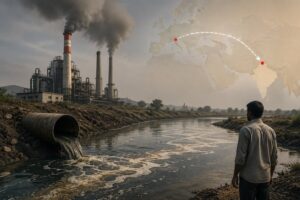
When a controversial chemical factory linked to one of Europe’s worst pollution scandals quietly found a second life in India, it triggered outrage far beyond environmental circles. Activists, scientists, and local communities are now raising difficult questions: Are wealthy nations simply exporting toxic industries to countries with weaker regulations? And who ultimately pays the price for industrial progress?
At the centre of the controversy are PFAS, which are commonly called “forever chemicals”. They are a group of synthetic compounds that are increasingly seen as one of the biggest environmental health threats of the modern era.
What Are “Forever Chemicals”?
PFAS, short for per- and polyfluoroalkyl substances, are a large family of human-made chemicals used in everything from non-stick cookware and waterproof clothing to firefighting foam, cosmetics, food packaging, electronics, and industrial manufacturing.
Their popularity comes from one defining feature: they are extremely resistant to heat, oil, grease, and water. But that same durability is also what makes them dangerous.
PFAS do not easily break down in nature. Once released into soil, rivers, groundwater, or the atmosphere, they can remain there for decades, sometimes centuries. Scientists call them “forever chemicals” because they accumulate over time in the environment, animals, and even the human body. Studies around the world have detected PFAS in rainwater, Arctic ice, oceans, wildlife, breast milk, and human blood. In many countries, virtually every person tested carries traces of PFAS compounds in their bodies.
The Italian Scandal That Shocked Europe
The current controversy traces back to the Miteni chemical plant in Vicenza, northern Italy. For decades, the factory manufactured PFAS chemicals while allegedly contaminating groundwater across large parts of the Veneto region. The pollution eventually affected drinking water supplies used by more than 350,000 people in the provinces of Vicenza, Verona, and Padua. Investigators described it as one of Europe’s most severe groundwater contamination cases.
The plant was shut down in 2018 after years of public anger, legal investigations, and scientific studies. In 2025, former Miteni executives were convicted in a landmark environmental ruling linked to the contamination. The scandal transformed PFAS from a relatively unknown chemical issue into a major public health debate across Europe.
What made the case especially alarming was the scale of exposure. Residents discovered that toxic chemicals had entered their drinking water for years without their knowledge. Some former workers reportedly showed among the highest PFAS concentrations ever recorded in human blood.
From Italy to India
After the Italian factory shut down, parts of its machinery, technology, and production systems were reportedly acquired by an Indian company and relocated to Maharashtra’s Lote Parshuram industrial area. Production of similar fluorochemicals later resumed there.
The development sparked protests in India after investigative reports highlighted the connection between the new operations and the Italian pollution scandal. Activists argue that the issue is not merely about one factory. Instead, they see it as part of a wider global pattern in which hazardous industries move from countries with stricter environmental laws to regions where regulations are weaker, or enforcement is limited.
The controversy has intensified because India currently lacks a comprehensive PFAS regulatory framework. While some discussions and draft rules exist for limiting PFAS in food packaging, there are still no nationwide standards for PFAS contamination in drinking water, soil, or industrial discharge.
This has led to fears that communities may face long-term contamination risks before strong safeguards are introduced.
The Hidden Health Hazards
The science surrounding PFAS is still evolving, but decades of research have already linked several PFAS compounds to serious health concerns. According to studies cited by environmental agencies and public health researchers worldwide, exposure to certain PFAS chemicals has been associated with:
Some studies have also suggested links to cardiovascular disease and pregnancy complications. One of the biggest concerns is bioaccumulation. PFAS build up in the body over time faster than they can be removed. Even low levels of repeated exposure through water, food, or air may eventually become significant. Children and pregnant women are considered especially vulnerable.
The environmental consequences are equally troubling. PFAS contamination can spread through rivers and groundwater, enter agricultural systems, accumulate in fish and wildlife, and persist for generations. Cleaning contaminated sites is also notoriously expensive and technically difficult. In many cases, there is still no perfect method for removing PFAS completely from ecosystems.
An Environmental Justice Question
Beyond chemistry and regulation, the PFAS debate has become a powerful environmental justice issue.
Environmental justice refers to the principle that no community, especially economically or politically vulnerable populations, should bear an unfair share of pollution and environmental harm. Critics argue that when dangerous industries are shut down in Europe or North America but reopened elsewhere with fewer safeguards, pollution is not eliminated: it is simply relocated. This creates a troubling imbalance: wealthier nations benefit from stricter environmental protections while developing regions inherit the risks.
Communities near industrial zones often face the harshest consequences despite having the least access to healthcare, legal resources, or environmental monitoring. The protests in India reflect growing public awareness that environmental risks cannot be separated from questions of equity, accountability, and corporate responsibility.
Why This Debate Matters Now
PFAS are increasingly becoming the “next asbestos” or “next lead” in global environmental politics, as chemicals once considered useful and safe before their long-term dangers became impossible to ignore.
Countries across Europe and North America are now moving toward tighter PFAS restrictions. Several governments are considering sweeping bans on non-essential uses of these chemicals. At the same time, industries dependent on PFAS continue searching for new production hubs and markets.
India now stands at an important crossroads. The country has the opportunity to strengthen environmental safeguards before contamination becomes widespread and irreversible. Experts say this would require stricter monitoring, transparency, independent scientific studies, public disclosure of emissions, and clear national PFAS standards. The debate is ultimately larger than one company or one chemical plant.
It is about deciding whether economic growth can coexist with environmental protection, and whether communities have the right to clean water, clean soil, and informed consent about the risks around them. Because once forever chemicals enter the environment, their legacy may last far longer than the industries that created them.
References:
PFAS – the ‘Forever Chemicals’
https://www.niehs.nih.gov/health/topics/agents/pfc
https://www.sciencedirect.com/science/article/pii/S2666016425000349
https://chemtrust.org/news/italian_ruling_sentences_exectives_pfas_pollution/
Banner Image: AI Generated
Sections of this article may have been developed with the assistance of artificial intelligence tools to support research, drafting and language refinement. All information has been reviewed, edited and verified by the author/editor to ensure accuracy, context and editorial integrity. The responsibility for the final content, interpretations and conclusions rests solely with the publisher.