Physical Address
23,24,25 & 26, 2nd Floor, Software Technology Park India, Opp: Garware Stadium,MIDC, Chikalthana, Aurangabad, Maharashtra – 431001 India
Physical Address
23,24,25 & 26, 2nd Floor, Software Technology Park India, Opp: Garware Stadium,MIDC, Chikalthana, Aurangabad, Maharashtra – 431001 India

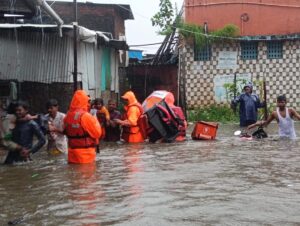
After weeks of waiting for the monsoon to arrive in full force, Mumbai’s skies finally broke open in mid-August. The city, which had endured an unusually dry July, suddenly found itself drenched by sheets of rain from August 16 onward. Traditionally, July is when Mumbai bears the brunt of the monsoon, with showers easing in August. But this year, the pattern flipped. By August 19, Santacruz had already been lashed with 944 mm of rainfall and Colaba with 461.8 mm—both exceeding the totals they had clocked through all of July. What began as a dry spell has now turned into one of the heaviest August deluges in recent memory.
The India Meteorological Department (IMD) issued a yellow nowcast warning on Wednesday evening for Mumbai city and its suburban districts. The forecast indicates moderate spells of rain over the next three hours, urging residents to remain cautious.
The IMD expects rainfall intensity to decline after August 21, but moderate showers will continue.
Scientists warn that these extreme events will no longer be rare—they are becoming the new monsoon reality in a warming world.
‘Climate change acts like a steroid’
“While there is a natural variability of monsoon weather systems, climate change acts like a steroid. The northward swing of the southwesterly monsoon winds is pumping massive amounts of moisture from the warm Arabian Sea into the northern Western Ghats,” said Dr. Raghu Murtugudde, Emeritus Professor, University of Maryland and retired IIT Bombay professor.
He explained that the Middle East is now warming nearly twice as fast as other inhabited regions, destabilising the Arabian Sea and pushing moist winds northward—fuel for the kind of cloudbursts Mumbai is enduring.
Early warnings must reach citizens
Experts say Mumbai’s vulnerability lies not only in its geography but also in its lack of preparedness. Dr. Subimal Ghosh, Chair Professor at IIT Bombay, warned: “We all know that there has been a rise in temperature due to global warming. Secondly, the exponential warming of the Arabian Sea has increased the moisture influx along the West Coast, contributing to heavy precipitation. In this scenario, the only way out is to have a very good network of early warning systems, nowcast systems for urban flooding.”
He stressed that these systems must be citizen-centric. “The information should reach out to people so informed decisions can be taken. IIT Mumbai has created the Mumbai Flood Monitoring System, which helps disseminate timely information to stakeholders.”
Building resilience before the next deluge
Experts agree that the city cannot afford to treat these floods as isolated disasters.
Unless urgent steps are taken, Mumbai’s economic engine and millions of its residents will remain hostage to a monsoon supercharged by climate change.
References:
Experts Link Mumbai’s Flooding to Climate-Driven Changes in the Arabian Sea
Banner Image: NDRF India on X