Physical Address
23,24,25 & 26, 2nd Floor, Software Technology Park India, Opp: Garware Stadium,MIDC, Chikalthana, Aurangabad, Maharashtra – 431001 India
Physical Address
23,24,25 & 26, 2nd Floor, Software Technology Park India, Opp: Garware Stadium,MIDC, Chikalthana, Aurangabad, Maharashtra – 431001 India

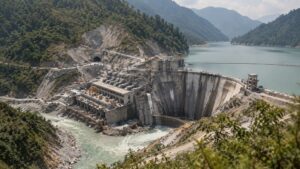
Nepal's Rasuwa flood damaged 13 hydropower projects. Is Himalayan hydropower climate-proof? We check the evidence from Nepal, India and Bhutan.
Engineers describe a Himalayan river in cubic metres per second. Insurers describe it in claims paid against premiums collected. For the region’s hydropower boom, the second set of numbers is starting to tell the more honest story.
In Nepal, insurance claims have exceeded premiums in four of the last five years, according to reporting by Nikkei Asia. Then came 26 August 2026. A single flood on the Bhote Koshi could generate more than NPR 20 billion (about USD 132 million) in commercial insurance losses, with hydropower projects expected to account for most of the claims, a senior executive at one of Nepal’s leading insurers told Reuters.
That raises a question worth checking against the evidence: is hydropower, the low-carbon workhorse that Nepal, Bhutan and India are all expanding in the mountains, actually safe from the climate it is meant to help stabilise?
Clean is not the same as climate-proof
Hydropower is often presented as the clean, steady backbone of South Asia’s energy transition, and on emissions alone that reputation largely holds. But a low-carbon source is not automatically a climate-safe one. In the glaciated Himalaya, dams, tunnels and powerhouses sit directly in the path of hazards that warming is making more frequent and harder to predict, from glacier collapses to outburst floods. And when the monsoon fails, their output can drop sharply. The record from Nepal, India and Bhutan shows these risks are well documented and have played out repeatedly. They are also still poorly reflected in how projects are sited, financed and insured.
What one flood took off the grid
The Rasuwa disaster began with a rock wall collapse on Langtang Lirung at about 5,150 metres, which also brought down part of the glacier above it, according to World Weather Attribution. The resulting surge of water, ice, rock and sediment reached the Rasuwagadhi border crossing, 22 km downstream, in about seven minutes, at an average speed of roughly 188 km per hour. CFC’s earlier explainer unpacks how an event with no rainfall at the district headquarters still turned into a deadly torrent.
More than 1,400 people lost their lives, and early reconstruction estimates of USD 4 to 5 billion amount to around a tenth of Nepal’s GDP. The energy toll was concentrated in one river corridor:
Early figures vary. Assessments are still being revised, and CFC will update this piece as official numbers settle.
The plant that was destroyed twice
The most striking detail is not the scale of the loss but the repetition. The 111 MW Rasuwagadhi plant had its headworks destroyed by a flood from the same tributary on 8 July 2025. It was repaired at the same intake, returned to partial service in December 2025, and was destroyed again fourteen months after the first disaster.
The authors argue this is not simply bad luck. They describe a “contractual siting lock-in”: generation licences in Nepal are tied to a defined site for up to fifty years, power purchase agreements run for 25 to 30 years against that site’s output, and loans are secured on the resulting revenue. Moving a plant means surrendering the licence, rejoining the permitting queue and renegotiating the tariff while still servicing debt. Rebuilding in the same place requires no fresh judgement about hazard at all. The authors call this maladaptation: adaptation that increases exposure rather than reducing it.
Shailendra Guragain, a former president of Nepal’s Independent Power Producers’ Association, said surface-built powerhouses and dams bore the brunt, and blamed haphazard permissions that ignored risks such as outburst floods from upstream in Tibet.
India has seen this film before
This is not a Nepal-only problem. Two Indian disasters in the last six years followed a similar script.
Chamoli, Uttarakhand (February 2021). Roughly 27 million cubic metres of rock and glacier ice collapsed from Ronti peak, a study found, turning into a debris flow that killed or left missing more than 200 people. It destroyed the 13.2 MW Rishiganga plant and severely damaged the 520 MW Tapovan-Vishnugad project downstream. At least 190 of the victims were hydropower workers unable to escape the project sites, and satellite records showed earlier ice masses had fallen from the same ridge into the same valley in recent years.
Teesta III, Sikkim (October 2023). A landslide of about 14.7 million cubic metres of frozen sediment into South Lhonak lake triggered an outburst flood, according to a 2025 study, that destroyed the 1,200 MW Teesta III dam at Chungthang. A 2015 Central Water Commission study had already flagged dams on the Teesta, including Teesta III, as vulnerable to such floods.
The money trail is instructive. The plant cost close to Rs 14,000 crore. After it was lost, the developer and the state government still owed lenders more than Rs 10,000 crore, while insurance cover for glacial lake outburst damage was capped at Rs 500 crore against a sum assured of around Rs 11,400 crore. In other words, how the hazard was classified in the contract mattered more than how big the flood was. Reconstruction at the same site was nonetheless cleared by an Expert Appraisal Committee of the environment ministry in January 2025, in a catchment where the developer’s own survey identified 119 glacial lakes, 13 of them potentially hazardous.
Bhutan’s bigger bet
For Bhutan, hydropower is not one energy source among many; it is the economy. It contributes 12 to 15 per cent of GDP, about 40 per cent of exports and 36 per cent of government revenue, and Bhutan sends an estimated 65 per cent of its 2.5 GW of capacity to India. Bhutan’s 2026 glacial lake inventory counted 620 lakes, up from 567 five years earlier. A modelled outburst from the Thorthormi and Raphstreng lakes could produce a peak flow of nearly 16,400 cubic metres per second within four hours, placing the Punatsangchhu I and II projects at serious risk.
Across High Mountain Asia, which holds the world’s largest untapped hydropower potential, a 2022 review warned that climate-driven landscape instability, from glacier collapses to sediment surges, poses a growing threat to dams and reservoirs being planned and built across the region.
The quieter risk: not enough water
Floods are the dramatic half of the story. The other half arrives slowly, through the meter. India’s 2026 monsoon ended at about 87 per cent of the long-period average, the weakest since 2015, IMD data show. The effect on hydropower showed up early: generation in June 2026 fell around 21 per cent year on year, to 13,361 GWh from 16,775 GWh.
That gap did not stay empty. An S&P Global analysis found that as demand rose and hydropower output fell in June, coal-fired generation rose by 20.7 average gigawatts to fill the shortfall. CREA projected the El Niño-driven gap could add around 17 million tonnes of carbon dioxide emissions, a risk CFC examined in July. A clean source that falters precisely in hot, dry years can push grids back towards the fuel it was meant to replace.
Who ends up paying
What would make it safer
None of this means the region should abandon hydropower. It means the risk needs to be built into decisions before the next flood rather than after it. Researchers and practitioners point to a few concrete fixes:
What to watch for online
Expect two opposite distortions as reconstruction debates heat up. One says the floods prove hydropower is a scam and should be scrapped; the evidence shows the problem is siting, contracts and preparedness, not the technology itself. The other says climate change “caused” the Rasuwa flood outright. World Weather Attribution’s analysis links rapid Himalayan warming to worsening geohazard cascades, but some scientists caution that attributing a specific rock-ice collapse requires event-specific analysis, as this review notes. Both “it is all climate” and “it has nothing to do with climate” oversimplify.
The bottom line
Hydropower remains one of South Asia’s most important low-carbon resources, and Nepal and Bhutan will keep building it. But the record from Chamoli, Teesta III and Rasuwa shows that the industry is repeatedly placing expensive, long-lived assets in valleys where the hazard is changing faster than the paperwork. Climate-proof, it is not, at least not yet. Until siting, insurance and early warning catch up with the mountains, the region’s clean energy will carry a climate bill of its own.
References
https://asia.nikkei.com/business/energy/himalayan-hydropower-boom-faces-mounting-insurance-pressures
1st October 2026 Today’s Round-Up of Climate News
https://chathamhouse.org/2026/10/nepals-floods-put-global-loss-and-damage-system-test
https://www.nature.com/articles/s44458-026-00163-2
Nepal’s flood disaster puts its hydropower-first strategy, exports to the test
https://fortune.com/2026/08/31/nepal-floods-hydropower-climate-infrastructure
No Rain, No Warning: How a Silent Mountain Collapse Triggered Nepal’s Deadly Torrent
Massive Rock and Ice Avalanche in Indian Himalaya Studied
https://doi.org/10.1126/science.abh4455
No early warning system and insufficient dam safety turned Sikkim flood deadly
https://www.ncl.ac.uk/press/articles/latest/2025/01/sikkimglof
https://dialogue.earth/en/business/the-growing-himalayan-risks-in-bhutans-hydropower-ties-with-india
https://www.coalzoom.com/article.cfm?articleid=43951
As El Niño develops, India turns to coal to offset lower hydropower
El Niño May Push India’s Power Grid to the Limit as Cooling Demand Rises
https://www.nature.com/articles/s41561-022-00953-y
The Bhotekoshi Floods and the Price of Climate Finance Delay
Banner Image: AI Generated
Sections of this article may have been developed with the assistance of artificial intelligence tools to support research, drafting, and language refinement. All information has been reviewed, edited, and verified by the author/editor to ensure accuracy, context, and editorial integrity. The responsibility for the final content, interpretations, and conclusions rests solely with the publisher.