Physical Address
23,24,25 & 26, 2nd Floor, Software Technology Park India, Opp: Garware Stadium,MIDC, Chikalthana, Aurangabad, Maharashtra – 431001 India
Physical Address
23,24,25 & 26, 2nd Floor, Software Technology Park India, Opp: Garware Stadium,MIDC, Chikalthana, Aurangabad, Maharashtra – 431001 India

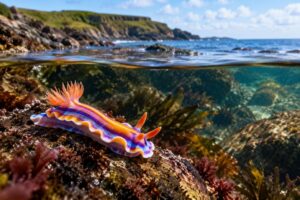
A rainbow sea slug found in Cornwall offers a vivid clue to warming seas and changing UK marine life. Discover why the tiny visitor matters.
A tiny, brightly coloured sea creature has turned up on the coast of Cornwall, drawing attention not just for its unusual appearance but also for what its presence could reveal about a changing marine environment. The rainbow sea slug, scientifically known as Babakina anadoni, was discovered at Porthpean Beach during a community wildlife-recording event organised by The Rock Pool Project. The finding was made during an event held in August, when volunteers and marine enthusiasts were exploring the rock pools along the Cornish coast.
For the person who found it, the discovery was unexpected. Luke Galpin, who was taking part in the event, spotted the small creature while turning over a rock. Its striking colours immediately caught his attention. The animal was only around the size of a thumbnail, but its vivid colouring made it difficult to miss. The rainbow sea slug has contrasting shades across its body, making it one of the more visually distinctive animals found in Britain’s coastal waters. The discovery is believed to be the first recorded sighting of the species at Porthpean. But the creature itself is not entirely new to British waters.
A species associated with warmer seas
Rainbow sea slugs are normally associated with relatively warm Atlantic waters around Spain, Portugal and France. Their increasing appearance farther north has therefore attracted the attention of marine conservationists and wildlife recorders.
The species has previously been recorded at several locations in Cornwall and elsewhere in south-west England. Earlier sightings included individuals found around the Isles of Scilly and in Cornish waters. A 2024 marine ecosystem assessment also recorded Babakina anadoni in Devon, highlighting how the species has been turning up at different locations along Britain’s coastline.
That does not mean that every sighting of a warm-water species can automatically be attributed to climate change. Marine animals can move, ocean currents can transport larvae and unusual weather or seasonal conditions can influence where species are found. But repeated observations of species appearing outside their traditional ranges can provide valuable evidence of broader ecological changes.
Dr Ben Holt, chief executive of The Rock Pool Project, described the latest discovery as exciting but also as a reminder that Britain’s shores are changing as the climate warms. He stressed the importance of continuing to monitor these changes to understand their effects on marine life. That monitoring is particularly important because coastal ecosystems can respond quickly to changes in temperature.
Why tiny creatures can tell a bigger climate story
The appearance of a rainbow sea slug may seem like a curiosity, but such observations can help scientists build a much larger picture of how marine ecosystems are responding to a warming world. Sea temperatures influence where marine organisms can survive, reproduce and find food. As waters become warmer, some species may expand towards higher latitudes, while others that depend on colder conditions can face shrinking habitats.
These shifts can gradually change the composition of coastal ecosystems. A species that was once considered unusual in a particular region may become more common, while native species adapted to cooler conditions may come under increasing pressure. This is why citizen science projects such as The Rock Pool Project are important. Volunteers exploring beaches and rock pools can record species that might otherwise go unnoticed. When individual observations are collected over time and across different locations, they can help researchers identify patterns that would be difficult to detect from occasional scientific surveys alone. The latest discovery also highlights the value of Britain’s rock pools as natural observation points. These small coastal habitats contain a surprising variety of marine life, and their accessibility allows members of the public to participate in wildlife monitoring.
The rainbow sea slug itself is unlikely to be a dramatic symbol of climate change. It is tiny, easily overlooked and only one species among thousands living in the Atlantic. Yet its appearance in Cornwall adds another observation to a growing record of marine species being found beyond their traditional ranges. For conservationists, the message is therefore less about one unusual slug and more about what such discoveries can reveal when viewed together.
Climate change does not always announce itself through dramatic events. Sometimes, its signals appear quietly, in the species living along a shoreline, the timing of seasonal changes or the gradual movement of marine life into new waters. A colourful creature beneath a rock in Cornwall may seem like a small event. But continued sightings like this could help scientists understand how Britain’s seas are changing, and what those changes could mean for marine ecosystems in the years ahead.
References:
https://www.bbc.com/news/articles/cq4g5ng8l31ro
https://www.therockpoolproject.co.uk/blog-posts/rainbow-sea-slug
https://caseagrant.ucsd.edu/sites/default/files/R-OPCENV-08-Goddard.pdf
Banner Image: AI generated
Sections of this article may have been developed with the assistance of artificial intelligence tools to support research, drafting, and language refinement. All information has been reviewed, edited, and verified by the author/editor to ensure accuracy, context, and editorial integrity. The responsibility for the final content, interpretations, and conclusions rests solely with the publisher.