Physical Address
23,24,25 & 26, 2nd Floor, Software Technology Park India, Opp: Garware Stadium,MIDC, Chikalthana, Aurangabad, Maharashtra – 431001 India
Physical Address
23,24,25 & 26, 2nd Floor, Software Technology Park India, Opp: Garware Stadium,MIDC, Chikalthana, Aurangabad, Maharashtra – 431001 India

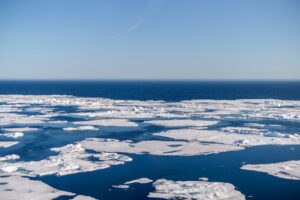
A summer heatwave in Europe and another in eastern Asia may look like separate disasters unfolding in different parts of the world. But new research suggests they can begin with the same trigger, far away in the Arctic. Scientists have found that the rapid loss of sea ice in the Barents Sea, north of Norway and Russia, is increasing the likelihood that both regions will experience extreme heat at the same time. The study shows how climate disruption in the Arctic is no longer a distant polar story. It is increasingly shaping the kind of dangerous summer weather millions of people now face much farther south.
The Arctic is leaving a clearer fingerprint on summer heat
The research was led by Jilan Jiang and colleagues at the Chinese Academy of Meteorological Sciences, who examined sea ice and atmospheric data dating back to 1979. What stood out was not just the steady decline in ice, but the way its influence changed after 2000. Before then, ice loss was mostly concentrated in the southern Barents Sea. Since 2000, however, the melt has become more persistent in the north as well, and that appears to have changed how summer weather behaves across large parts of Eurasia.
That matters because the Barents Sea is not just losing ice, it is also losing its role as a natural climate regulator. When bright sea ice disappears, darker ocean water is exposed, and that water absorbs more heat. Over time, that extra warmth feeds into the atmosphere and begins to influence pressure systems and wind patterns. In this case, the study suggests it is helping set up the kind of atmospheric conditions that make long, punishing heatwaves more likely far beyond the Arctic itself.
Europe and eastern Asia are now more likely to heat up together
One of the most important findings in the study is that these heatwaves are increasingly happening at the same time. Researchers describe them as synchronous heatwaves, meaning both Europe and eastern Asia are hit by prolonged summer heat in the same season. That may sound like a technical detail, but it has real-world consequences. When two major regions heat up together, the strain is not local anymore. It becomes continental, and in some cases global.
This kind of overlap can stretch health systems, energy grids and farming regions all at once. It also makes it harder for countries to respond to one another’s crises, because they may be dealing with their own at the same time. The study suggests the Arctic is helping shape a wave-like atmospheric pattern across Eurasia, with one part of that pattern favouring heat over northwestern Europe and another helping build high pressure over eastern Asia. In practical terms, one patch of disappearing sea ice may now be nudging two separate regions toward the same dangerous outcome.
The consequences go far beyond a hot summer
Scientists say the danger here is not only about people feeling uncomfortable in the heat. When major agricultural regions in Europe and eastern Asia experience extreme temperatures together, crops can come under stress at the same time. That raises the risk of lower yields, supply shocks and price volatility in global food markets. Heat arriving across multiple regions in one season can also put added pressure on hospitals, labour productivity and ecosystems already under strain from a warming climate.
The study also offers something useful amid the warning signs. Researchers say Barents Sea ice conditions in late spring and early summer may help improve seasonal forecasting. In other words, what happens in that part of the Arctic could serve as an early clue for what kind of summer lies ahead in other parts of the world. That does not remove the risk, but it could give governments and weather agencies more time to prepare. And in a world where extreme heat is becoming harder to predict and harder to live through, even a little extra warning can matter a lot.
References:
https://agupubs.onlinelibrary.wiley.com/doi/10.1029/2025JD044630?af=R
https://www.theguardian.com/news/2026/apr/02/arctic-ice-loss-dual-heatwaves-europe-eastern-asia
Banner image:Photo by Hector John Periquin on Unsplash
Sections of this article may have been developed with the assistance of artificial intelligence tools to support research, drafting and language refinement. All information has been reviewed, edited and verified by the author/editor to ensure accuracy, context and editorial integrity. The responsibility for the final content, interpretations and conclusions rests solely with the publisher.