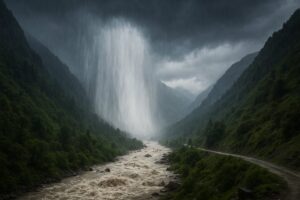
In recent years, news of devastating cloudbursts has become increasingly common. From the Himalayas in India to the Alps in Europe and the Rocky Mountains in the United States, these sudden downpours are leaving behind trails of destruction. A cloudburst is not just an ordinary rainstorm—it is a highly localized, intense rainfall event that can discharge enormous amounts of water in a very short span of time, often leading to flash floods, landslides, and loss of life. Scientists and disaster management experts now warn that climate change is amplifying the conditions that trigger such events, making them more frequent and deadlier across the globe.
Characteristics of Cloudburst
A cloudburst typically involves rainfall greater than 100 mm per hour over a small area, usually less than 25 square kilometers. Unlike normal rainfall, which may last for hours or days and spread across large regions, a cloudburst is highly localized and concentrated. This intensity often overwhelms natural and man-made drainage systems, causing sudden floods.
Cloudbursts are often associated with thunderstorms, convective cloud formations, and orographic lifting—when moist air is forced upward due to mountains, cooling and condensing rapidly to unleash torrential rain. In high-altitude or hilly areas, the sudden influx of water has little room to spread out, which magnifies its destructive power.
Factors Causing the Rise in Frequency
1. Direct Causes Linked to Climate Change
- Global Warming and Moisture Retention: Warmer air holds more water vapor. For every 1°C rise in temperature, the atmosphere can hold about 7% more moisture. This excess moisture creates the perfect setup for intense rainfall when conditions align.
- Erratic Weather Patterns: Climate change is altering global circulation systems, such as monsoons, jet streams, and trade winds. This makes rainfall events more unpredictable and extreme.
- Increased Extreme Weather Events: According to the IPCC (Intergovernmental Panel on Climate Change), the frequency of high-intensity rainfall has increased significantly in the last five decades, with cloudbursts being one of its manifestations.
2. Indirect Causes
- Urbanization and Land-Use Change: Expanding cities, deforestation, and reduced green cover are amplifying flood risks by removing natural barriers that absorb rainfall. Urban heat islands also contribute by increasing local convection currents that fuel sudden storms.
- Air Pollution and Aerosols: Particulate matter and aerosols act as condensation nuclei, altering cloud microphysics. While they sometimes suppress rainfall, under certain conditions they can intensify thunderstorms, making cloudbursts more severe.
- Glacial Retreat in High-Altitude Regions: Melting glaciers destabilize local weather systems and feed additional moisture into the atmosphere, increasing the likelihood of intense precipitation events.
Geographical & Topographical Factors
Cloudbursts are not evenly distributed across the globe. They are more common in mountainous terrains and regions with steep gradients.
- The Himalayas: Perhaps the most notorious cloudburst-prone region, where monsoon moisture collides with high mountain ranges. States like Uttarakhand, Himachal Pradesh, and Jammu & Kashmir in India, along with Nepal and northern Pakistan, witness frequent deadly incidents.
- The Andes & Rockies: Both ranges see cloudbursts, particularly in summer when moist tropical air is lifted rapidly.
- The Alps in Europe: Central Europe has reported sudden torrential rains leading to flash floods in Switzerland, Austria, and Italy.
- East Africa: Highlands in Ethiopia and Kenya are also vulnerable due to shifting rainfall patterns linked to climate change.
Topography plays a critical role: when moist air masses are forced to rise sharply over mountains, rapid condensation takes place, leading to sudden downpours. Narrow valleys further amplify flooding risk, as water accumulates quickly with little chance to disperse.
Case Studies and Recent Trends
- Kishtwar (Jammu & Kashmir) – August 14, 2025
In a tragic event on 14 August 2025, a catastrophic cloudburst struck Chositi (Chashoti) village in Kishtwar district along the Machail Mata Yatra route, triggering a devastating flash flood. At around 11:30 a.m., torrential rain unleashed torrents of water and debris, washing away homes, a community kitchen hosting about 200 pilgrims, a security outpost, vehicles, and entire structures within minutes.
- Uttarakhand (Uttarkashi / Dharali) – August 5, 2025
Earlier in the season, on 5 August 2025, another powerful cloudburst (or possibly a glacial lake outburst flood, GLOF, or landslide) struck Dharali village near Uttarkashi in Uttarakhand, severely impacting the Kheer Ganga catchment area and Kheer Ganga River.
- India’s other Himalayan Cloudbursts (2023–2024):
Uttarakhand and Himachal Pradesh have seen multiple deadly events in recent years. In July 2023, a cloudburst in Himachal Pradesh triggered landslides and flash floods, killing dozens. Similarly, in August 2024, heavy cloudbursts in Uttarakhand damaged infrastructure, disrupted pilgrimages, and caused widespread panic.
- Pakistan’s Gilgit-Baltistan (2022):
A severe cloudburst led to massive flooding, displacing thousands and destroying homes in mountain villages. The incident highlighted the vulnerability of glacial-fed river systems in South Asia.
- Alps, Europe (2021):
Intense rainfall across Germany, Switzerland, and Belgium led to devastating floods, which experts linked to localized cloudburst-like events. Over 200 lives were lost, with damages worth billions of euros.
- United States (Colorado, 2013):
A series of cloudbursts in the Rocky Mountain region caused widespread flooding, infrastructure collapse, and significant economic damage. Scientists linked the intensity to warmer conditions and altered jet stream patterns.
Challenges in Prediction and Response
- Forecasting Limitations:
Cloudbursts are hyper-localized phenomena, making them notoriously difficult to predict using traditional weather models. Even advanced Doppler radars and satellites often cannot provide adequate early warnings with sufficient lead time.
- Rapid Urban Expansion in Risk Zones:
Many high-risk regions, such as Himalayan towns or Alpine villages, are experiencing rapid urbanization without adequate disaster-resilient planning. Infrastructure built on fragile slopes is especially vulnerable.
- Data Gaps:
Developing countries often lack dense meteorological networks in mountainous regions, resulting in insufficient data to forecast such events accurately.
- Emergency Preparedness:
Cloudbursts can unleash destruction within minutes, leaving very little time for evacuation. Many local communities lack proper awareness, training, and infrastructure to respond quickly.
- Climate Uncertainty:
While scientists agree that climate change is amplifying extreme rainfall events, pinpointing how much of a specific cloudburst is attributable to global warming remains complex. This creates challenges in framing effective policies and accountability measures.
Conclusion
Cloudbursts are an old natural phenomenon, but their frequency and intensity have risen sharply in the era of climate change. Warmer temperatures, shifting monsoons, rapid urbanization, and fragile mountain ecosystems have combined to make these events deadlier and more widespread than ever before.
While forecasting remains difficult, a combination of scientific advancement, better disaster management systems, stricter urban planning, and climate action can help reduce their impact. Ultimately, addressing the root cause—climate change—remains the most crucial step. If global emissions are not curtailed, the world will face not just more frequent cloudbursts but a cascade of extreme weather events threatening communities everywhere.
References:
https://www.weather.gov/owp/hdsc_world_record
https://timesofindia.indiatimes.com/india/What-is-a-cloudburst/articleshow/6269735.cms
https://timesofindia.indiatimes.com/india/Leh-flash-floods-Toll-rises-to-145-rescue-on/articleshow/6275411.cms
https://timesofindia.indiatimes.com/india/cloudbursts-pose-serious-threat-in-himachal-pradesh/articleshow/20996240.cms
https://climatefactchecks.org/from-cloudburst-to-climate-crisis-understanding-the-uttarkashi-flash-floods/
Cloudburst in Kishtwar Highlights Rising Vulnerability of the Himalayas
Banner Image: AI Generated








s8hpcz
В Telegram появилась свежая функция — система звёзд.
Они используются для вознаграждения каналов.
Пользователи вправе отправлять звёзды чатам.
где купить звезды в тг боте
Звёзды переводятся в доход.
Это удобный способ поблагодарить авторов.
Оцените опцию уже немедленно.
В приложении Telegram появилась функция звёзд.
Теперь пользователи могут отмечать важные сообщения.
Это позволяет быстро открывать нужную переписку.
купить звезды телкграм телеграмм
Функция комфортна для деловых задач.
С её помощью легко зафиксировать ключевые моменты.
Такой инструмент бережёт нервы и делает общение быстрее.
В Telegram появилась функция звёзд.
Теперь пользователи могут отмечать важные месседжи.
Это дает возможность быстро возвращаться нужную заметку.
купить звезды за ton
Функция комфортна для ежедневного общения.
С использованием звёзд легко сохранить ключевые фразы.
Такой инструмент сохраняет нервы и делает общение эффективнее.
Домашняя работа имеют важную роль в процессе обучения.
Они помогают усваивать пройденный материал.
Систематическая работа домашних заданий развивает дисциплину.
Задания также учат распределению усилий.
https://nasuang.go.th/forum/suggestion-box/52856-z-ni-si-v-bshch-vi-sinu-v-vip-ln-nii-d-shn-g-z-d-ni
Благодаря им ученики подготавливаются к экзаменам.
Учителя могут понимать усвоение материала.
Таким образом, работа вне класса являются необходимыми для хорошей учёбы.
Домашние задания играют важную роль в обучении.
Они помогают усваивать новый материал.
Систематическая работа домашних заданий поддерживает самостоятельность.
Задания также способствуют планированию.
https://skelux.net/showthread.php?tid=544&pid=9481#pid9481
Благодаря им ученики подготавливаются к экзаменам.
Наставники могут понимать результаты обучения.
Таким образом, учебная практика дома являются необходимыми для хорошей учёбы.