Physical Address
23,24,25 & 26, 2nd Floor, Software Technology Park India, Opp: Garware Stadium,MIDC, Chikalthana, Aurangabad, Maharashtra – 431001 India
Physical Address
23,24,25 & 26, 2nd Floor, Software Technology Park India, Opp: Garware Stadium,MIDC, Chikalthana, Aurangabad, Maharashtra – 431001 India

Sri Lanka’s current heatwave is not just uncomfortable- it is pushing into dangerous territory. Across the island, “feels-like” temperatures are surging under a mix of intense seasonal sun, trapped urban heat, and a steadily warming climate. The Department of Meteorology has issued “Amber” advisories warning that the heat index (temperature + humidity) is reaching caution levels in many provinces, including Western, Sabaragamuwa, Southern, and North-Western and several districts. Read here. Health warnings, rising heat stress, and public concern are all justified. But alongside the real risks, misinformation is also spreading, linking this heat to dramatic predictions of imminent floods or guaranteed climate shocks. The science tells a more grounded story: this heat is the result of well-understood seasonal patterns amplified by urbanisation and long-term warming, not a signal of any sudden or inevitable disaster.
What Is El Niño? And What Do Experts Say about 2026?
El Niño is a Pacific climate pattern – periodic warming of equatorial Pacific waters – that shifts global weather. It tends to affect monsoons, but it is not the only factor. Importantly, meteorologists do not predict a guaranteed El Niño arriving next month.
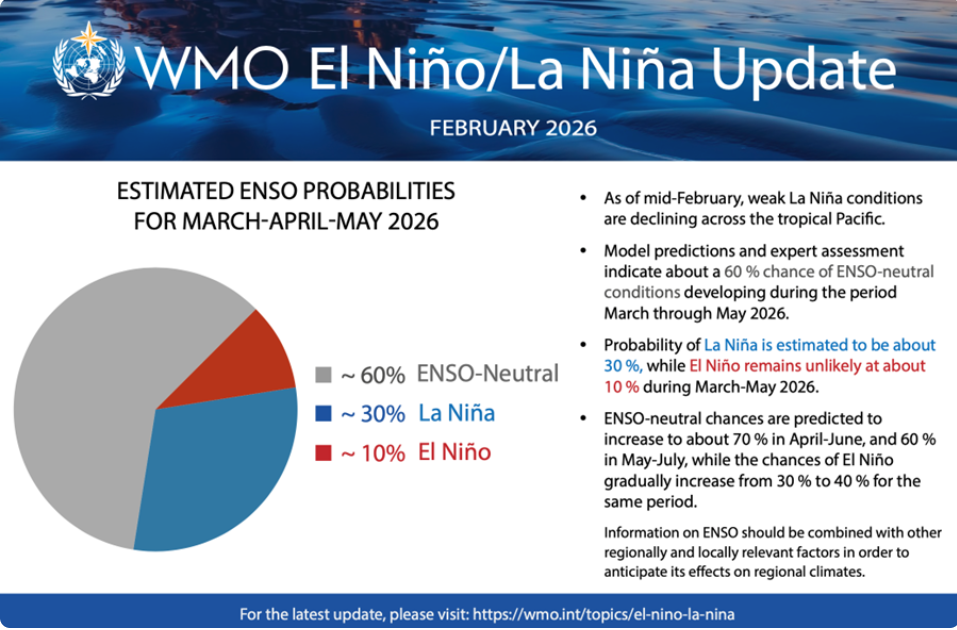
In fact, current forecasts say, “Neutral conditions are expected in early 2026; there is some chance of El Niño developing later, but it is not certain.” In other words, it would be incorrect to say “El Niño will definitely start in May.” Instead: “La Niña is ending; El Niño-Southern Oscillation (ENSO) neutral is likely for the first half of 2026, with an El Niño only possibly forming later.” Read here
How Would El Niño Affect Sri Lanka Rainfall?
If an El Niño does emerge in 2026, it would tend to tilt probabilities towards drier south-west monsoons, but with important warnings:
Based on historical analyses of rainfall in the Mahaweli/Kelani basins, it shows that during El Niño years the south-west (Yala) monsoon rains are often lower than average. In plain terms, drought risk rises if El Niño conditions coincide with the Yala rains. (Conversely, La Niña tends to boost those rains.).
However, El Niño’s impact can be amplified or offset by the Indian Ocean Dipole (IOD). For example, the study found that drought is especially likely if El Niño coincides with a positive IOD index; if both are negative, rains may actually recover. Thus, multiple climate factors interact.
Therefore, climate scientists can use ENSO and IOD to classify seasons (dry vs normal vs wet) with moderate success (roughly 60–70% accuracy for “dry” vs “not dry” in key zones). These are useful tools for planning, but far from foolproof. The researchers stress that final rainfall depends on many things, so forecasts give guidance, not guarantees. Read here
In the bottom line, it is reasonable to prepare for a somewhat drier monsoon if El Niño develops later by tightening water use and crop plans. But it would be misleading to claim “El Niño will definitely block the monsoon” or to say a catastrophic drought is inevitable. The science only says “risk is higher”, not “monsoon = zero”.
Why Heat Is Rising Even Without El Niño
Even if El Niño never appears, Sri Lanka’s climate is getting hotter anyway. Key studies confirm that:
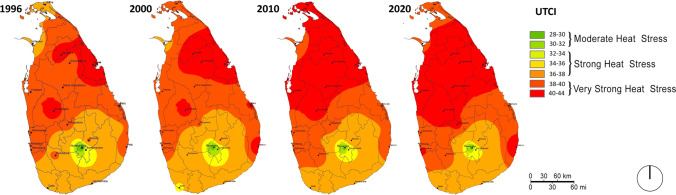
Recent decades have seen a clear jump in heat stress. By 2020, analysis of 30 years of data shows two-thirds of Sri Lanka under “extreme heat stress” in April, a category that was nearly absent in the 1990s. Even January (the coolest month) now brings moderate stress in city areas. These shifts are attributed to global warming (higher greenhouse gases) plus local urban warming (urban island effect). Read here
A 2025 study of Colombo’s weather stations found a strong upward trend in the Temperature–Humidity Index since 1997. April–May are now clearly the peak discomfort months, and the loss of green cover has paralleled rising heat stress. This confirms what people feel: everyday heat is intensifying. Read here
Trees, shade and better city planning can shave off a few degrees, but they cannot undo global warming. The Intergovernmental Panel on Climate Change and WMO stress that natural climate cycles like El Niño simply modulate a warming baseline. In practical terms, even a neutral-ENSO year now feels hotter than the 1980s or 1990s due to climate change and built environments. Read here
In summary, long-term warming and urbanisation are the main drivers of this heatwave, on top of which any El Niño effect would be layered. El Niño does not create the baseline of warmth; it merely tweaks an already hotter system.
Is Today’s Heat a “Sign” of a Coming “Great Flood”?
No. There is no scientific basis for treating this heatwave as a sign of an upcoming great flood (“මහා දියවැස්ම”) or any specific disaster.
Both heatwaves and extreme rains are increasing under climate change, but one does not cause the other in a simple sequence. Climate science can say overall flood risk is rising in a warming world, but it cannot say, “Because it’s hot now, a giant flood will surely happen soon.”
As El Niño (if it comes) raises the chance of a drier monsoon and possibly lower reservoir levels. Conversely, other factors (like a strong IOD or normal conditions) could still bring heavy rains. No model can turn a hot March into a specific forecast of a “great flood” months later. A heatwave neither “creates” nor “prevents” floods; both are part of wider variability.
Both WMO and Sri Lanka’s Met Department are focusing on the current heat and on monitoring seasonal rain patterns, not on warning of floods from a heat spell. Meteorologists have repeatedly urged the public to ignore sensational social media rumours.
What Do Experts Say
In a recent media briefing, Athula Karunanayake, the director general of the Department of Meteorology Sri Lanka, explained the current weather conditions in Sri Lanka. Watch here
He noted that the country is now in the first inter-monsoon season, a period typically marked by high daytime heat and localised rainfall.
According to him, strong morning heat increases evaporation from land and surrounding water bodies. Because Sri Lanka is an island, the atmosphere becomes rich in water vapour. This can lead to cloud formation and afternoon showers caused by convection. However, he stressed that cloud formation is not guaranteed every day, meaning rainfall can be irregular while heat remains high.
He also warned that hot and humid conditions are likely to continue and advised vulnerable groups, such as the elderly, children, and outdoor workers, to limit exposure during peak heat hours.
Looking ahead, he explained that after this inter-monsoon period, the south-west monsoon will begin. Its strength may be influenced by global climate patterns such as El Niño, which is appearing in the Pacific Ocean.
If El Niño strengthens, it could weaken the southwest monsoon and reduce rainfall, particularly during the Yala season. However, this depends on how the climate system evolves and cannot be predicted with certainty.
He further added that after mid-April, especially following April 15, Sri Lanka may experience “Bak Maha” thunderstorms (බක් මහ අකුණු), bringing some rainfall during the inter-monsoon transition. Despite this, warm and humid conditions are expected to persist until around the end of May, until the southwest monsoon becomes fully active.
Finally, he emphasized that similar hot conditions have been observed in previous years, and noted that such weather can have impacts on electricity demand and agricultural activities.
Moreover, a discussion with a scientist from Sri Lanka’s Department of Meteorology helps cut through much of the confusion.
Meteorologist Kasun Paskuel explains that conditions linked to El Niño and La Niña are not unusual, they are part of natural climate variability and can appear in different strengths over time. These patterns are identified based on long-term ocean and atmospheric data, not sudden short-term weather changes.
Most importantly, he stresses a point that directly challenges viral claims:
In other words, even if El Niño-like conditions develop, that alone is not enough to trigger extreme outcomes.
He also points out a growing problem: some social media content is exaggerating real climate signals for attention, turning uncertain or moderate risks into dramatic, guaranteed disasters.
Conclusion
Sri Lanka’s heatwave is serious- but it is not a warning of a specific disaster. It reflects a predictable seasonal peak, intensified by urbanisation and long-term climate warming, not a signal of an imminent flood or failed monsoon.
Climate systems are complex. Patterns like El Niño can shift rainfall risks, but they do not determine outcomes. Turning heat into dramatic predictions oversimplifies that reality and distracts from what truly matters.
The priority is clear: prepare for a hotter, more variable climate by strengthening resilience, improving urban planning, and protecting vulnerable communities, not chasing misinformation.
References:
https://meteo.gov.lk/pdfs/heat_pdf.pdf?t=1773655046106
https://www.mdpi.com/2220-9964/6/7/189#:~:text=urbanization,on%20air%20temperature%2C%20while%20SUHI
https://www.pmel.noaa.gov/elnino/what-is-la-nina
https://www.pmel.noaa.gov/elnino/what-is-el-nino
Banner Image: Photo by Jonathan Borba on Unsplash
Sections of this article may have been developed with the assistance of artificial intelligence tools to support research, drafting and language refinement. All information has been reviewed, edited and verified by the author/editor to ensure accuracy, context and editorial integrity. The responsibility for the final content, interpretations and conclusions rests solely with the publisher.