Physical Address
23,24,25 & 26, 2nd Floor, Software Technology Park India, Opp: Garware Stadium,MIDC, Chikalthana, Aurangabad, Maharashtra – 431001 India
Physical Address
23,24,25 & 26, 2nd Floor, Software Technology Park India, Opp: Garware Stadium,MIDC, Chikalthana, Aurangabad, Maharashtra – 431001 India

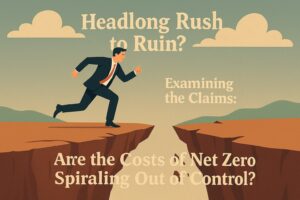
A recent post on X, quoting a Telegraph article, declared that the “supposed economic benefits from net zero are disintegrating in the face of reality” and that “the costs appear to be rising on a near-continuous basis.” These sweeping statements echo a common narrative among climate-skeptical commentators: that the economic logic behind decarbonisation has collapsed and that the transition to clean energy has become an unaffordable burden. A careful look at credible evidence, however, paints a very different picture.
Claim 1: “The supposed economic benefits from net zero are disintegrating in the face of reality.”
Fact: False. There is no credible evidence that the economic benefits of pursuing net zero are “disintegrating.” In fact, most peer-reviewed analyses, government assessments, and international energy agency reports continue to find that the economic case for a well-managed net-zero transition remains strong.
For example, the Grantham Research Institute on Climate Change and the Environment at the London School of Economics estimates that the net cost of achieving net zero in the UK will be less than one percent of GDP by mid-century and that the transition could bring considerable benefits through energy-efficiency improvements, reduced household costs, cleaner air, and greater energy security. Similarly, a survey of economists published by The Independent in 2021 found that two-thirds of respondents believed it was “likely or extremely likely” that the benefits of reaching net zero would outweigh the costs.
The International Energy Agency (IEA) goes further, projecting that under its “Net Zero Emissions by 2050” scenario, global GDP in advanced economies would be around four percent higher in 2030 than it would be without such a transition. The reason is straightforward: investing in clean technology drives innovation, cuts energy imports, and reduces the economic drag of volatile fossil-fuel prices. An Oxford University study by the Smith School of Enterprise and the Environment also finds that adopting net-zero technologies such as electric vehicles, heat pumps, and renewable generation could save the UK economy billions over time. These findings are consistent across multiple independent research institutions.
The suggestion that these benefits are “disintegrating in the face of reality” misrepresents what is actually happening. Net-zero economics have always involved high up-front costs and delayed payoffs. The initial investments in infrastructure such as grid upgrades, public transport, and renewable-energy deployment are expensive, while many of the benefits, like reduced fuel bills, new industries, and avoided climate damage, accumulate later. This lag can make the transition feel costly in the short term, especially when households face inflation or energy-price shocks. But feeling economic strain now does not mean that the overall economic case has collapsed.
Critics also tend to ignore that climate policy is not a static calculation. As clean-energy technologies scale, their costs fall and their benefits rise. In the early 2000s, renewable energy was expensive; today, wind and solar are among the cheapest sources of electricity in most regions. That trend continues, suggesting that the benefits of net zero are actually strengthening over time, not “disintegrating.”
Of course, uncertainties remain. Some academic analyses note that the net benefits could be small or unevenly distributed, depending on how the transition is managed. Certain industries, regions, or workers may bear heavier short-term costs. But that does not amount to evidence of an overall economic failure it simply highlights the need for fair and well-designed policy. When weighed against the long-term cost of inaction climate-driven damage to infrastructure, agriculture, and health the case for net zero remains economically sound.
In short, there is no data to support the dramatic claim that the economic benefits of net zero are “disintegrating.” The transition remains challenging but broadly beneficial, and the overwhelming body of evidence points toward continued, not collapsing, economic justification.
Claim 2: “The costs appear to be rising on a near-continuous basis.”
Fact: Misleading. It is true that reaching net zero requires major investment, particularly in the early years, but the idea that costs are spiraling upward without limit contradicts the empirical record.
Studies by McKinsey & Company and other analysts show that global spending on low-carbon infrastructure will need to rise sharply through the 2020s but then stabilize or decline as technology becomes cheaper and efficiency improves. In other words, the cost curve is front-loaded rather than “continuously rising.” McKinsey estimates that annual investment may peak at around 9 percent of global GDP in the late 2020s before falling as clean technologies become mainstream.
Meanwhile, technology costs the main driver of total spending are plummeting. The price of solar photovoltaic modules has fallen by more than 80 percent since 2010; offshore wind by around 30 percent; and lithium-ion batteries, essential for electric vehicles and grid storage, by roughly 90 percent over the past decade. These dramatic declines have transformed what once looked like prohibitively expensive technologies into affordable mass-market options. In the UK, the government’s independent adviser, the Climate Change Committee, has repeatedly revised downward its cost projections for net zero precisely because of such technological progress.
The claim that costs are rising “on a near-continuous basis” also overlooks operational savings. Once installed, renewable systems have minimal fuel costs, while electric vehicles and heat pumps can be significantly cheaper to run over their lifetimes than fossil alternatives. According to Oxford’s Smith School, more than 80 percent of low-carbon investments deliver net cost savings to consumers or businesses over time.
None of this means that the transition is cost-free. Households and industries will face high up-front expenses, and there will be short-term bottlenecks from supply-chain pressures to skills shortages that can push some prices up temporarily. But these are transitional dynamics, not evidence of perpetual cost escalation. In the longer term, the trajectory is clearly downward.
Equally important is what this claim leaves out: the cost of not acting. Climate damages flooding, drought, heatwaves, lost agricultural productivity, and rising insurance losses already impose major economic burdens. The Grantham Institute and the Intergovernmental Panel on Climate Change (IPCC) both stress that the costs of unchecked climate change would far exceed the investment required to reach net zero. To focus only on near-term expenditures while ignoring avoided losses and health benefits presents a distorted picture of the economics involved.
Both of the post’s central assertions are inaccurate. The idea that the economic benefits of net zero are “disintegrating” is not supported by credible research; most evidence suggests that, although front-loaded and uneven, the transition remains economically justified and increasingly advantageous as technologies mature. The notion that costs are “rising on a near-continuous basis” is also false; while initial investment is high, total system costs are expected to stabilize and fall, driven by rapid declines in renewable-energy and battery prices.
In reality, the global economy is already benefiting from the transition. Clean-energy sectors are among the fastest-growing sources of jobs and investment, and countries that lead in these industries are likely to capture significant competitive advantage. The path to net zero will not be smooth, but describing it as a “headlong rush to ruin” is a misrepresentation. The evidence overwhelmingly indicates that, managed wisely, the shift to net zero is not economic suicide it is a prudent and ultimately profitable course correction.
References:
https://x.com/PeterDClack/status/1980496186961432657
https://www.ipcc.ch/2021/08/09/ar6-wg1-20210809-pr/
https://www.sciencedirect.com/science/article/pii/S0960148118308437
https://www.sciencedirect.com/science/article/pii/S2211467X22001158
Banner Image: AI Generated