Physical Address
23,24,25 & 26, 2nd Floor, Software Technology Park India, Opp: Garware Stadium,MIDC, Chikalthana, Aurangabad, Maharashtra – 431001 India
Physical Address
23,24,25 & 26, 2nd Floor, Software Technology Park India, Opp: Garware Stadium,MIDC, Chikalthana, Aurangabad, Maharashtra – 431001 India


Water security, drought resilience, and land restoration emerged as major priorities at the 17th Conference of the Parties (COP17) to the United Nations Convention to Combat Desertification (UNCCD), held in Ulaanbaatar, Mongolia, from 17 to 28 August 2026.
Against a backdrop of intensifying drought, land degradation, and climate-related water stress, nearly 200 countries gathered under the COP17 theme “Restoring Land. Restoring Hope.” The conference sought to strengthen practical action on the interconnected challenges of land degradation, desertification, and drought, while linking land restoration with climate resilience, food security, biodiversity, and sustainable development.
For Sri Lanka, the connection between land, water, and climate resilience was particularly prominent during Water Day of the conference on 25 August. During the High-Level Ministerial Dialogue on Drought Resilience, Sri Lanka’s Environment Minister Dhammika Patabendige highlighted the country’s position that water security cannot be separated from the health of soils, landscapes, and ecosystems.
The minister emphasized Sri Lanka’s commitment to an integrated approach to land, water, climate, and ecosystem management, supported by science, innovation, financing, and community participation. He also highlighted Sri Lanka’s ancient hydraulic civilization, including traditional tank and Ellanga cascade systems, as examples of how traditional knowledge can complement modern approaches to water management.
The statement also pointed to the restoration of wetlands and landscapes, the “Wanaspathi” program, and stronger environmental regulatory mechanisms as part of Sri Lanka’s efforts to protect water resources and ecological integrity.
The message from Sri Lanka closely reflected a broader theme running through COP17: drought should be addressed before it becomes a crisis rather than simply managed after its impacts appear.
Drought moves closer to the center of climate adaptation.
UNCCD discussions at Ulaanbaatar increasingly treated drought as a major climate and development challenge rather than simply a natural disaster. Climate change, unsustainable land and water management, and biodiversity loss are contributing to greater drought risks, with consequences for agriculture, ecosystems, water supplies, livelihoods, and economies.
The conference placed particular emphasis on early-warning systems, drought monitoring, anticipatory action, integrated land and water management, and improved access to science and technology.
One notable development was the launch of the International Drought Resilience Observatory (IDRO), designed to strengthen the availability and use of information for drought monitoring and resilience planning.
This emphasis on information and early action is particularly relevant for developing countries such as Sri Lanka, where drought can affect agriculture, drinking-water supplies, hydropower generation and ecosystems simultaneously.
New push to finance drought resilience
Finance was another central issue at COP17. UNCCD estimates indicate that approximately US$355 billion a year is required between 2025 and 2030 to meet land-restoration targets and address land degradation, desertification and drought. Current annual investment is estimated at only about US$77 billion, leaving a financing gap of roughly US$278 billion per year.
COP17 therefore placed considerable emphasis on mobilizing private investment alongside public and development finance.
One of the most significant initiatives was the launch of the Drought Resilience Investment Facility (DRIF), intended to mobilize up to US$400 million for drought resilience, water infrastructure and land restoration through innovative and blended-finance approaches.
The initiative is significant because climate adaptation projects have traditionally struggled to attract private capital. By using mechanisms such as concessional finance, guarantees and partnerships, the facility seeks to make investments in resilient agriculture, water infrastructure and nature-based solutions more attractive to investors.
Rangelands become a major climate-resilience priority
Another major COP17 outcome was the increased international attention given to rangelands, which cover more than half of the Earth’s terrestrial surface. They support hundreds of millions of pastoralists and provide important ecosystem services, including water regulation, biodiversity protection and carbon storage. Yet approximately half of the world’s rangelands are considered degraded.
COP17 advanced a Rangelands Flagship Initiative, with a portfolio worth about US$1.2 billion across 45 projects, forming the centrepiece of a broader US$1.3 billion land-restoration finance portfolio.
The significance extends beyond pastoral livelihoods. Healthy rangelands can store carbon, protect soils, regulate water and improve resilience to drought. Their degradation, on the other hand, can accelerate erosion, biodiversity loss and greenhouse-gas emissions while increasing vulnerability to climate shocks.
The focus was particularly timely because 2026 has been designated the International Year of Rangelands and Pastoralists, providing additional international momentum for their restoration and sustainable management.
Cities and local governments also brought into the climate-resilience agenda
COP17 also sought to move land and drought action beyond national governments. The Ulaanbaatar Declaration, adopted by mayors, governors and other local leaders, called for stronger local action on sustainable land management, drought resilience, biodiversity, climate resilience and water security.
The declaration also called for a more permanent role for cities and regions within the UNCCD process. An associated Ulaanbaatar Initiative will explore ways for cities to measure and report land degradation, with results to be shared with the Convention ahead of COP18.
This is increasingly important as urban expansion, land conversion and water demand place additional pressure on surrounding ecosystems. COP17 therefore recognized that climate resilience cannot be achieved through rural land management alone; cities and their surrounding landscapes must also be considered as interconnected systems.
The unresolved question of a global drought agreement
Despite progress on finance, monitoring and land restoration, one major issue remained unresolved: whether countries should establish a legally binding international instrument specifically addressing drought.
Countries have debated this issue for several years. While some governments, particularly drought-vulnerable developing countries, support a stronger legally binding framework, others have preferred strengthening existing mechanisms and initiatives rather than creating a new treaty.
The issue was not resolved at COP17 and has been pushed toward the next round of negotiations, with Egypt scheduled to host COP18 in 2028.
The disagreement illustrates a wider challenge in global climate and environmental governance: countries increasingly agree on the severity of drought risks, but differ over the legal and financial mechanisms required to respond to them.
A message relevant to Sri Lanka
For Sri Lanka, the outcomes of COP17 have particular relevance. The country’s exposure to changing rainfall patterns, drought, floods, land degradation and water-security pressures makes the integration of climate adaptation with ecosystem and land management increasingly important.
Sri Lanka’s emphasis at Ulaanbaatar on traditional tanks and cascade systems, wetlands, landscape restoration and community participation fits closely with the conference’s broader recognition that healthy landscapes are infrastructure for climate resilience.
The central lesson from Ulaanbaatar is therefore not simply that more water infrastructure is needed. Rather, landscapes themselves must be managed as water-security infrastructure. Healthy soils can retain water; vegetation can reduce erosion; wetlands can regulate flows; restored landscapes can improve drought resilience; and well-managed ecosystems can store carbon while supporting livelihoods.
For Sri Lanka, this approach could provide an important bridge between its commitments under the UNCCD Strategic Framework, Land Degradation Neutrality targets and the Sustainable Development Goals, while also complementing national climate-adaptation efforts.
As the impacts of climate change intensify, the distinction between land policy, water policy and climate policy is becoming increasingly difficult to maintain. COP17’s message from Ulaanbaatar was clear: restoring degraded land is not only an environmental objective- it is increasingly a strategy for securing water, food, livelihoods and climate resilience.
References
UN land conference advances new global architecture for drought resilience
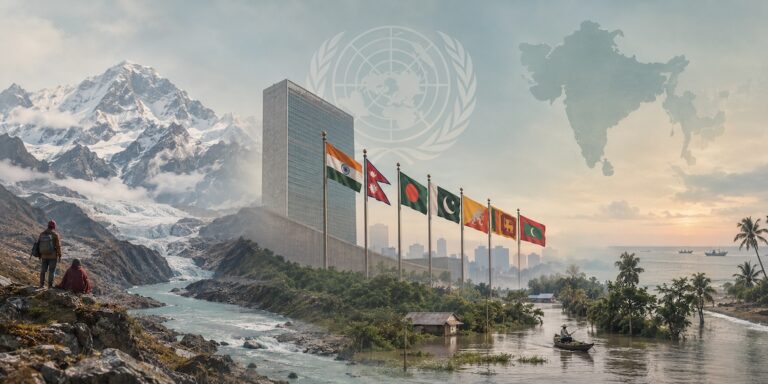
Banner Image: AI Generated
Sections of this article may have been developed with the assistance of artificial intelligence tools to support research, drafting and language refinement. All information has been reviewed, edited and verified by the author/editor to ensure accuracy, context and editorial integrity. The responsibility for the final content, interpretations and conclusions rests solely with the publisher.