Physical Address
23,24,25 & 26, 2nd Floor, Software Technology Park India, Opp: Garware Stadium,MIDC, Chikalthana, Aurangabad, Maharashtra – 431001 India
Physical Address
23,24,25 & 26, 2nd Floor, Software Technology Park India, Opp: Garware Stadium,MIDC, Chikalthana, Aurangabad, Maharashtra – 431001 India

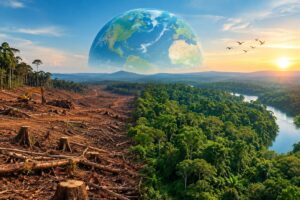
Global deforestation declined by 15 per cent in 2025, offering a rare sign of progress in the fight to protect the world’s forests. But the improvement is still not enough to put countries on course to meet their pledge of ending deforestation by 2030.
The latest Forest Declaration Assessment found that global deforestation fell to just over 7 million hectares in 2025, marking the sharpest annual decline since the 2018–2020 baseline period. However, the rate of forest loss remains considerably higher than what would be required to meet the 2030 target. The findings underline a familiar problem in global environmental policy: progress is visible, but it is happening too slowly.
More than 140 countries pledged at the 2021 UN climate summit in Glasgow to halt and reverse forest loss and land degradation by 2030. Forests are central to that commitment because they absorb carbon dioxide, regulate rainfall, support biodiversity and provide food and livelihoods to millions of people. Yet the latest figures show that the world has little room for complacency.
Latin America Leads the Improvement
The biggest gains in reducing deforestation came from Latin America and the Caribbean, where forest loss fell by around 28 per cent in 2025. The region remains one of the world’s most important forest areas, meaning reductions there can have a significant effect on global figures.
Brazil has been a major contributor to this improvement. In the Amazon, annual deforestation dropped to 3,335 square kilometres between August 2025 and July 2026, the lowest level recorded since satellite monitoring began in 1988. The figure represents a 42 per cent decline from the previous year. The fall has been linked to stronger environmental enforcement and policies aimed at controlling illegal forest clearing. Brazil’s experience suggests that deforestation can respond relatively quickly when governments combine monitoring, law enforcement, restrictions on illegal land use and political commitment. Colombia has also recorded a sustained decline in forest loss, adding to the positive picture emerging from parts of Latin America.
But the global situation is far from uniform. In Central Africa, particularly the Congo Basin, deforestation has moved in the opposite direction. Forest loss in the region reached about 2.4 million hectares, according to the assessment. The Congo Basin is especially important because it contains one of the world’s largest tropical forest ecosystems and acts as a major carbon sink. This divergence highlights why a global reduction in the headline figure does not necessarily mean that forests everywhere are becoming safer.
A Smaller Loss Is Still a Loss
The 15 per cent decline is encouraging, but it should not be mistaken for a turnaround. The world still needs a much faster reduction in deforestation to reach zero forest loss by 2030. The latest assessment indicates that the 2025 rate remained about 70 per cent higher than the level required to stay on the trajectory towards the 2030 goal. At the same time, forest protection cannot be measured simply by the number of hectares that remain standing. Forest degradation, fragmentation, fires and the loss of biodiversity can weaken ecosystems even when complete clearing does not take place.
The pressure on forests is also being compounded by climate change. Hotter and drier conditions can increase the risk of wildfires and make forests more vulnerable to pests and extreme weather. The return of El Niño-related climate pressures could further complicate conservation efforts in some tropical regions.
Protection is another area where progress remains inadequate. Only about 17.33 per cent of the world’s land and inland waters are currently covered by protected areas, well below the 30 per cent target for 2030 under the global biodiversity framework. The challenge, therefore, is not simply to cut down fewer trees. Countries need to protect existing forests, restore degraded landscapes, support forest-dependent communities and ensure that agricultural and commodity supply chains do not continue driving forest clearance.
The latest decline provides evidence that policy can make a difference. Brazil’s progress, for example, shows that strong institutions and sustained enforcement can reverse damaging trends. But with only four years left before the 2030 deadline, the message from the new figures is clear: the world is moving in the right direction in some places, but not nearly fast enough. The 15 per cent decline should be treated as an opportunity to accelerate action, rather than a reason to ease pressure. The coming years will determine whether the recent improvement becomes the beginning of a lasting global reversal, or simply another temporary pause in the destruction of the world’s forests.
References:
https://forestdeclaration.org/resources/forest-declaration-assessment-2026/
Conserve and restore forests and other terrestrial ecosystems
Banner Image: AI generated
Sections of this article may have been developed with the assistance of artificial intelligence tools to support research, drafting, and language refinement. All information has been reviewed, edited, and verified by the author/editor to ensure accuracy, context, and editorial integrity. The responsibility for the final content, interpretations, and conclusions rests solely with the publisher.