Physical Address
23,24,25 & 26, 2nd Floor, Software Technology Park India, Opp: Garware Stadium,MIDC, Chikalthana, Aurangabad, Maharashtra – 431001 India
Physical Address
23,24,25 & 26, 2nd Floor, Software Technology Park India, Opp: Garware Stadium,MIDC, Chikalthana, Aurangabad, Maharashtra – 431001 India

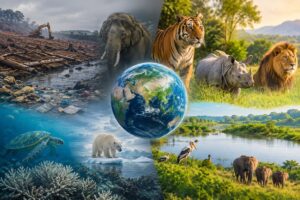
The world has lost much of its wildlife abundance over the past five decades, with monitored animal populations declining sharply across ecosystems. Yet, amid this global deterioration, India offers some encouraging examples of wildlife recovery, demonstrating that sustained conservation efforts can make a difference.
The World Wide Fund for Nature’s (WWF) Living Planet Report 2026, released in October, found that the average size of monitored wildlife populations declined by 73 per cent between 1970 and 2022. The assessment, prepared with the Zoological Society of London (ZSL), draws on data covering 5,790 vertebrate species and 35,803 population trends worldwide.
The findings underline the mounting pressure on biodiversity from habitat destruction, unsustainable exploitation of natural resources, climate change and pollution. However, the report also highlights the potential for recovery when governments, conservation organisations and local communities work together to protect vulnerable species.
Freshwater ecosystems face the steepest decline
The report identifies freshwater ecosystems as the worst-affected environment, with monitored wildlife populations declining by an average of 85 per cent during the assessment period. Terrestrial populations recorded a 69 per cent decline, while marine populations fell by 59 per cent.
The disproportionate decline in freshwater wildlife reflects the pressures facing rivers, lakes and wetlands. Pollution, dams, water diversion, habitat degradation and the drying of waterways can disrupt breeding grounds, reduce food availability and fragment habitats. Species dependent on freshwater environments are particularly vulnerable when multiple pressures occur simultaneously. On land, the conversion of forests and grasslands for agriculture, infrastructure and other human activities continues to reduce the space available to wildlife. Unsustainable hunting and fishing further threaten species, while climate change adds to existing pressures by altering habitats, temperatures and water availability.
The report identifies habitat loss and degradation as the most frequently reported threats to monitored populations. Overexploitation, climate change, pollution, invasive species and disease also contribute to wildlife declines. Importantly, the 73 per cent figure does not mean that 73 per cent of all individual wild animals have disappeared. Instead, it represents the average change in the size of monitored populations over time. The distinction matters because the index tracks changes across selected populations rather than counting every wild animal on Earth.
The overall decline also masks considerable variation. Around half of the monitored populations were either stable or increasing, but declines elsewhere were large enough to pull the global average down substantially.
India’s conservation gains show recovery is possible
India stands out in the report for recording increases in several prominent wildlife species, including tigers, Asiatic lions and greater one-horned rhinoceroses. These gains demonstrate that targeted interventions, backed by sustained funding, monitoring and habitat protection, can help threatened species recover.
India’s tiger conservation programme offers an important example of long-term action. Protected areas, anti-poaching measures, wildlife monitoring and coordinated management have helped strengthen tiger conservation. Similar efforts to protect rhinoceroses and Asiatic lions have supported recovery in their respective habitats.
The report’s findings nevertheless highlight the need to look beyond individual species and protected areas. An increase in the numbers of a flagship species does not automatically mean that the wider ecosystem is healthy. Smaller mammals, birds, amphibians, reptiles, insects and freshwater organisms may continue to face serious threats even where large animals are recovering. Human-wildlife conflict is another growing challenge. As human settlements, roads, farms and other infrastructure expand into wildlife habitats, encounters between people and animals become more frequent. Crop damage, livestock losses and threats to human safety can create resentment among local communities, undermining conservation efforts if affected households do not receive adequate support.
India therefore needs to combine species-specific protection with landscape-level conservation. Maintaining wildlife corridors, restoring degraded habitats, protecting wetlands and rivers, and ensuring that development projects account for ecological impacts will be essential. Local communities must also have a meaningful role in conservation decisions, with fair compensation and practical measures to reduce conflict.
The report further emphasises that wildlife recovery cannot depend on conservation programmes alone. The food, energy and financial systems that shape land use, resource extraction and investment must also change. More sustainable agricultural practices, reduced pollution, responsible consumption and financing that supports nature-positive activities can help address the underlying causes of biodiversity loss.
The global findings present a serious warning, but India’s conservation gains offer a reason for cautious optimism. Wildlife populations are not destined to decline indefinitely. Recovery is possible when threats are addressed consistently and habitats receive long-term protection. The challenge now is to extend these successes beyond a handful of well-known species. Protecting biodiversity means safeguarding the ecological systems that provide clean water, fertile soil, food and climate resilience. Without such action, the loss of wildlife will eventually affect human communities as well.
The message from the Living Planet Report 2026 is clear: conservation can work, but isolated successes will not be enough. Reversing the global decline requires sustained action that places nature at the centre of development, rather than treating its protection as an afterthought.
References:
https://wwflpr.awsassets.panda.org/downloads/living-planet-report-2026-english.pdf
https://www.pib.gov.in/PressReleasePage.aspx?PRID=2290233®=48&lang=1
https://www.nwf.org/Educational-Resources/Wildlife-Guide/Threats-to-Wildlife/Habitat-Loss
https://www.un.org/en/climatechange/science/climate-issues/biodiversity
Banner Image: AI generated
Sections of this article may have been developed with the assistance of artificial intelligence tools to support research, drafting, and language refinement. All information has been reviewed, edited, and verified by the author/editor to ensure accuracy, context, and editorial integrity. The responsibility for the final content, interpretations, and conclusions rests solely with the publisher.