Physical Address
23,24,25 & 26, 2nd Floor, Software Technology Park India, Opp: Garware Stadium,MIDC, Chikalthana, Aurangabad, Maharashtra – 431001 India
Physical Address
23,24,25 & 26, 2nd Floor, Software Technology Park India, Opp: Garware Stadium,MIDC, Chikalthana, Aurangabad, Maharashtra – 431001 India

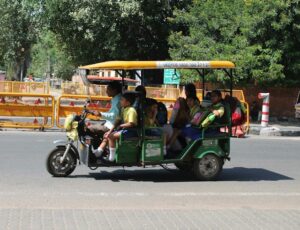
Gurugram traffic pollution caused nearly 95,000 missed school days in 2025. See what the ICCT study found and which solutions could help.
Traffic pollution in Gurugram contributed to an estimated 94,859 school days lost to illness among children and teenagers in 2025, while accounting for one in four new asthma cases linked to air pollution in the city, according to a study by the International Council on Clean Transportation (ICCT). The lost school days are equivalent to an entire academic year for 431 students. The findings highlight the health costs of growing vehicle use in the Delhi satellite city, where private cars are the biggest source of traffic emissions. Researchers say shifting vehicles to electricity could substantially reduce the burden, but cleaner transport policies will also need to address vehicles entering Gurugram from other parts of the National Capital Region (NCR).
Traffic emissions take a toll on children’s health
The ICCT study found that vehicle exhaust contributed to a quarter of new asthma cases associated with air pollution among children and teenagers in Gurugram during 2025. Traffic pollution was also estimated to be responsible for children missing 94,859 days of school due to illness. The findings identify that vehicle emissions impact more than just air quality and that children are a group that can be impacted by pollution-related illnesses affecting their health and education.
Private cars emerged as the largest source of traffic pollution in the city. Gurugram has around 323 cars for every 1,000 residents, one of the highest rates in India, according to the study. Researchers also found that more than 80% of vehicle emissions came from newer BS-IV and BS-VI vehicles. This suggests that restrictions targeting older vehicles alone may not be enough to significantly reduce traffic-related pollution, making a broader shift towards cleaner transport necessary.
Electric vehicles could deliver major health benefits
The study found that electrifying every vehicle registered in Gurugram could deliver about three-quarters of the potential health benefits from reducing traffic emissions. Electric vehicles produce no exhaust emissions while being driven, helping reduce the release of pollutants directly onto city roads. However, the full climate and pollution benefits depend partly on how the electricity used to charge them is generated.
The other benefits would depend on tackling pollution from the nearly 500,000 vehicles that enter Gurugram daily from Delhi and other parts of the NCR. These vehicles are registered elsewhere, but they add to local traffic emissions. Thus, researchers suggest that policies to achieve cleaner transport should not only target the registered vehicle fleet of the city but also should consider the movement of vehicles across regional boundaries.
The findings also come as electric vehicles continue to make up a small share of new vehicle sales in Gurugram. Vehicle registrations climbed to a seven-year high, but EVs accounted for only 4.3% of new sales, the report said. Researchers have called for fast electrification for categories of vehicles including two-wheelers, three-wheelers and school buses, not only private cars.
Cleaner transport requires action across the NCR
The study’s findings underline the limits of treating air pollution as a problem confined to individual cities. Vehicles move between Gurugram, Delhi, Faridabad, Noida, Ghaziabad and other NCR areas, carrying emissions across administrative boundaries. Addressing traffic pollution will therefore require coordination between governments and transport authorities across the region.
Rajesh Verma, chairperson of the Commission for Air Quality Management (CAQM), said vehicles are a leading source of pollution in Delhi-NCR, both through direct exhaust emissions and through secondary pollution. He pointed to the need for coordinated action across states and highlighted electric-vehicle incentives as one way to support the transition. Former G20 Sherpa Amitabh Kant also stressed that Delhi cannot clean its air in isolation from neighbouring cities.
Researchers say Gurugram has an opportunity to build on existing transport-emission controls by accelerating the adoption of zero-tailpipe-emission vehicles and tackling pollution from incoming traffic. The findings also reinforce the importance of cleaner public transport and electric school buses, which could reduce children’s exposure to vehicle exhaust during daily journeys.
For a city where traffic emissions are linked to thousands of asthma cases and nearly 95,000 missed school days, the challenge is not simply to improve air quality readings. It is to reduce children’s exposure to pollution through transport policies that work across Gurugram and the wider NCR.
References:
Banner image: Photo by Leonie Clough on Unsplash
Sections of this article may have been developed with the assistance of artificial intelligence tools to support research, drafting, and language refinement. All information has been reviewed, edited, and verified by the author/editor to ensure accuracy, context, and editorial integrity. The responsibility for the final content, interpretations, and conclusions rests solely with the publisher.