Physical Address
23,24,25 & 26, 2nd Floor, Software Technology Park India, Opp: Garware Stadium,MIDC, Chikalthana, Aurangabad, Maharashtra – 431001 India
Physical Address
23,24,25 & 26, 2nd Floor, Software Technology Park India, Opp: Garware Stadium,MIDC, Chikalthana, Aurangabad, Maharashtra – 431001 India

The catastrophic glacial collapse near the Nepal-China border has intensified concerns about the growing dangers facing the Himalayas as rising temperatures alter glaciers, permafrost and mountain slopes. Chinese researchers investigating the disaster have said the underlying instability must be understood in the context of a rapidly warming high-mountain environment, while scientists continue to examine the precise chain of events that triggered the collapse.
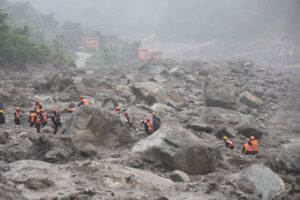
The disaster struck on August 26, when a glacier and surrounding mountain material collapsed on the southern slope of Langtang Lirung in Nepal, unleashing a destructive avalanche of ice and rock that transformed into a massive debris flow downstream. The event devastated areas around the China-Nepal border and triggered a major humanitarian and rescue operation.
As of September 8, rescue operations were still underway, particularly at hydropower tunnels buried under mud and debris. At least 11 hydropower projects were affected, and authorities were continuing efforts to locate workers who may have been trapped underground.
A glacier collapse turned into a devastating mountain disaster
Chinese scientists investigating the event reconstructed the disaster using remote-sensing data, field inspections and information collected at the site. According to the findings reported by Chinese authorities and researchers, the collapse occurred at an elevation of around 5,200 metres before the avalanche swept rapidly down the steep mountain terrain. The ice-rock avalanche descended through a dramatic elevation difference of more than 3,000 metres, gathering debris and transforming into a powerful flow that travelled downstream towards Gyirong Port, a major crossing between China and Nepal. The flow covered about 22 kilometres in roughly seven minutes, demonstrating the extraordinary speed with which cascading mountain disasters can develop.
Researchers said the extreme destructive power of the event was shaped not only by the initial collapse but also by the geography of the mountains. The steep elevation gradient allowed the collapsing ice, rock and debris to accelerate rapidly as it moved through the valley. The disaster has also exposed the vulnerability of infrastructure built in Himalayan valleys. Hydropower projects, roads and settlements located downstream can be affected by hazards originating far above them, leaving little time for warnings once a large collapse begins. Rescue teams have been concentrating on several tunnel systems after floodwaters and debris buried parts of hydropower facilities.
Scientists see a growing climate risk, but the exact trigger remains under investigation
The disaster has inevitably raised questions about climate change and its role in destabilising the Himalayas. Chinese researchers have warned that rapid environmental changes are affecting glaciers, permafrost and mountain slopes across the region, potentially increasing the risk of glacier-related and cascading disasters.
However, scientists have also stressed an important distinction: the broader influence of climate warming on Himalayan hazards does not automatically establish climate change as the direct trigger of this particular collapse. The immediate cause of such events can involve several interacting factors, including glacier conditions, unstable bedrock, slope structure and water. Determining exactly why a particular section of mountain failed requires detailed investigation.
The wider scientific evidence, nevertheless, points to growing risks across the Hindu Kush Himalaya. AP reported that warming temperatures and melting glaciers are increasing hazards in the region, including flash floods, rockslides and avalanches. As glaciers retreat and mountain environments change, communities and infrastructure downstream can become increasingly exposed to cascading disasters.
Both Nepal and China have publicly linked the broader catastrophe to climate change, reflecting increasing concern over how rapidly warming conditions are reshaping one of the world’s most environmentally sensitive mountain regions.
The disaster highlights the urgent need for better Himalayan monitoring
The Langtang Lirung collapse has reinforced calls for stronger monitoring and early-warning systems across the Himalayas, particularly in regions where hazards can cross national borders. Remote sensing and satellite technology have significantly improved scientists’ ability to observe glaciers and unstable mountain terrain. But the speed of the August 26 disaster demonstrated the enormous challenge of converting scientific monitoring into warnings that can reach communities and infrastructure in time.
Chinese researchers investigating the collapse said its sudden onset and rapid movement left little opportunity for warning or response once the failure began.
The disaster is therefore being seen as a warning not only about the physical changes occurring in the Himalayas but also about the growing exposure of people and infrastructure in mountain valleys. As the region continues to warm, scientists say understanding where glaciers, slopes and glacial lakes are becoming unstable will become increasingly important. The challenge will be to combine satellite observations, field monitoring and cross-border cooperation into systems capable of identifying risks before they turn into catastrophic disasters.
The August collapse has shown how a failure high in the Himalayas can rapidly become a disaster hundreds or even thousands of metres below. While investigations into its precise trigger continue, the broader warning from scientists is becoming increasingly clear: a warming mountain environment is creating new and increasingly complex risks for the millions of people living downstream.
References:
https://english.cas.cn/newsroom/cas-in-media/202609/t20260903_1192541.shtml
Banner image: PMO Post on X
Sections of this article may have been developed with the assistance of artificial intelligence tools to support research, drafting, and language refinement. All information has been reviewed, edited, and verified by the author/editor to ensure accuracy, context, and editorial integrity. The responsibility for the final content, interpretations, and conclusions rests solely with the publisher.