Physical Address
23,24,25 & 26, 2nd Floor, Software Technology Park India, Opp: Garware Stadium,MIDC, Chikalthana, Aurangabad, Maharashtra – 431001 India
Physical Address
23,24,25 & 26, 2nd Floor, Software Technology Park India, Opp: Garware Stadium,MIDC, Chikalthana, Aurangabad, Maharashtra – 431001 India
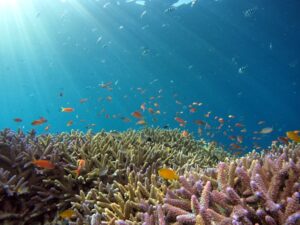
Under the national initiative to protect Sri Lanka’s coastal and marine ecosystems, the exceptional Coral Conservation Centre and Laboratory complex currently being established in Nilaveli, Trincomalee, was formally inspected by the Deputy Minister of Environment, Anton Jayakody, on August 25.
Out of the 245 coral species identified along Sri Lanka’s eastern coastline, the primary focus of this facility is the conservation of highly rare species, including Black Coral and Red Coral. Necessary measures have been taken to conserve and artificially propagate these rare varieties, yielding successful outcomes already.
The core operations of the centre involve artificially replicating natural marine temperatures and environmental conditions within the laboratory to cultivate corals, which are subsequently outplanted onto the seabed. Construction is scheduled for completion by the end of September this year. In the future, this facility will open to university students, researchers, and the general public as a Coral Museum and Research Centre, aiming to expand scientific marine research.
This project demonstrates the practical, on-the-ground execution of the government’s sustainable environmental policy. To safeguard vulnerable marine biodiversity against climate change, ensure the sustainable management of oceanic resources, and preserve natural ecosystems for future generations, several similar conservation initiatives are planned for rollout across the island.
Why coral reefs matter
Coral reefs are much more than attractive underwater landscapes.They provide habitat and feeding grounds for a wide range of marine organisms and support fisheries, tourism and other coastal livelihoods. They also contribute to coastal protection by reducing the energy of waves reaching shorelines.
MEPA describes coral reefs as among the world’s most biodiverse ecosystems and highlights their importance for marine species, fisheries, tourism, recreation and coastal protection.For a country such as Sri Lanka, where large communities depend directly or indirectly on the sea, degradation of coral reefs can have consequences far beyond biodiversity loss.Healthy reefs provide habitat for fish and other organisms, supporting coastal fisheries. They also form part of the natural attractions that draw visitors to destinations such as Trincomalee, Nilaveli and Pigeon Island.
Climate change adds another layer of pressure
The new laboratory comes at a time when coral reefs around the world are facing unprecedented environmental pressure.Rising sea temperatures can cause coral bleaching, a process in which corals expel the microscopic algae living within their tissues. These algae provide much of the coral’s energy and contribute to its colour. When bleaching is prolonged or severe, corals can die.
Ocean warming is not the only threat. Ocean acidification, pollution, destructive fishing practices, sedimentation, coastal development and physical damage can all reduce the ability of reefs to recover from climate-related disturbances.MEPA identifies rising ocean temperatures, coral bleaching, overfishing and human activities among the major pressures affecting coral ecosystems.This makes coral restoration increasingly relevant to climate adaptation.
However, scientists caution that restoration alone cannot compensate for continuing global warming. Coral nurseries and transplantation can help damaged reefs recover, but reducing local pressures such as pollution, destructive fishing and poorly managed coastal development is also essential.
From laboratory to seabed
The proposed conservation process at Nilaveli essentially creates a bridge between controlled laboratory conditions and natural reef ecosystems.Corals can first be maintained and propagated in a controlled environment. Once sufficiently developed, selected colonies or fragments can be transplanted to appropriate reef locations.Such approaches can include coral fragmentation, nursery cultivation, transplantation onto artificial structures and, in some programmes, the collection and rearing of coral larvae.
MEPA identifies several approaches to coral restoration, including in-situ and ex-situ nurseries, fragmentation, microfragmentation, artificial reefs and larval reseeding. It also stresses the importance of assessing restoration sites and monitoring the survival and growth of transplanted corals over time.The success of a restoration programme therefore cannot be measured simply by the number of corals planted.
Researchers need to determine whether transplanted colonies survive, grow and reproduce, whether the restored area attracts associated marine organisms, and whether the reef develops ecological characteristics similar to a functioning natural reef.Long-term monitoring will consequently be critical to determining the effectiveness of the Nilaveli facility.
Eastern Sri Lanka provides an important research setting
Nilaveli is particularly significant because of its proximity to several important coral reef ecosystems.The Ministry of Environment describes Nilaveli as a major eastern coastal destination with clear shallow waters and coral reefs, while Pigeon Island, located offshore, is known for its marine environment and snorkelling opportunities.
Scientific studies have also examined shallow-water coral reefs at locations including Pigeon Island, Adukkuparu, Salli Beach, Kayankerni and Passikudah. Research covering 2020–2022 found variations in coral cover and diversity between sites, reinforcing the need for continued monitoring of eastern Sri Lanka’s reefs.
The proximity of these ecosystems could make Nilaveli an important location for research, field training and restoration activities.The proposed centre is also expected eventually to function as a Coral Museum and Research Centre, opening opportunities for university students, researchers and members of the public to learn about coral ecosystems and participate in marine research and education.That educational component could be particularly valuable in a region where tourism and marine recreation are closely connected to the health of coastal ecosystems.
Conservation must extend beyond the laboratory
Establishing a coral laboratory does not, by itself, guarantee the recovery of Sri Lanka’s reefs.The country’s previous restoration experience demonstrates the importance of combining coral propagation with effective management of the surrounding marine environment.For example, MEPA has identified marine pollution, improper waste disposal, illegal fishing gear and unauthorised tourism as threats to the Kayankerni reef ecosystem. Its conservation programme there involves multiple government agencies, research organisations and local stakeholders.
This integrated approach is important because a transplanted coral colony cannot thrive if the wider reef environment remains heavily polluted or physically disturbed.Restoration therefore needs to be accompanied by measures that address the causes of reef degradation.
These include controlling marine pollution, reducing destructive fishing practices, improving coastal management, protecting important reef habitats, monitoring water quality and strengthening awareness among tourism operators, fishing communities and visitors.
A new opportunity for marine science
The proposed Nilaveli centre could also help address an important gap in Sri Lanka’s marine research capacity.The country’s coral reefs are exposed simultaneously to local pressures and global climate change, yet understanding how individual coral species respond to changing conditions requires sustained scientific observation.A dedicated laboratory could provide opportunities to investigate coral growth, environmental tolerance, propagation techniques and restoration outcomes.
It could also create opportunities for collaboration between universities, government agencies, marine scientists, conservation organisations and local communities.The broader value of the centre may therefore extend beyond the number of corals it produces.If effectively managed, it could become a long-term platform for generating scientific knowledge, training young researchers and developing restoration methods suitable for Sri Lanka’s different reef environments.
Protecting reefs in a warming ocean
Sri Lanka’s coral reefs are facing a future in which climate change is likely to increase the frequency and intensity of environmental stresses.The facility will not stop ocean warming or prevent coral bleaching on its own. But it could provide scientists and conservation authorities with another tool to protect vulnerable species, restore damaged reef areas and understand how Sri Lanka’s coral ecosystems respond to a rapidly changing ocean.The government has indicated that similar conservation initiatives are planned in other parts of the country.
The real measure of the Nilaveli project, however, will ultimately be determined not by the opening of the laboratory, but by what happens afterwards: how many corals survive, whether restored reefs become functioning ecosystems, how effectively local threats are controlled, and whether the knowledge generated there can be applied across Sri Lanka.For an island nation whose economy, food security, tourism and coastal communities are closely connected to the ocean, conserving coral reefs is not simply an exercise in protecting underwater beauty. It is an investment in the resilience of Sri Lanka’s coastal future.
References
https://island.lk/nilaveli-to-get-coral-conservation-Lab,
https://english.news.cn/20260828/938f3efa17184926adeb2ab8b77347b5/c.html
https://onlinelibrary.wiley.com/doi/abs/10.1111/maec.12825?
Banner Image: Representative Image. Photo by Hiroko Yoshii on Unsplash
Sections of this article may have been developed with the assistance of artificial intelligence tools to support research, drafting and language refinement. All information has been reviewed, edited and verified by the author/editor to ensure accuracy, context and editorial integrity. The responsibility for the final content, interpretations and conclusions rests solely with the publisher.