Physical Address
23,24,25 & 26, 2nd Floor, Software Technology Park India, Opp: Garware Stadium,MIDC, Chikalthana, Aurangabad, Maharashtra – 431001 India
Physical Address
23,24,25 & 26, 2nd Floor, Software Technology Park India, Opp: Garware Stadium,MIDC, Chikalthana, Aurangabad, Maharashtra – 431001 India

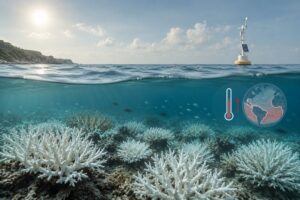
The world’s oceans are facing an increasingly dangerous form of climate stress that often goes unnoticed from the shore. Marine heatwaves are the extended periods when ocean temperatures remain unusually high and are becoming more frequent, more intense and longer-lasting as the planet warms. Though invisible to most people, these underwater heat events can devastate coral reefs, fish populations, seagrass meadows and coastal economies.
Marine heatwaves occur when seawater becomes significantly warmer than the normal temperature for a particular location and season. Scientists generally classify an event as a marine heatwave when ocean temperatures remain above the 90th percentile of historical records for at least five consecutive days. Such events can develop when hot surface water remains trapped above cooler layers, particularly during periods of weak winds. Strong ocean currents can also transport unusually warm water into regions where marine life is not adapted to such temperatures.
A Heatwave Beneath the Waves
The effects of marine heatwaves can be severe because marine species respond differently to sudden and prolonged warming. Fish and other mobile animals may escape to cooler waters, although moving away can disrupt feeding, breeding and migration patterns. Species that remain fixed in one location, such as corals, kelp and many bottom-dwelling organisms, have little opportunity to escape the heat.
Coral reefs are particularly vulnerable. Excessive heat can cause corals to expel the microscopic algae that live within their tissues, producing the familiar phenomenon known as coral bleaching. If stressful conditions persist, bleaching can result in widespread coral mortality. Seagrass and kelp ecosystems can also suffer, while the loss of species lower in the food chain can deprive larger animals of essential food.
The consequences are not confined to marine biodiversity. Fisheries, aquaculture and tourism depend heavily on healthy oceans, meaning extreme ocean temperatures can translate into substantial economic losses for coastal communities. Marine heatwaves can also damage so-called blue-carbon ecosystems, including mangroves and seagrass habitats, which absorb and store carbon while providing important protection for coastlines.
Recent events illustrate the scale of the threat. In Western Australia, a marine heatwave that began in September 2024 lasted several months and was described as the state’s longest, largest and most severe on record. It killed around half of the coral in the North West Shelf region. Meanwhile, during the European summer of 2026, sea-surface temperatures in some areas surged as much as 5°C above average, raising concerns for marine ecosystems in the Mediterranean, North Sea and Baltic Sea.
Marine heatwaves can also occur alongside heatwaves on land, creating compound climate events with potentially greater consequences. A major compound heatwave in Western Australia in 2011 damaged terrestrial ecosystems while simultaneously causing widespread coral bleaching across several marine regions.
Climate Change Turns the Heat Up
Marine heatwaves are not entirely new. They are a natural feature of the climate system and have always occurred under certain conditions. What is changing is the background against which they occur. Human-driven climate change is steadily raising ocean temperatures, meaning that an extreme marine temperature today begins from a warmer baseline than it did decades ago.
This warming makes marine heatwaves more likely, severe and persistent. Climate patterns such as El Niño and La Niña can further influence where extreme ocean temperatures develop. However, scientists point out that climate change has altered the conditions so substantially that major ocean-warming events no longer necessarily require a strong El Niño or La Niña to occur. The challenge is particularly difficult because much of the ocean remains poorly observed. Satellites can track changes at the surface, but significant heat can remain hidden beneath the surface, where it may continue damaging ecosystems without immediately being detected. Better monitoring of subsurface waters is therefore essential.
Scientists are exploring several ways to reduce the ecological damage. Improved ocean modelling and early-warning systems could help fisheries, conservation authorities and coastal communities prepare for approaching heatwaves. Research is also examining whether heat-tolerant marine species could help vulnerable ecosystems withstand rising temperatures.
But these measures can only limit the damage; they cannot remove the underlying cause. The most important long-term response remains reducing greenhouse-gas emissions and slowing the rise in global ocean temperatures. Marine heatwaves demonstrate that climate change is not simply making the air hotter. It is transforming the oceans, often in ways that remain invisible until ecosystems begin to collapse. As these underwater extremes become increasingly common, protecting marine ecosystems will require both better preparation and much faster action to address global warming.
References:
https://www.sciencedirect.com/science/article/pii/S1470160X24005260
https://www.ncei.noaa.gov/news/super-marine-heatwaves-new-term-growing-concern
https://pmc.ncbi.nlm.nih.gov/articles/PMC5893591
https://wmo.int/news/media-centre/strong-el-nino-expected-intensify
Banner Image: AI generated
Sections of this article may have been developed with the assistance of artificial intelligence tools to support research, drafting, and language refinement. All information has been reviewed, edited, and verified by the author/editor to ensure accuracy, context, and editorial integrity. The responsibility for the final content, interpretations, and conclusions rests solely with the publisher.