Physical Address
23,24,25 & 26, 2nd Floor, Software Technology Park India, Opp: Garware Stadium,MIDC, Chikalthana, Aurangabad, Maharashtra – 431001 India
Physical Address
23,24,25 & 26, 2nd Floor, Software Technology Park India, Opp: Garware Stadium,MIDC, Chikalthana, Aurangabad, Maharashtra – 431001 India

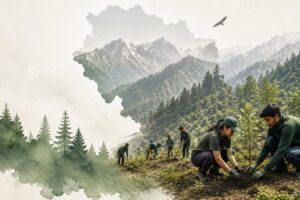
Himachal Pradesh is betting on forests to strengthen its climate resilience, but experts say planting more trees will not be enough. The real challenge is restoring healthy diverse forests, protecting water sources and bringing local communities into conservation.
As climate change intensifies across the Himalayas, Himachal Pradesh has placed forests at the centre of its response. The state government’s Mission-32 aims to increase forest cover from 29.5 percent to 32 per cent by 2030.
The target sounds straightforward, but the challenge is much larger. Scientists and environmental experts say that simply increasing the area covered by trees cannot guarantee climate resilience. The health, diversity and ecological functioning of forests will matter just as much as their extent.
The initiative is being positioned as a wider climate-adaptation and green-growth strategy. It brings together forest conservation, water security, biodiversity, renewable energy, natural farming and rural livelihoods. The approach reflects a growing understanding that climate impacts in the mountains do not remain confined to forests. They affect agriculture, drinking water, infrastructure, livelihoods and disaster risks as well.
The devastating floods, landslides and other extreme events experienced by Himachal Pradesh in 2023 highlighted this vulnerability. Degraded catchments, soil erosion and declining natural ecosystems can amplify the effects of extreme weather, putting roads, irrigation systems, water supplies and rural economies at risk.
Beyond Planting Trees: The Forest Health Question
Mission-32 has three broad objectives: expand tree cover through suitable plantations, improve the ecological condition of existing forests and increase tree cover on private land by involving farmers, panchayats, community institutions and others.
But experts caution that the number of saplings planted cannot be the main measure of success. A forest is much more than a collection of trees. Healthy Himalayan forests regulate water, stabilise slopes, store carbon, support biodiversity and sustain rural livelihoods. A plantation may increase green cover while failing to provide the same range of ecological functions as a mature natural forest.
Research cited in the discussion around Mission-32 has also highlighted this distinction. Indian forests have shown increases in apparent green cover even as indicators such as photosynthetic efficiency, carbon sequestration and water-use efficiency have declined. Satellite images can show how much land is green, but they cannot fully reveal whether native species are regenerating, soils are healthy or ecosystems are becoming more resilient.
This makes species selection critical. Experts argue that plantations should use healthy planting material and native species suited to local ecological conditions wherever appropriate. Natural regeneration should also be encouraged rather than relying exclusively on artificial plantations. Existing forests need equal attention. Himachal Pradesh faces increasing pressures from forest fires, invasive species such as Lantana, pests, diseases and habitat degradation. Rising temperatures and longer dry periods could further increase these threats.
Protecting mature natural forests is particularly important because they contain complex ecological relationships that take decades to develop. Replacing a degraded natural forest with plantations elsewhere may increase overall forest-cover figures without compensating for the loss of biodiversity and ecological functions.
The success of Mission-32 will therefore depend on whether it evolves from a plantation programme into a broader forest-restoration effort.
Communities Could Decide Mission-32’s Success
The other major test is community participation. Forests in Himachal Pradesh are closely connected with rural life. Mountain communities depend on forests for fodder, fuelwood, water, agriculture and other resources. Local residents also possess knowledge of native species, seasonal water sources and patterns of natural regeneration.
The government plans to involve farmers, panchayats, community institutions and private landowners in increasing tree cover. It also proposes promoting medicinal plants and economically valuable species suited to local conditions, linking conservation with income generation. Experts argue that this “life and livelihood” approach could make conservation more durable. Communities are more likely to protect forests when healthy ecosystems provide direct and sustainable economic benefits.
Panchayats, village institutions and women’s self-help groups could also have a greater role in monitoring plantations and protecting local forests. Such participation can help ensure that conservation does not remain limited to periodic plantation drives. Mission-32 also presents a potential opportunity for carbon finance. Well-managed forests can absorb and store carbon, creating possible economic benefits through climate-finance mechanisms. However, experts caution that carbon should remain a co-benefit rather than the main objective. Carbon storage has little meaning if forests are unhealthy, biodiversity is declining or plantations fail to survive.
That makes monitoring crucial. The state will need to measure more than the number of saplings planted or the percentage of forest cover achieved. Indicators such as tree survival, species diversity, natural regeneration, forest health, watershed condition and community participation will provide a better picture of the programme’s impact.
For Himachal Pradesh, Mission-32 is therefore a test of whether forest policy can keep pace with a rapidly changing climate. The target of 32 percent forest cover may be achieved on paper, but the real success will be measured in healthier forests, protected water sources, stronger biodiversity and communities that can continue to depend on resilient Himalayan ecosystems.
If implemented with scientific planning, protection of natural forests and meaningful community participation, Mission-32 could become a model for climate adaptation across the Indian Himalayan region. If it remains focused primarily on plantation numbers, however, it may increase green-cover statistics without delivering the ecological resilience the Himalayas urgently need.
References:
Banner Image: AI Generated
Sections of this article may have been developed with the assistance of artificial intelligence tools to support research, drafting, and language refinement. All information has been reviewed, edited, and verified by the author/editor to ensure accuracy, context, and editorial integrity. The responsibility for the final content, interpretations, and conclusions rests solely with the publisher.