Physical Address
23,24,25 & 26, 2nd Floor, Software Technology Park India, Opp: Garware Stadium,MIDC, Chikalthana, Aurangabad, Maharashtra – 431001 India
Physical Address
23,24,25 & 26, 2nd Floor, Software Technology Park India, Opp: Garware Stadium,MIDC, Chikalthana, Aurangabad, Maharashtra – 431001 India
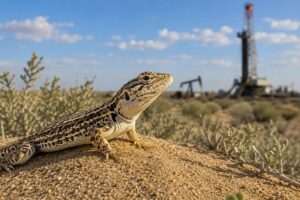
A tiny reptile found in the sandy landscapes of West Texas and southeastern New Mexico has once again become the center of a major political and environmental debate in the United States. The dunes sagebrush lizard, measuring barely three inches long, may be small in size, but the legal fight surrounding its future reflects a much larger conflict between wildlife conservation and economic development.
In a recent decision, a federal judge approved an agreement that temporarily removes the lizard’s protections under the U.S. Endangered Species Act (ESA), requiring the U.S. Fish and Wildlife Service (USFWS) to reassess whether the species should remain listed as endangered. The move has reignited discussions over the role of science in environmental policymaking, particularly in regions where biodiversity and fossil fuel production overlap.
Why the Dunes Sagebrush Lizard Matters
The Dunes Sagebrush Lizard inhabits a highly specialized ecosystem of sand dunes and shinnery oak shrubs in the Permian Basin, one of the world’s most productive oil and gas regions. Its survival depends on this fragile habitat, making the species especially vulnerable to land-use changes caused by energy extraction, road construction, and sand mining.
After decades of scientific assessment and legal challenges, the USFWS classified the species as endangered in 2024. At the time, the agency concluded that habitat loss had become severe enough to threaten the lizard’s long-term survival. The listing meant that activities affecting its habitat would require greater scrutiny under federal law.
However, Texas officials and industry groups strongly opposed the decision, arguing that it would unnecessarily restrict oil and gas operations in the Permian Basin, a region responsible for a significant share of U.S. crude oil and natural gas production. They maintained that voluntary conservation efforts by landowners and energy companies were already helping protect the species without imposing federal restrictions.
The Trump administration later supported this position, stating that the original endangered listing may have relied on an incomplete assessment of habitat restoration possibilities. As part of a legal settlement, the federal government agreed to withdraw the protections while conducting a fresh scientific review over the next two years.
Conservation Versus Development
The court-approved agreement has drawn sharply divided reactions.
Supporters of the decision, including Texas officials and representatives of the oil and gas industry, see it as a victory for balanced conservation. They argue that collaborative habitat restoration programmes involving landowners, state agencies and companies can effectively protect wildlife while allowing energy production to continue. Industry groups also contend that the original endangered listing underestimated the impact of ongoing conservation initiatives across the region.
Environmental organisations, however, view the decision as a setback for science-based conservation. They argue that removing protections before completing a new scientific assessment exposes the lizard to additional habitat destruction during a critical period. Conservation groups have also questioned the legal process, saying the settlement bypassed normal public participation and judicial scrutiny that typically accompany major environmental decisions.
Beyond the fate of one reptile, the case reflects a broader shift in U.S. environmental policy. It highlights ongoing efforts to reconsider several wildlife protections introduced in recent years, particularly where they intersect with energy production and infrastructure development. Critics fear such decisions could weaken the effectiveness of the Endangered Species Act, while supporters argue they provide greater flexibility for economic growth and local conservation initiatives.
The USFWS is expected to complete a new assessment of the dunes sagebrush lizard within the next 24 months. That review will determine whether the species should once again receive federal protection as endangered or threatened, or whether current conservation measures are sufficient without ESA safeguards.
For now, the future of the tiny desert reptile remains uncertain. Yet its story illustrates how conservation decisions often extend far beyond biology. They involve questions of energy security, economic priorities, land management and the role of scientific evidence in public policy. As governments seek to balance environmental protection with development goals, cases like that of the dunes sagebrush lizard are likely to shape future debates on how natural resources and biodiversity can coexist in an increasingly industrialized landscape.
References:
https://www.nytimes.com/2026/07/22/climate/dunes-sagebrush-lizard-trump.html
https://www.fws.gov/species/dunes-sagebrush-lizard-sceloporus-arenicolus
Banner Image: AI generated
Sections of this article may have been developed with the assistance of artificial intelligence tools to support research, drafting, and language refinement. All information has been reviewed, edited, and verified by the author/editor to ensure accuracy, context, and editorial integrity. The responsibility for the final content, interpretations, and conclusions rests solely with the publisher.