Physical Address
23,24,25 & 26, 2nd Floor, Software Technology Park India, Opp: Garware Stadium,MIDC, Chikalthana, Aurangabad, Maharashtra – 431001 India
Physical Address
23,24,25 & 26, 2nd Floor, Software Technology Park India, Opp: Garware Stadium,MIDC, Chikalthana, Aurangabad, Maharashtra – 431001 India

85% will pay more for eco-friendly products, but only 1 in 6 always checks the label and 59% felt misled. See what the CFC greenwashing survey found.
A leaf on the label. A shade of green on the bottle. The word “natural” in a soft, curly font. On a store shelf, sustainability is sold in a glance, and a new survey by Climate Fact Checks suggests shoppers are paying for that glance with very little to go on.
Our survey, Eco-friendly or Fake?, found that 85% of respondents are willing to pay more for a product that is genuinely eco-friendly. Yet only 17% always look for an official eco-certification symbol, and more than one in four admit they do not know what most of those symbols mean. The result is a market that runs largely on goodwill: 59% say they have felt misled after buying a “green” product, and nearly three in four have opened an item sold as “eco-friendly”, “organic” or “natural” only to find heavy plastic packaging inside.
The timing is significant. India’s Central Consumer Protection Authority (CCPA) has had guidelines against greenwashing in force since October 2024, and from September 27, 2026, generic claims such as “eco-friendly” or “green” made without proof become banned commercial practices across the European Union. Our respondents are clear about where they stand: nearly nine in ten want strict financial penalties for brands that make unverified green claims.
Why We Surveyed
Greenwashing, which the United Nations describes as misleading the public into believing a company is doing more for the environment than it really is, is usually discussed as a corporate or regulatory problem. We wanted to see it from the aisle: what shoppers weigh first, how much extra they will pay for a greener option, whether they can tell a certified claim from a marketing one, and what happens once the product is opened at home.
The three-minute online survey ran from August 25 to September 24, 2026, and drew responses from across India along with Colombo and Negombo in Sri Lanka. Most respondents were aged 26-35 (44%) or 36-50 (38%). It builds on earlier CFC reader surveys on e-waste and urban water security, and on our explainer on how to spot greenwashing.
What We Found
1. The 10% Ceiling on Going Green
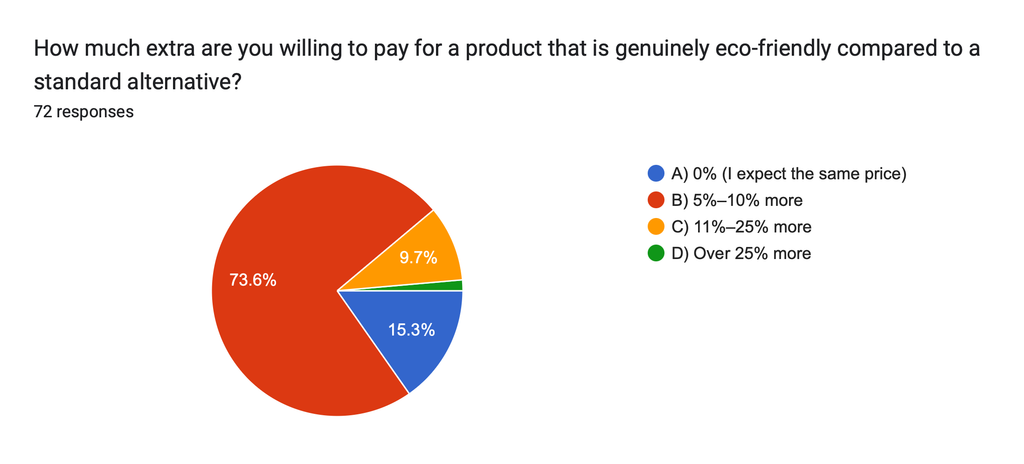
Willingness to pay is real, but narrow. 73% of respondents would pay 5-10% more for a genuinely eco-friendly product. Only 11% would go beyond 10%, and just one respondent would pay more than 25% extra. Another 15.5% expect green products to cost the same as conventional ones.
The same ceiling appeared when we placed two identical products side by side. 56% chose plastic-free packaging at a 10% higher price, 30% picked a refill or bring-your-own-container option at the normal price, and 14% stayed with plastic packaging at the normal price.
This closely mirrors global data. PwC’s 2024 Voice of the Consumer survey, covering more than 20,000 people in 31 countries and territories, found consumers willing to spend an average of 9.7% more on sustainably produced or sourced goods, while cautioning that cost-of-living pressures may keep that intent from turning into actual spending. The green premium shoppers will accept appears to stop at roughly a tenth of the price.
2. Paying More, Trusting Less
Willingness to pay does not mean trust. When a store charges significantly more for a “green” or “organic” product, only 20% believe the higher price reflects genuine sustainable production. 38% assume the brand is marking up prices to profit from eco-conscious buyers, and 42% say it depends on the brand’s reputation.
The suspicion extends to those ready to spend. About 35% of respondents willing to pay a premium also believe steep green prices are mostly profiteering. For brands, that is a warning sign: the customer holding the greener product at the counter may already doubt the price tag.
3. The Label Literacy Gap
Official eco-labels are meant to answer the question “is this claim real?” at the shelf. Most shoppers are not using them that way.
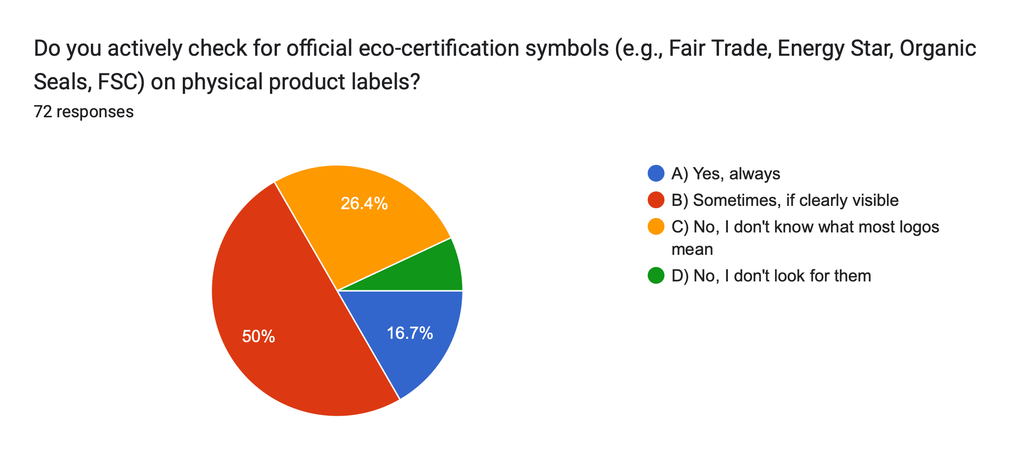
Only 17% always check for certification symbols, while 49% check only if the symbol happens to be clearly visible. 27% say they do not know what most logos mean, and 7% do not look for them at all. Among the 60 respondents willing to pay extra, only one in six always checks, which means most of the green premium is being paid on faith. The gap was widest among the youngest respondents: five of the nine aged 18-25 said they do not understand most logos, though the group is too small for firm conclusions.
India does have a government eco-label. The Ecomark Rules, 2024, notified in September 2024 to replace a scheme dating back to 1991, aim to ensure accurate labelling and prevent misleading information. The scheme is implemented by the Central Pollution Control Board with the Bureau of Indian Standards. Our findings suggest the harder task is making sure shoppers recognise and understand such labels.
There is appetite for easier verification. 22.5% would definitely use an in-store scanner or phone app to check a product’s eco-credentials before paying, and another 59% would do so if they suspected the claims were fake. Only 18% said they were unlikely to bother.
4. Misled After the Checkout
59% of respondents have felt misled after buying a “green” product that performed poorly or lacked real environmental value. A further 15.5% said they have never paid attention to eco-claims, so among shoppers who do notice such claims, seven in ten have been let down at least once. Respondents under 35 reported feeling misled more often (62.5%) than those aged 36 and above (55%).
Packaging is where the contradiction is easiest to see. 73% have bought an item marked “Eco-Friendly,” “Organic” or “Natural” and found heavy, excessive plastic packaging inside: 22.5% frequently and 51% occasionally. Only 13% said this has never happened to them. As CFC has reported earlier, products marketed as “eco-friendly” or “biodegradable” may be uncertified or offer only marginal benefits, which erodes the very trust green products depend on.
5. What Keeps Green Products Out of the Cart
Asked why they do not buy eco-friendly products more often, 48% pointed to limited availability on store shelves, ahead of lack of trust in eco-claims (27%) and the green price markup (24%). Only one respondent doubted the quality of such products.
A similar story emerges on single-use plastics. 41% say inconvenience and a lack of easy alternatives are their main barrier to cutting out plastic bags, bottles and wrappers, while 24% cite habit and 22.5% the higher cost of plastic-free products. About 13% say they have already eliminated single-use plastics from their routine.
Sustainability is also rarely the first filter. 58% weigh quality and brand first, 18% price and discounts, and 11% need and convenience; only 13% put eco-friendliness and packaging first. Personal care and cosmetics is where most respondents (77.5%) actively look for greener versions, followed by clothing (46.5%), food and groceries (46.5%) and cleaning supplies (45%).
6. A Clear Mandate for Enforcement
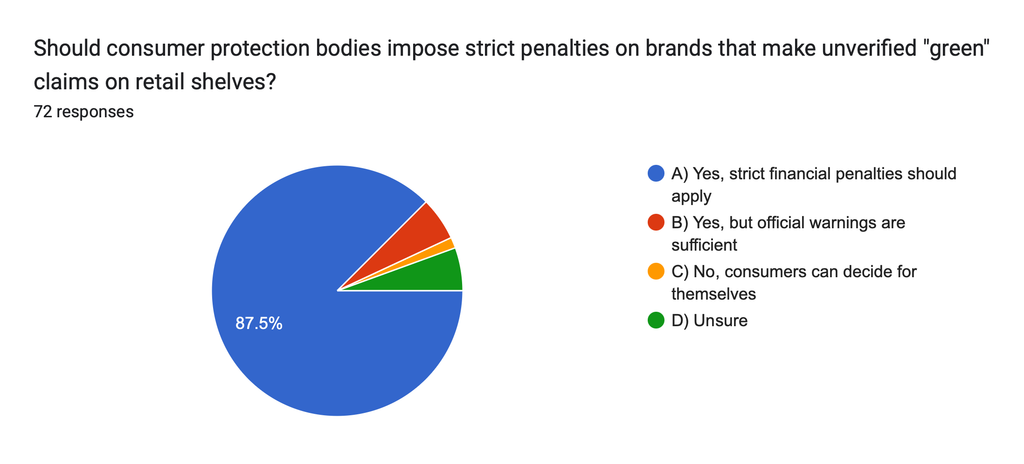
On one question, respondents were close to unanimous. 88.7% say consumer protection bodies should impose strict financial penalties on brands that make unverified green claims on retail shelves. Another 5.6% would settle for official warnings and 5.6% were unsure. Not a single respondent chose “consumers can decide for themselves.” Among those who had felt misled, support for strict penalties rose to 90.5%.
In Their Own Words
When we asked what one change brands or stores could make to help them shop more sustainably, respondents from Bengaluru to Guwahati returned to the same themes: price, packaging, proof and circularity.
On the cost of going green, Rajshree Sharma from Bengaluru called the premium a burden on everyday buyers:
“[It’s] heavy on [the] customer to pay [a] premium, or what we can call a green tax. Eco-friendly items often carry a premium price tag that turns away everyday shoppers. Brands should subsidize sustainable lines using profits from conventional ones.”
Rajshree Sharma, Bengaluru
From Sri Lanka, Uvindi Jayathilake in Negombo questioned who green products are really made for:
“It should be accessible to the general public in order to make proper changes. It cannot cater to the high end market. Green products and slow living [are] marketed as a premium lifestyle now.”
Uvindi Jayathilake, Negombo, Sri Lanka
In Jaipur, Radhika pointed to the smallest and most ubiquitous culprit:
“Shampoo sachet[s] in plastic packaging are of single use and end up in landfills or water bodies. Brands should eliminate plastic packaging heavy products.”
Radhika, Jaipur
Several respondents asked for proof, not adjectives. Aditya Bhale from Maharashtra proposed borrowing from food labelling:
“Put a standardized ‘sustainability facts’ score directly on every price tag, just like nutrition labels on food.”
Aditya Bhale, Maharashtra
“Brands should clearly disclose whether a product is genuinely organic, including proper certification and sourcing details, instead of using ‘organic’ only as a marketing claim.”
Priyanka Borah, Assam
Others wanted retailers to close the loop. Shweta Babanagare from Maharashtra suggested:
“I would like cosmetic and toiletries brand[s] to have [a] program to ship them the empties in exchange for [a] minor discount… so that the bottles are reused effectively.”
Shweta Babanagare, Maharashtra
And from Colombo, Sha offered a three-part plan: take back packaging and bottles, offer a repair option where relevant, and create a resale or second-hand space for old stock.
What the Rules Already Say
India is not starting from scratch. The CCPA’s Guidelines for Prevention and Regulation of Greenwashing or Misleading Environmental Claims, 2024, issued under the Consumer Protection Act, 2019, require specific claims such as “compostable”, “plastic-free”, “recyclable” or “net-zero” to be backed by credible certification, reliable scientific evidence or independent third-party verification. Vague terms like “natural”, “organic”, “pure” or “eco-friendly” cannot be used without substantiation. Under the Act, the CCPA can impose a penalty of up to Rs 10 lakh on a manufacturer or endorser for a false or misleading advertisement, rising to Rs 50 lakh for subsequent offences.
The European Union is going further. From September 27, 2026, generic environmental claims made without proof and self-certified sustainability labels become prohibited practices across member states, with the European Commission clarifying that the rules apply to existing products already on shelves. The shift followed a 2020 Commission study which found that 53.3% of the environmental claims it examined were vague, misleading or unfounded, and 40% were unsubstantiated.
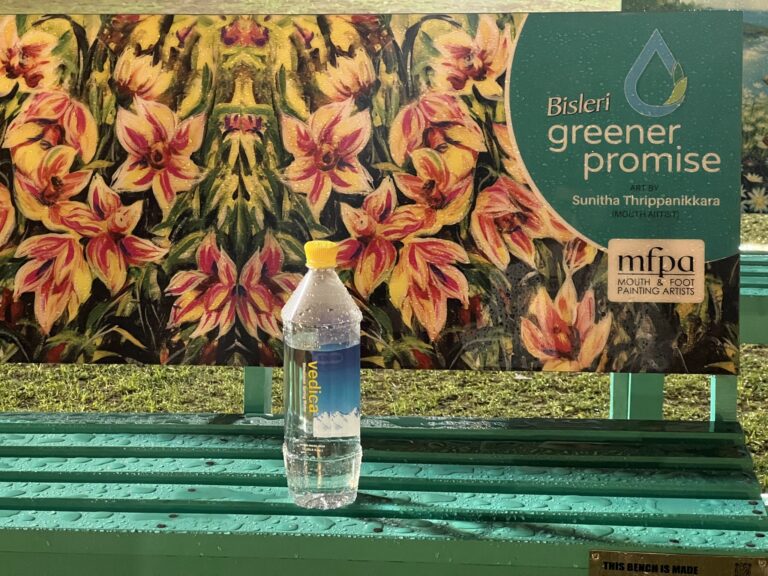
What our respondents describe, from plastic-wrapped “natural” products to labels they cannot decode, suggests India’s gap is less about the absence of rules than about visibility and enforcement at the point of sale. CFC’s own fact-check of a bottled water brand’s “greener” campaign found similar difficulties for consumers trying to verify claims such as plastic neutrality, for which there is no government-certified standard.
What Could Help: A Shopper-First Fix
Before You Pay the Green Premium: A Quick Checklist
Conclusion: Trust Is the Real Price Tag
Shoppers in this survey are not indifferent to the planet. Most will pay a little more, most want less plastic, and almost all want brands punished for faking it. What they lack is a reliable way to tell the genuine from the cosmetic at the moment of purchase. Until labels become readable, packaging matches the promise and enforcement becomes visible, the green premium will keep being paid on faith, and too often, as 59% of our respondents discovered, that faith will be misplaced.
About This Survey
The “Eco-friendly or Fake?” survey was conducted online through Google Forms and circulated through Climate Fact Checks’ networks between August 25 and September 24, 2026. It received 72 submissions; one duplicate submission was removed, leaving 71 unique responses from India and Sri Lanka. Respondents were self-selected, so the results reflect the views of those who took part and are not statistically representative of all consumers. Percentages are rounded. Quotes are lightly edited for spelling and grammar, with changes shown in brackets.
References
PRS Legislative Research, “The Consumer Protection Bill, 2019” summary
Kar Parivartan, “Ecomark Rules, 2024: India’s Eco-Label Explained” (July 2026)
United Nations, “Greenwashing: the deceptive tactics behind environmental claims”
Climate Fact Checks, “Fact Check: Is Bisleri’s ‘Greener Promise’ Just Greenwashing?” (July 2025)
Banner image: AI Generated
Sections of this article may have been developed with the assistance of artificial intelligence tools to support research, drafting, and language refinement. All information has been reviewed, edited, and verified by the author/editor to ensure accuracy, context, and editorial integrity. The responsibility for the final content, interpretations, and conclusions rests solely with the publisher.