Physical Address
23,24,25 & 26, 2nd Floor, Software Technology Park India, Opp: Garware Stadium,MIDC, Chikalthana, Aurangabad, Maharashtra – 431001 India
Physical Address
23,24,25 & 26, 2nd Floor, Software Technology Park India, Opp: Garware Stadium,MIDC, Chikalthana, Aurangabad, Maharashtra – 431001 India


In July 2026, a reader in India can scroll past two headlines within minutes of each other. One announces a below-normal monsoon and a dry, difficult season ahead. The other shows submerged villages, families wading through chest-deep water, and a railway bridge buckling into a swollen river. The two seem to cancel each other out. They do not. Both are accurate, and understanding why is the key to reading an Indian monsoon forecast correctly.
What the forecast says
The India Meteorological Department (IMD) has placed the 2026 southwest monsoon at 90 percent of the Long Period Average (LPA), with a model error of about 4 percent, which sits in the “below normal” category. Its outlook for July, one of the season’s most important months, expects rainfall to stay under 94 percent of the July average of 280.4 millimetres, with both daytime and night-time temperatures running above normal across most of the country. A weak El Niño may strengthen through the season, while the Indian Ocean Dipole is expected to remain neutral.
What’s actually happening on the ground
Against that backdrop, the first major flood wave of the 2026 monsoon has already struck the northeast. More than 22,000 people across six districts of Assam and Arunachal Pradesh, including Dhemaji, Lakhimpur and Dibrugarh, have been affected, with close to 100 villages and over 1,600 hectares of farmland under water.
In Dhemaji, riverbank erosion partially collapsed a railway bridge over the Simen river, cutting off several villages. Meghalaya has seen landslides, North Sikkim lost a bridge over the Phee Khola, and Nagaland has issued flash-flood warnings. A monsoon forecast to be weak has, in one corner of the country, already turned deadly.
Averages hide geography
The first thing a seasonal figure conceals is space. A single national percentage is stretched across a subcontinent, and it says nothing about how rain is shared between regions. The IMD’s own spatial forecast makes this explicit: below-normal rain is expected over most of India, but normal to above-normal rain is likely over parts of the northwest, the northeast, eastern peninsular India and adjoining east-central areas. A dry national aggregate can, and routinely does, contain very wet pockets. The northeast is one of them this year.
Averages hide timing
The second thing a seasonal figure conceals is time. Even where the total is modest, rainfall increasingly arrives in short, violent bursts rather than steady, absorbable spells. Analysis compiled by the Centre for Energy, Environment and Development (CEED) finds that nearly half of India’s seasonal rain now falls within just 20 to 30 hours, that extreme rainfall events above 150 millimetres a day rose by about 75 percent in central India between 1950 and 2015, and that monsoon dry spells lengthened by 27 percent over recent decades [4]. A river basin can flood catastrophically on a single day of cloudburst-grade rain and still end the season labelled “below normal.”
A warming atmosphere widens the gap
This pattern of less total rain but more dangerous rain is the fingerprint of a warming climate. Warmer air holds more moisture, roughly 7 percent more for every additional degree Celsius, which tilts the odds toward intense downpours separated by longer dry gaps. A team at the Indian Institute of Tropical Meteorology (IITM) led by climate scientist Roxy Mathew Koll has documented that widespread extreme rain events over central India have tripled since 1950, even as the average summer monsoon rainfall has fallen. The trend is measurable year to year: an assessment by CSE and Down To Earth found that India recorded extreme weather on every one of the 122 monsoon days in 2025.
Why the northeast is hit hardest
The northeast carries a double burden. Long-term studies of extreme point rainfall single out peninsular, east and northeast India for rising frequency and intensity. Layered on top of that climatic trend is the region’s geography. The Brahmaputra basin drains steep, young mountains with a heavy sediment load, and its floodplains are densely settled. Water that falls fast on the hills of Arunachal Pradesh reaches the plains of Assam with little to slow it, which is why a regionally wet pocket inside a nationally dry season tends to land here first and hardest.
Reading the forecast, not the headline
The distance between a reassuring headline and a devastating reality is exactly where confusion, and sometimes deliberate misinformation, takes root. “If the monsoon is weak, why are there floods?” is a fair question, and it has a clear answer. A seasonal average describes a total, not a distribution; neither the calendar nor the map spreads rain evenly. A below-normal season can still deliver record single-day downpours to a vulnerable basin. Reading a monsoon forecast well means looking past the one big number to the two questions that actually decide risk on the ground: where is the rain expected to fall, and how fast.
References
https://www.pib.gov.in/PressReleasePage.aspx?PRID=2266479®=3&lang=1
https://www.thenewsminute.com/amp/story/news/floods-and-landslides-batter-northeast-india
From Floods to Drought – The 2025 Climate Story of India
A threefold rise in widespread extreme rains over India
https://pmc.ncbi.nlm.nih.gov/articles/PMC9937866
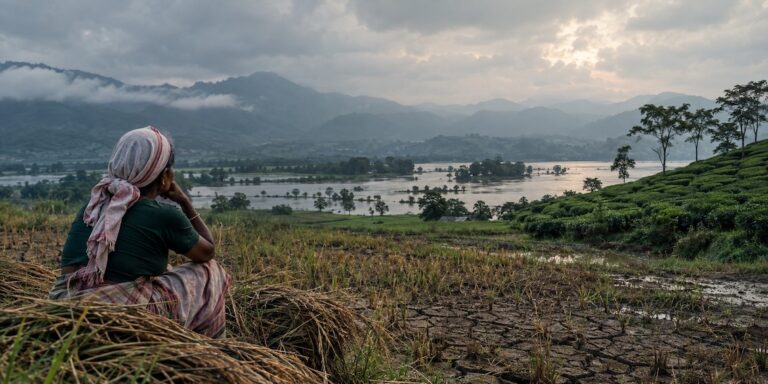
Banner Image: AI Generated
Sections of this article may have been developed with the assistance of artificial intelligence tools to support research, drafting and language refinement. All information has been reviewed, edited and verified by the author/editor to ensure accuracy, context and editorial integrity. The responsibility for the final content, interpretations and conclusions rests solely with the publisher.