Physical Address
23,24,25 & 26, 2nd Floor, Software Technology Park India, Opp: Garware Stadium,MIDC, Chikalthana, Aurangabad, Maharashtra – 431001 India
Physical Address
23,24,25 & 26, 2nd Floor, Software Technology Park India, Opp: Garware Stadium,MIDC, Chikalthana, Aurangabad, Maharashtra – 431001 India

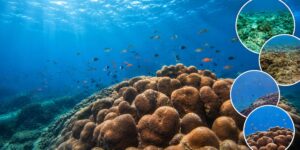
Hidden beneath the turquoise waters of Lakshadweep lies a marine wonder that may redefine our understanding of coral resilience and longevity. Scientists have recently documented a massive coral formation near Kadmat Island, locally known as the “Potato Patch”, which could be one of the largest living coral colonies ever recorded anywhere in the world. Beyond its impressive size, the discovery offers a rare glimpse into the remarkable ability of coral ecosystems to survive centuries of environmental change.
The giant colony belongs to “Pavona clavus”, a reef-building coral species commonly called potato coral because of its rounded, mound-like appearance. Stretching across an estimated 4,250 square metres which is roughly half the size of an international football field, the colony stands as a testament to the hidden richness of India’s marine biodiversity.
Researchers conducting a biodiversity survey around Kadmat Island were astonished by the scale of the formation. The coral extends along the reef from shallow waters to depths of nearly 20 metres, creating a vast underwater landscape that reportedly takes more than an hour to traverse completely. Such dimensions place it among the largest known living coral colonies documented globally.
A Survivor Across Centuries
What makes the discovery even more extraordinary is the colony’s estimated age. Based on preliminary growth assessments, scientists believe the coral may be between 700 and 1,800 years old. If future scientific dating confirms these estimates, the colony would have begun growing long before the modern era, quietly witnessing centuries of climatic shifts, oceanic changes and natural disturbances.
Large and ancient coral colonies are often described as natural archives. Like tree rings on land, corals preserve valuable information about historical ocean conditions within their skeletal structures. Researchers hope that studying the Lakshadweep colony will provide insights into past marine environments, helping scientists better understand long-term climate patterns and ecosystem responses.
The colony has another remarkable story to tell, its survival. Over the past few decades, coral reefs around the world have faced unprecedented pressure from rising sea temperatures, marine heatwaves, coral bleaching and increasingly frequent extreme weather events. Lakshadweep itself has experienced severe bleaching episodes linked to major El Niño events and tropical cyclones.
Yet despite these challenges, surveys found that nearly 58 per cent of the coral tissue remains alive, indicating a relatively healthy condition. The formation has persisted through multiple environmental disturbances that have damaged many surrounding reef systems, making it a valuable example of ecological resilience.
Why This Discovery Matters
Coral reefs are often called the “rainforests of the sea” because of the immense biodiversity they support. Although they occupy only a small fraction of the ocean floor, they provide habitat, food and breeding grounds for countless marine species. The newly documented coral colony continues to support diverse fish populations, highlighting its importance within the Lakshadweep reef ecosystem.
For island communities, healthy coral reefs are far more than ecological treasures. They serve as natural barriers against waves and coastal erosion, support fisheries that sustain livelihoods, attract tourism and contribute to carbon sequestration. In fragile island environments such as Lakshadweep, the health of coral reefs is closely linked to the well-being of both people and nature.
The discovery also comes at a time when coral ecosystems worldwide are facing increasing uncertainty. Scientists warn that prolonged marine heatwaves and repeated bleaching events are pushing many reefs towards ecological tipping points. Against this backdrop, the survival of such a large and long-lived coral colony offers a rare source of optimism.
Researchers believe the “Potato Patch” could become an important site for long-term scientific monitoring. Understanding why this colony has endured while many others have declined may help identify traits that enable corals to withstand environmental stress. Such knowledge could prove crucial for future conservation and restoration efforts across the Indian Ocean and beyond.
The finding reinforces Lakshadweep’s significance as one of India’s most valuable marine biodiversity hotspots. It also highlights how much remains undiscovered beneath the ocean’s surface. While local divers have known about the site for decades, its scientific documentation has now brought global attention to a natural wonder that has quietly thrived beneath the waves for centuries.
As climate change continues to challenge marine ecosystems worldwide, Lakshadweep’s giant coral colony stands as both a scientific treasure and a symbol of hope: a reminder that nature’s resilience, when protected, can endure far longer than we imagine.
References:
https://www.frontiersin.org/journals/marine-science/articles/10.3389/fmars.2025.1592429/full
https://oceanservice.noaa.gov/education/tutorial_corals/coral07_importance.html
https://www.academia.edu/19593718/Handbook_on_Hard_Corals_of_India
Banner Image: AI Generated
Sections of this article may have been developed with the assistance of artificial intelligence tools to support research, drafting and language refinement. All information has been reviewed, edited and verified by the author/editor to ensure accuracy, context and editorial integrity. The responsibility for the final content, interpretations and conclusions rests solely with the publisher.