Physical Address
23,24,25 & 26, 2nd Floor, Software Technology Park India, Opp: Garware Stadium,MIDC, Chikalthana, Aurangabad, Maharashtra – 431001 India
Physical Address
23,24,25 & 26, 2nd Floor, Software Technology Park India, Opp: Garware Stadium,MIDC, Chikalthana, Aurangabad, Maharashtra – 431001 India

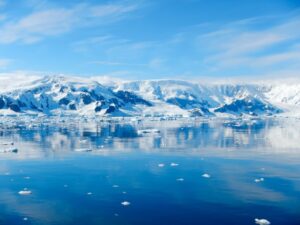
A study published in Nature Geoscience has uncovered evidence that the Antarctic Ice Sheet became dramatically more sensitive to falling carbon dioxide levels during a major climate transition nearly one million years ago, a finding scientists say could reshape understanding of future sea level rise in a warming world.
Using advanced climate and ice sheet simulations spanning the past three million years, researchers identified what they describe as a “nonlinear regime shift” in the Antarctic Ice Sheet during the Mid-Pleistocene Transition, a period between roughly 1.2 million and 700,000 years ago when Earth’s glacial cycles underwent major changes. The study suggests that once atmospheric carbon dioxide concentrations dropped below about 240 parts per million, the Antarctic Ice Sheet began responding more strongly to climate shifts. Scientists warn that the discovery of such threshold-like behaviour in Earth’s past climate system raises new concerns about how Antarctica may react to modern greenhouse gas driven warming.
“Ice sheet model simulations show that continued warming due to rising greenhouse gas concentrations could lead to a rapid decline of the Antarctic Ice Sheet volume,” the researchers wrote in the study.
Scientists have long known that Antarctica plays a critical role in regulating global sea levels. The continent contains enough ice to raise sea levels by several metres if large sections melt. However, understanding precisely how sensitive the ice sheet is to atmospheric carbon dioxide and temperature changes has remained a major challenge. One obstacle has been the lack of continuous climate records capable of driving long-term simulations. By combining paleoclimate reconstructions with advanced modelling, the new study sought to overcome those limitations. The Mid-Pleistocene Transition has intrigued climate scientists for decades. Before this transition, Earth’s glacial cycles generally followed a 41,000-year rhythm linked to changes in the planet’s tilt. Afterward, ice ages became longer and more intense, shifting toward cycles lasting around 100,000 years.
The new simulations indicate that Antarctica itself may have played a more active role in this transformation than previously understood.
According to the study, several interconnected factors contributed to the Antarctic Ice Sheet’s increased sensitivity. These included colder Antarctic temperatures, lower sea levels, bedrock dynamics beneath the ice, and changes in the balance between snowfall accumulation and ice loss. The researchers found that these processes helped accelerate Antarctic ice growth during colder glacial periods after the Mid-Pleistocene Transition.
Importantly, the study points to the possibility that ice sheets may not respond gradually to climate forcing. Instead, they may cross critical thresholds that trigger much larger and faster changes. Such nonlinear responses are particularly concerning for projections of future sea level rise because they are difficult to predict and may unfold rapidly once tipping points are crossed. The findings also add to a growing body of evidence suggesting Antarctica’s ice systems are highly vulnerable to changing climate conditions. Previous research has already shown that warming oceans can destabilize ice shelves, while rising temperatures can increase melting and weaken ice sheet stability.
Although the new study focused on ancient climate changes rather than present-day warming, scientists say Earth’s climate history offers valuable clues about how ice sheets behave under different atmospheric conditions. The researchers emphasized that their findings carry implications for future climate modelling and global sea level projections.
“Our discovery of past threshold behaviour in the Antarctic Ice Sheet highlights the potential for nonlinear responses of the ice sheet to future climate forcing and their implication for global sea-level change,” the study stated.
The study arrives as global temperatures continue to rise due to human-driven greenhouse gas emissions. Atmospheric carbon dioxide concentrations today exceed 420 parts per million, far above the levels examined during the Mid-Pleistocene Transition. Modern Antarctica is already experiencing measurable ice loss in several regions, particularly in West Antarctica, according to satellite observations and previous research. The new study adds to growing evidence that Antarctic ice sheets can respond nonlinearly to climate forcing, meaning changes may accelerate once certain thresholds are crossed. The new findings highlight the importance of improving ice sheet modelling in climate forecasts. Many uncertainties remain regarding how quickly Antarctic ice loss could accelerate and how different parts of the ice sheet may interact with the atmosphere and oceans.
The study’s authors argue that examining past climate transitions can help scientists better understand the thresholds and feedback mechanisms that govern ice sheet stability. As policymakers worldwide debate emissions reductions and adaptation strategies, the research serves as another reminder that Earth’s climate system may respond in abrupt and unexpected ways once critical limits are crossed. For coastal communities already facing rising seas, storms and erosion, understanding those risks is becoming increasingly urgent.
References:
https://www.nature.com/articles/s41561-026-01979-2
Banner Image: Photo by Torsten Dederichs on Unsplash
Sections of this article may have been developed with the assistance of artificial intelligence tools to support research, drafting and language refinement. All information has been reviewed, edited and verified by the author/editor to ensure accuracy, context and editorial integrity. The responsibility for the final content, interpretations and conclusions rests solely with the publisher.