Physical Address
23,24,25 & 26, 2nd Floor, Software Technology Park India, Opp: Garware Stadium,MIDC, Chikalthana, Aurangabad, Maharashtra – 431001 India
Physical Address
23,24,25 & 26, 2nd Floor, Software Technology Park India, Opp: Garware Stadium,MIDC, Chikalthana, Aurangabad, Maharashtra – 431001 India

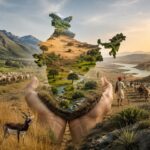
A new global report by UNESCO offers a rare glimmer of cautious optimism in an age of climate anxiety, biodiversity collapse and growing estrangement from nature. Some of the world’s most protected and culturally important landscapes are not just surviving – but thriving, according to a new report, People and Nature in UNESCO-designated Sites.
There are more than 2,260 of these sites, ranging from World Heritage Sites to Biosphere Reserves and Global Geoparks, in 175 countries, covering over 13 million square kilometres, one of the biggest coordinated conservation networks on Earth designated by UNESCO. But these landscapes show something more complex and powerful than traditional conservation models that divide nature from people: the possibility of coexistence.
A Global Lifeline for People and Planet
More than 10% of the world’s population is living in or near these sites, ~900 million people . These are not empty wilderness zones, but living landscapes where livelihoods, cultures and ecosystems intersect. From the pastoralists crossing the Sahara to the fisherfolk communities of Lake Malawi, human survival here is intimately linked to the health of the ecosystem.
The report says that taken together, these areas absorb about 700 million tonnes of carbon dioxide every year – roughly the same as Germany’s fossil fuel emissions . That makes them vital, nature-based climate solutions in a warming world. More striking still, while global wildlife populations have dropped 73% since 1970 species within UNESCO-designated sites have been on average relatively stable.
This contrast is no accident. It is the result of decades of integrated management approaches that combine conservation and sustainable development, based on scientific research and local knowledge systems.
Three Designations, One Vision
What makes this global network so powerful is its diversity. There are three complementary designations through which UNESCO works, each addressing a different aspect of the relationship between humans and nature.
World Heritage Sites are locations of ‘Outstanding Universal Value’ designated under the 1972 Convention. From ancient cities to pristine ecosystems, they include iconic landscapes and cultural landmarks that are considered to be part of all of humanity.
“Learning laboratories” for sustainable development are the Biosphere Reserves, launched in 1971 under the Man and the Biosphere Programme. These are designated landscapes where conservation, research and human use are carefully balanced.
Global Geoparks are a relatively new category, set up in 2015, to protect the geological heritage of the Earth and promote education, tourism and local economic development.
Individually, these designations are formidable. They develop a multi-dimensional framework, which considers ecological, cultural and geological values as interrelated.
Nature as a Foundation for Human Innovation
UNESCO sites across all continents reveal how human societies have shaped and adapted their environments over the centuries.
In the Andean region, the ancient road network of Qhapaq Ñan continues to link communities, cultures and ecosystems, showing that infrastructure can coexist with natural landscapes. In Tanzania’s Serengeti-Ngorongoro ecosystem, the pastoralist traditions of the Maasai people live alongside one of the world’s most spectacular wildlife migrations.
In a similar vein, Indigenous agricultural practices spanning millennia have resulted in one of North America’s most biodiverse semi-arid landscapes in the Tehuacán–Cuicatlán Valley of Mexico. These examples illustrate a key insight of the report: human ingenuity often comes not in opposition to nature, but in partnership with it.
Guardians of Knowledge and Culture
In addition to their ecological importance, UNESCO sites are also repositories of cultural and linguistic diversity. These areas contain over 1,000 languages, or about 15% of the total number of languages in the world. Many are indigenous languages with knowledge systems that are inseparable from local ecosystems.
The Baka people of Cameroon’s Dja forest have deep ecological knowledge through storytelling, hunting practices and spiritual traditions. In Japan’s Toya-Usu Geopark, Ainu communities carry on a worldview rooted in respect for natural forces. These knowledge systems are not vestiges of the past but living, adaptive systems that contribute to sustainable resource management.
The report notes that at least 25% of UNESCO sites overlap with Indigenous lands . It underscores the vital importance of indigenous communities as protectors of biodiversity and cultural heritage.
Economic Engines with a Sustainable Edge
These sites are not economic drains but are in fact important contributors to the local and global economies. The zones are sites designated by UNESCO , which produce about 10% of world GDP . World Heritage Sites attract some 1.5 billion visitors a year for tourism alone.
But the economic value of these landscapes runs deeper than tourism. These areas, if well managed, can sustain fisheries, agriculture, forestry and artisanal industries. Community led fisheries management in the Lake Malawi National Park has cut illegal fishing by more than 50%, while other initiatives such as fuel efficient cookstoves have lowered rates of deforestation.
These examples show how conservation and economic development need not be mutually exclusive. Instead, they can reinforce each other if aligned.
Resilience Under Pressure
Although successful, UNESCO sites are not immune to global environmental pressures. Climate change, land-use change, pollution and overexploitation are increasingly affecting regions. The report warns that more than one in four sites could reach critical tipping points by the year 2050 if current trends continue.
The implications are deep. These tipping points could lead to ecosystem collapse, disrupt livelihoods and erode cultural heritage. Many UNESCO sites are particularly vulnerable, including coral reefs, glaciers, wetlands and forests.
But the report also points out a key opportunity: each degree of warming avoided could halve the number of places affected by major disruption. This makes UNESCO-designated sites the front-line indicators of global environmental change and the testing grounds for solutions.
A Blueprint for the Future
What makes UNESCO sites unique is not just their ecological or cultural importance, but the governance models they represent. These landscapes are managed within inclusive frameworks incorporating scientific research, policy interventions, and community engagement.
The report outlines key strategies including accelerating ecosystem restoration, strengthening local governance, investing in sustainable livelihoods and promoting knowledge exchange across regions. Importantly, the report calls for increased financial and political support to help these efforts.
These sites are, in many ways, microcosms of what a sustainable future could look like. They demonstrate how to balance conservation with development, tradition with innovation, and local needs with global priorities.
Lessons for a Changing World
The story of UNESCO sites is not a story of perfection. There are still challenges to be met and success is uneven across regions. But together they provide a powerful counter-narrative to the notion that environmental decline is inevitable.
Rather, they demonstrate that when people are empowered as stewards of their environments – when cultural values, scientific knowledge and economic incentives are aligned – resilience becomes possible.
These lessons are particularly relevant to countries such as Sri Lanka, which has its own network of World Heritage Sites and Biosphere Reserves. With climate impacts mounting across the island, from coastal erosion to shifting rainfall patterns, the need for integrated, place-based solutions has never been greater.
In the end, the UNESCO report has a simple message, but it is a powerful one: the future of nature is the future of mankind. Protecting one means supporting the other
In a world looking for answers, these living landscapes may already contain many of the solutions.
Reference
https://unesdoc.unesco.org/ark:/48223/pf0000397874
Banner Image: Photo by Shane Rounce on Unsplash
Sections of this article may have been developed with the assistance of artificial intelligence tools to support research, drafting and language refinement. All information has been reviewed, edited and verified by the author/editor to ensure accuracy, context and editorial integrity. The responsibility for the final content, interpretations and conclusions rests solely with the publisher.