Physical Address
23,24,25 & 26, 2nd Floor, Software Technology Park India, Opp: Garware Stadium,MIDC, Chikalthana, Aurangabad, Maharashtra – 431001 India
Physical Address
23,24,25 & 26, 2nd Floor, Software Technology Park India, Opp: Garware Stadium,MIDC, Chikalthana, Aurangabad, Maharashtra – 431001 India

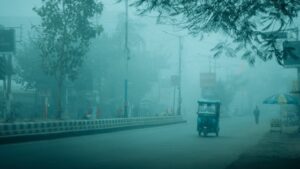
Delhi recorded some of the country’s worst air quality in November, placing fourth among the ten most polluted cities, according to a new analysis by the Centre for Research on Energy and Clean Air. The report shows that pollution surged sharply across the National Capital Region, with every city in the top ten list located in either Haryana, Uttar Pradesh or Delhi. The findings highlight how winter pollution continues to overwhelm the region despite lower stubble burning compared to previous years.
Delhi’s Pollution Spike Reflects Broader NCR Trend
The Report places Ghaziabad at the top of the pollution rankings for November, followed by Noida and Bahadurgarh. Delhi appears in the fourth position with Hapur, Greater Noida, Baghpat, Sonipat, Meerut and Rohtak making up the rest of the list. All ten cities recorded PM2.5 levels that far exceeded national standards. Delhi’s average PM2.5 concentration for November rose to 215 micrograms per cubic metre, nearly double what the city recorded in October. With such high pollution levels, the capital experienced 23 days in the Very Poor category, six in the Severe category and one in the Poor category. Not a single day met the threshold considered safe under national air quality standards.
Pollution levels, according to the report, were not confined to Delhi alone. Several NCR cities experienced major jumps in PM2.5 compared with their October averages. This reflects how winter weather patterns combined with local emissions can trap particulate matter across the region. While Delhi has long been the focus of national discussions on pollution, the new data shows that neighbouring cities are facing equally intense conditions.
Lower Stubble Burning Influence Shows Changing Pollution Sources
One of the report’s most notable findings is the reduced role of crop residue burning in Delhi’s air quality this season. The average contribution of stubble burning dipped to around 7% in November, compared with 20% during the same period last year. Even peak influence from crop fires reached only about 22%, a significant drop from roughly 38% in the previous year.
This shift indicates progress in efforts to control agricultural burning in Punjab and Haryana. However, the report points out that despite fewer emissions from crop fires, air quality remained extremely poor through most of November. This suggests that other sources within the city and surrounding areas now play a much larger role in winter pollution.
The study notes that vehicle emissions, industrial activity, construction dust and power generation are likely contributing more heavily to particulate levels. With fewer stubble-burning events, these year-round sources have gained greater visibility. The findings make it clear that improving air quality will require stronger intervention across multiple sectors rather than a singular focus on crop residue fires.
Need for Broader Action Beyond Seasonal Measures
The report’s insights raise questions about long-term strategies for the region. Even with a dip in stubble burning influence, pollution remained steadily high throughout November. This indicates that restrictions applied during winter months, such as traffic curbs or construction controls, may not be sufficient to address the larger and more persistent sources of emissions.
Experts have long noted that winter winds slow down and temperatures drop, causing pollutants to settle near the surface. The latest figures show that when this natural trapping effect combines with emissions from transport, industry and dust, pollution levels can climb rapidly even without major farm fire events.
The findings suggest a need for more consistent measures across the year. Stronger industrial regulation, cleaner transport options, sustained dust control and better monitoring systems are likely to play a central role in reducing winter pollution peaks. The new data makes it clear that while progress is being made in managing agricultural fires, the larger challenge lies in cutting emissions that originate within the NCR’s urban centres.
References:
India monthly ambient air quality snapshot: November 2025
Banner image:
Photo by Subhra Jyoti Paul on Unsplash

Comments are closed.





I love your wp theme, exactly where do you download it from?
This design is incredible! You obviously know how to keep a reader entertained. Between your wit and your videos, I was almost moved to start my own blog (well, almost…HaHa!) Great job. I really enjoyed what you had to say, and more than that, how you presented it. Too cool!
Magnificent beat ! I would like to apprentice while you amend your web site, how can i subscribe for a blog site? The account aided me a acceptable deal. I had been tiny bit acquainted of this your broadcast provided bright clear concept
I’ve really noticed that credit improvement activity must be conducted with tactics. If not, you may find yourself causing harm to your position. In order to succeed in fixing your credit score you have to be careful that from this time you pay all your monthly fees promptly in advance of their booked date. It’s really significant because by not necessarily accomplishing so, all other actions that you will decide on to improve your credit positioning will not be successful. Thanks for giving your thoughts.
We are a group of volunteers and starting a new scheme in our community. Your website provided us with helpful info to work on. You’ve done a formidable task and our whole neighborhood will likely be grateful to you.