Physical Address
23,24,25 & 26, 2nd Floor, Software Technology Park India, Opp: Garware Stadium,MIDC, Chikalthana, Aurangabad, Maharashtra – 431001 India
Physical Address
23,24,25 & 26, 2nd Floor, Software Technology Park India, Opp: Garware Stadium,MIDC, Chikalthana, Aurangabad, Maharashtra – 431001 India
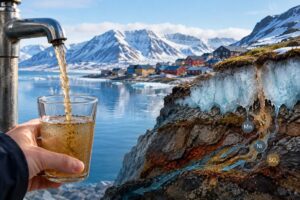
Residents of Longyearbyen, a remote Norwegian settlement in the Arctic, have been advised not to drink water from their taps after tests detected elevated levels of potentially harmful metals. The contamination has been linked to the rapid thawing of permafrost, highlighting how climate change is beginning to affect even some of the world’s most remote communities.
Longyearbyen is located in the Svalbard archipelago, roughly 800 miles from the North Pole. It is one of the world’s northernmost inhabited settlements and lies in an area experiencing exceptionally rapid warming. Temperatures in the Arctic region are rising several times faster than the global average, with profound consequences for frozen soils, ecosystems and infrastructure. The latest water-quality problem has added another concern to the growing list of climate-related changes facing the town.
Thawing ground exposes hidden pollution
The contamination is connected to changes taking place beneath the surface. Much of Svalbard is covered by permafrost, ground that normally remains frozen for long periods. As temperatures rise, the frozen layer is increasingly thawing, allowing water to move through soils and rocks that were previously locked away from the active water cycle.
In Longyearbyen, the local water supply comes from Isdammen lake. The surrounding geology contains shale rich in pyrite, a mineral that can contribute to acidic conditions when exposed to air and water. As thawing accelerates runoff and changes the way water moves through the landscape, acidic water can interact with the underlying rock and mobilise metals into the water system. Tests found manganese concentrations reaching around 25 times the recommended safe level. High exposure to manganese can pose health concerns, particularly for the nervous system, with children among those considered more vulnerable.
Although manganese concentrations later declined, the problem did not disappear. Subsequent testing detected elevated levels of sulphate and nickel, prompting authorities to maintain the advice against drinking untreated tap water. The situation demonstrates how climate change can trigger environmental problems that are not always immediately obvious. The issue is not simply that Arctic temperatures are rising; warming is changing the chemical and physical processes that determine how water moves through the landscape. For residents, the consequences are immediate and practical. A community that has traditionally relied on its local water supply must now look for alternative sources while authorities assess how to make the system safe again.
A warning for other Arctic communities
Temporary measures have already been introduced to provide residents with safer drinking water. A purified water tank, with filtration provided with help from a local brewery, is being used while authorities consider longer-term solutions. Those solutions could include developing a new water-supply system or exploring desalination. But both options come with substantial costs and technical challenges, particularly in a remote Arctic settlement where construction, transport and maintenance are difficult.
The Longyearbyen episode also raises a larger question: could similar problems emerge elsewhere as the Arctic continues to warm? Scientists have increasingly warned that thawing permafrost can have consequences extending well beyond the loss of frozen ground. Permafrost stores large quantities of carbon and influences hydrology, landscapes and infrastructure. When it thaws, previously stable chemical and biological processes can change, potentially affecting rivers and lakes as well as roads, buildings and water supplies. Longyearbyen therefore offers a glimpse of a less discussed dimension of Arctic warming. Climate change is not only shrinking glaciers, altering wildlife habitats or changing sea ice. It can also interfere with basic services that communities depend on every day.
The situation is particularly striking because Longyearbyen is not a large industrial centre where water pollution might traditionally be associated with human activity. Instead, the contamination is emerging from interactions between a warming climate, thawing permafrost, local geology and the movement of water. Experts have warned that the experience could serve as an early indication of what other Arctic communities may face as warming continues. For Longyearbyen, the immediate priority is finding a reliable source of safe drinking water. But beyond the town, the incident carries a wider message: in a rapidly warming Arctic, even systems that have remained stable for generations can begin to change.
What was once locked beneath permanently frozen ground is becoming part of the active environment again. And in Longyearbyen, some of those changes have now reached the kitchen tap.
https://www.sciencedirect.com/org/science/article/pii/S2754700025001385
https://en.visitsvalbard.com/visitor-information/destinations/longyearbyen
Banner Image: AI generated
Sections of this article may have been developed with the assistance of artificial intelligence tools to support research, drafting, and language refinement. All information has been reviewed, edited, and verified by the author/editor to ensure accuracy, context, and editorial integrity. The responsibility for the final content, interpretations, and conclusions rests solely with the publisher.