Physical Address
23,24,25 & 26, 2nd Floor, Software Technology Park India, Opp: Garware Stadium,MIDC, Chikalthana, Aurangabad, Maharashtra – 431001 India
Physical Address
23,24,25 & 26, 2nd Floor, Software Technology Park India, Opp: Garware Stadium,MIDC, Chikalthana, Aurangabad, Maharashtra – 431001 India

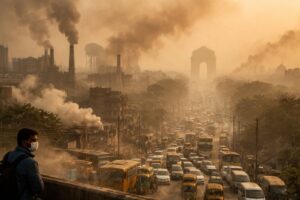
For millions across India, clean air remains a distant reality as the country continues to rank among the world’s most polluted, with the 2025 World Air Quality Report placing it sixth globally.
The report underscores both the scale of the problem and the limited progress made in addressing it. While this position may indicate a slight improvement compared to previous years, the overall air quality across the country remains dangerously high.
Understanding Air Pollution and PM2.5
Air pollution is commonly assessed through the concentration of fine particulate matter known as PM2.5. These microscopic particles are small enough to penetrate deep into the lungs and even enter the bloodstream, leading to severe health complications. In India, PM2.5 levels frequently exceed the safety limits prescribed by global health agencies. A large proportion of the population is exposed to air that is far more polluted than recommended standards, making clean air inaccessible for many.
India in the Global and Regional Context
The report places India within a wider regional crisis, as South Asia continues to dominate global air pollution rankings. Countries such as Bangladesh and Pakistan consistently feature among the most polluted nations, highlighting the transboundary nature of the problem. While India’s position as the sixth most polluted country suggests a marginal improvement, it still reflects a deeply concerning environmental reality shared across the region.
A more alarming insight emerges at the city level, where Indian urban centres frequently dominate global pollution lists. Cities such as Delhi, Ghaziabad, and Noida regularly record hazardous air quality levels, particularly during the winter months. Delhi, in particular, often experiences Air Quality Index (AQI) readings in the “severe” category, driven by a combination of vehicular emissions, industrial pollution, construction dust, and seasonal stubble burning in neighbouring states.
The Indo-Gangetic Plain remains one of the most critically affected regions in the world. Its unique geographical and meteorological conditions—coupled with high population density, rapid urbanisation, and concentrated economic activity—lead to the accumulation of pollutants over large areas. During winter, low wind speeds and temperature inversions trap pollutants close to the ground, resulting in prolonged smog episodes across cities in northern India.
These patterns underline that air pollution is not confined to isolated hotspots but is a widespread regional challenge. The concentration of multiple highly polluted cities within a single geographic belt demonstrates the scale and persistence of the crisis, calling for coordinated efforts both within India and across neighbouring countries.
Year-on-Year comparison
A comparison with previous years reveals that India’s progress in tackling air pollution remains slow and uneven. According to recent global air quality assessments, India ranked the 5th most polluted country in 2024, improving from 3rd position in 2023, but slipping slightly to 6th position in 2025, indicating fluctuating rather than sustained improvement.
In terms of pollution levels, the country continues to record high average PM2.5 concentrations—around 48.9 µg/m³ in 2025, which is nearly 10 times higher than the World Health Organisation’s safe limit of 5 µg/m³. This highlights that even when rankings improve, the actual air quality remains severely compromised.
City-level trends further reinforce this pattern of limited progress. For instance, Delhi recorded an annual average PM2.5 level of 91.6 µg/m³ in 2024, making it one of the most polluted capitals globally, while towns like Byrnihat reported extreme levels as high as 128.2 µg/m³. Similarly, cities such as Kolkata have shown only marginal improvement, with PM2.5 levels reducing from around 50 µg/m³ in 2022 to approximately 45–51 µg/m³ in 2025, still well above national and global standards.
At a broader level, exposure remains widespread—about 46% of India’s population lives in areas where PM2.5 levels exceed the national standard of 40 µg/m³. Seasonal spikes also continue year after year, particularly during winter months, offsetting gains made during cleaner periods.
Causes of Air Pollution
The causes of air pollution in India are diverse and interconnected. Vehicular emissions are a major contributor, especially in rapidly growing cities where the number of vehicles continues to rise. Industrial activities release significant quantities of pollutants into the air, while construction work adds to dust pollution. Additionally, the burning of fossil fuels for energy remains a key source of emissions.
Seasonal factors further worsen the situation. Agricultural practices such as stubble burning in neighbouring states lead to sharp increases in pollution levels, particularly in northern regions. These emissions, combined with unfavourable weather conditions like low wind speeds and temperature inversions, result in the accumulation of pollutants in the atmosphere.
Gaps in Monitoring and Health Impacts of Air Pollution
The report also highlights gaps in India’s air quality monitoring and governance systems. Although the country has expanded its network of monitoring stations in recent years, coverage is still uneven. Many smaller cities and rural areas lack adequate monitoring infrastructure, making it difficult to assess the true extent of pollution.
Moreover, not all highly polluted cities are included in national clean air programmes, limiting the effectiveness of policy interventions. Weak enforcement of existing regulations further reduces the effectiveness of measures to control pollution. These challenges point to the need for more comprehensive and better-coordinated efforts.
The health consequences of poor air quality are severe and far-reaching. Long-term exposure to high levels of PM2.5 is associated with respiratory illnesses, heart disease, and other chronic conditions. Air pollution is also a major contributor to premature deaths, making it one of the most significant environmental health risks in the country. Vulnerable groups, including children, the elderly, and individuals with pre-existing health issues, are particularly at risk.
Signs of Progress and the Way Forward
Despite the grim picture, there are some indications of gradual improvement. Efforts such as stricter emission norms, increased adoption of cleaner fuels, and growing public awareness have contributed to modest reductions in pollution levels in certain areas. However, these improvements are not sufficient to meet global air quality standards.
Equally important is regional cooperation, as air pollution often crosses national boundaries. Collaborative efforts among neighbouring countries can help address shared sources of pollution and improve overall air quality in the region.
India’s ranking as the sixth most polluted country in the 2025 World Air Quality Report serves as a stark reminder of the challenges that remain. While some progress has been made, much more needs to be done to ensure clean and healthy air for all. Tackling this issue is not only vital for public health but also for the country’s long-term environmental and economic sustainability.
References:
https://thewire.in/environment/a-2025-world-air-quality-report-lists-india-as-the-sixth-most-polluted-country
https://www.researchgate.net/publication/373772911_Effects_of_stubble_burning_and_firecrackers_on_the_air_quality_of_Delhi
https://pmc.ncbi.nlm.nih.gov/articles/PMC8494774
https://pmc.ncbi.nlm.nih.gov/articles/PMC8555193
Banner Image: AI Generated
Sections of this article may have been developed with the assistance of artificial intelligence tools to support research, drafting, and language refinement. All information has been reviewed, edited, and verified by the author/editor to ensure accuracy, context, and editorial integrity. The responsibility for the final content, interpretations, and conclusions rests solely with the publisher.