Physical Address
23,24,25 & 26, 2nd Floor, Software Technology Park India, Opp: Garware Stadium,MIDC, Chikalthana, Aurangabad, Maharashtra – 431001 India
Physical Address
23,24,25 & 26, 2nd Floor, Software Technology Park India, Opp: Garware Stadium,MIDC, Chikalthana, Aurangabad, Maharashtra – 431001 India
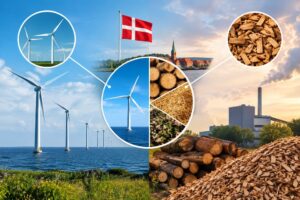
Denmark’s 64% figure covered all solid biomass, while wood supplied 48% of renewable energy in 2018. See what the data show.
A X post having claims about Denmark’s renewable-energy system appears convincing at first glance: “64% of Denmark’s renewable energy comes from cutting and burning trees.” A second claim says that biomass is the main source of Denmark’s renewable electricity. Both statements are based on real Danish energy statistics—but they distort what those statistics actually measure.
Claim 1: “64% of Denmark’s renewable energy comes from cutting and burning trees”
Fact: Misleading.
The 64% figure is real, but it does not mean that 64% of Denmark’s renewable energy comes from cutting down and burning trees. According to the Danish Energy Agency’s analysis of biomass use in 2018, solid biomass accounted for 64% of renewable energy used in Denmark. However, “solid biomass” is a broader category. It included wood, straw and biodegradable waste.
The composition matters. In 2018, wood accounted for 75% of Denmark’s solid biomass, while biodegradable waste accounted for 13% and straw for 12%. So, while wood was certainly the largest component of the solid-biomass category, turning the statistic into “64% comes from cutting and burning trees” removes two important pieces of information: the statistic includes non-wood biomass, and it refers to renewable energy use overall, not simply electricity generation.
There is also another important nuance. The Danish Energy Agency has acknowledged that biomass is not automatically climate-neutral in every circumstance. Its biomass analysis noted that the climate benefits depend on the type of biomass and how it is sourced; some forms of Danish biomass consumption can lead to global greenhouse-gas emissions.
The underlying statistic therefore tells us something significant about Denmark: biomass was a major part of its renewable-energy mix, particularly for replacing fossil fuels in heat and power generation. But it does not support the much narrower claim that 64% of renewable energy came specifically from cutting trees.
Claim 2: “Denmark’s renewable electricity is mostly biomass”
Fact: False.
This claim confuses Denmark’s overall renewable-energy consumption with its renewable electricity generation. The Danish Energy Agency’s 2018 energy statistics show that renewable sources supplied 60.5% of Denmark’s domestic electricity supply. But the largest contributor was clearly wind power, which alone accounted for 40.2% of domestic electricity supply.
Wood, including wood chips and wood pellets, accounted for 11.4%, while total biomass-based electricity, including straw, renewable waste and biogas, was higher but still well below wind. The official statistics put biomass at 15.3% of domestic electricity supply. That distinction is crucial. Denmark can simultaneously have a biomass-heavy renewable-energy system overall and a wind-dominated renewable-electricity system.
The reason is that “renewable energy” encompasses more than electricity. Biomass has historically played a particularly important role in heating and district-heating systems, where wood pellets, wood chips and straw have been used to replace coal and other fossil fuels. The Danish Energy Agency says straw, wood chips and wood pellets had largely replaced coal in parts of the electricity and heat sector.
Denmark’s energy statistics therefore paint a more complicated picture than either social-media claim suggests. Wind is the dominant renewable source for electricity, while biomass has a much larger role when electricity, heat and other energy uses are considered together.
What the numbers actually tell us
The viral claims appear to have arisen from mixing different categories of energy statistics and then presenting them as though they describe the same thing. The distinction between total renewable energy use, solid biomass and renewable electricity is essential to understanding what Denmark’s energy data actually show.
The 64% figure is based on solid biomass as a share of Denmark’s renewable energy use in 2018. But solid biomass is a broad category that includes wood, straw and biodegradable waste. It therefore cannot accurately be presented as meaning that 64% of Denmark’s renewable energy came from cutting down and burning trees. Wood was indeed the largest component of solid biomass, accounting for around 75% of the category. That means the use of woody biomass was substantial and should not be dismissed. However, the original statistic still included other materials, and the figure referred to renewable energy consumption across the energy system, not exclusively to electricity generation.
The claim becomes even clearer when the data are narrowed down to electricity. In 2018, renewable sources supplied 60.5% of Denmark’s domestic electricity supply. But wind power alone contributed 40.2%, making it by far the largest renewable source for electricity. Biomass was not the dominant source. Wood chips and pellets contributed 11.4%, while biomass as a broader category: including wood, straw, renewable waste and biogas, accounted for around 15.3% of domestic electricity supply. In other words, biomass was important, but it was nowhere near being Denmark’s primary renewable electricity source.
This distinction also explains why both seemingly contradictory statements can appear in discussions about Denmark. Biomass can have a large share of the country’s overall renewable-energy consumption while wind dominates renewable electricity generation. These are different measurements covering different parts of the energy system.
The difference is partly explained by the role biomass plays in heat and district-heating systems. Unlike wind and solar, biomass can be burned when heat or electricity is needed, making it useful in systems that require dispatchable energy. Denmark has historically used materials such as wood pellets, wood chips and straw in combined heat-and-power plants and district-heating systems, replacing some fossil-fuel use.
However, the fact that biomass can replace coal or other fossil fuels does not automatically mean that all biomass has the same climate impact. The source, type and management of the biomass matter. Burning woody biomass releases carbon dioxide at the point of combustion, while the overall climate balance depends on factors including where the material came from, whether forests are regrown, what would have happened to the biomass otherwise, and the time required to reabsorb the released carbon.
This is why Denmark’s reliance on biomass is a legitimate subject for climate and sustainability debate. Questioning whether particular forms of woody biomass should be classified as renewable, or whether they deliver sufficient climate benefits, is a valid discussion. But those questions should be based on the actual statistics rather than by changing the meaning of the statistics.
References:
https://x.com/Electroversenet/status/2104949331300061537?s=20
https://www.eia.gov/energyexplained/biomass
https://www.sciencedirect.com/science/article/abs/pii/S0360544214011232
https://www.eia.gov/energyexplained/biomass/wood-and-wood-waste.php
https://ens.dk/en/press/biomass-analysis-has-been-translated-english
https://www.eia.gov/energyexplained/biomass/biomass-and-the-environment.php
https://fm.dk/media/yarhhp23/kingdom-of-denmark-green-bond-second-opinion.pdf
Banner Image: AI generated
Sections of this article may have been developed with the assistance of artificial intelligence tools to support research, drafting, and language refinement. All information has been reviewed, edited, and verified by the author/editor to ensure accuracy, context, and editorial integrity. The responsibility for the final content, interpretations, and conclusions rests solely with the publisher.