Physical Address
23,24,25 & 26, 2nd Floor, Software Technology Park India, Opp: Garware Stadium,MIDC, Chikalthana, Aurangabad, Maharashtra – 431001 India
Physical Address
23,24,25 & 26, 2nd Floor, Software Technology Park India, Opp: Garware Stadium,MIDC, Chikalthana, Aurangabad, Maharashtra – 431001 India


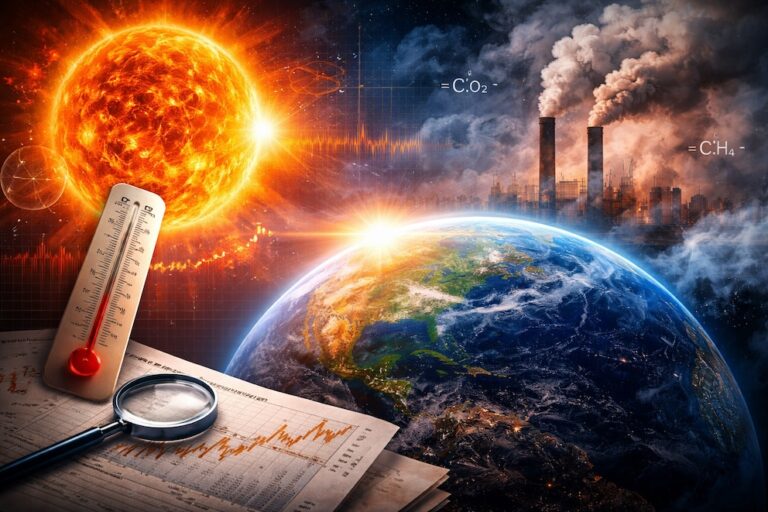
A viral post on X argues that fears around climate change are overblown by pointing to disaster statistics. The post claims that despite rising carbon dioxide emissions and record global temperatures, the number of climate-related disasters has not increased. It goes further by stating that 2025 is shaping up to be the quietest disaster year in decades and suggests that if climate change were truly driving extremes, disasters would already be exploding in number. Based on this framing, the post questions whether there is any real climate emergency at all.
These claims rely heavily on selective readings of disaster databases and misunderstand how climate science evaluates risk. Each of the core assertions can be tested against long-term data, scientific assessments, and the way experts interpret climate impacts.
Claim Post:
Claim 1: “From 2000 to 2025, we’ve seen emissions skyrocket… Yet, the number of reported disasters hasn’t shot up.”
Fact: False. The claim assumes that rising greenhouse gas emissions should lead to a simple and steady rise in the annual number of disasters. Climate science does not work this way.
Long-term assessments by the World Meteorological Organisation show that weather, climate, and water-related hazards have become more frequent and more intense over recent decades. In a major analysis covering the past 50 years, the WMO reported a strong rise in floods, storms, heatwaves, and drought-related events globally, alongside growing economic losses.
Disaster counts fluctuate from year to year due to natural variability and reporting practices. Scientists, therefore, focus on trends across decades rather than individual years. Heatwaves are becoming longer and more severe. Heavy rainfall events are becoming more intense in many regions. Drought conditions are persisting longer in parts of Africa, the Mediterranean, and the Americas. These shifts are well documented in peer-reviewed studies and assessment reports.
Another key issue is exposure. As populations grow and urban areas expand into flood plains and coastal zones, the impacts of extreme events increase even if the number of events does not rise smoothly every year. Climate risk is measured through intensity, duration, spatial reach, and damage, not by raw event counts alone.
Claim 2: “2025 clocks in as the LOWEST year in the past quarter century for these events, according to the EM DAT database.”
Fact: Misleading. This claim rests on a misunderstanding of how the EM DAT disaster database works. The EM DAT database, maintained by the Centre for Research on the Epidemiology of Disasters, is not a real-time monitoring tool. Disaster entries are added only after events meet specific thresholds for impacts such as deaths, people affected, or formal emergency declarations. Reporting often lags by months or longer, especially for events in low-income regions.
EM DAT itself warns users not to conclude incomplete annual data. Provisional figures for an ongoing or recently ended year are not suitable for ranking or historical comparison. Declaring 2025 as the lowest disaster year in 25 years based on incomplete entries ignores these methodological limits.
Independent assessments paint a very different picture of 2025. Major floods, heatwaves, storms, and wildfires were recorded across multiple continents. Reinsurance firms and national meteorological agencies documented substantial economic loss of $120 bn linked to extreme weather events during the year. These impacts do not disappear simply because not all events have yet been coded into a global database. Using provisional disaster data to claim a historic decline creates a misleading narrative that collapses once the full reporting cycle is complete.
Claim 3: “If CO2 is the villain driving these disasters, why aren’t we seeing an explosion in events?”
Fact: False. This claim is built on an incorrect premise about what climate science predicts. Rising carbon dioxide levels do not guarantee a rapid increase in the number of disasters each year. Instead, climate change alters the likelihood and intensity of certain types of extreme events. Heatwaves become more frequent and last longer. Rainfall events release more water over shorter periods. Tropical cyclones tend to carry more moisture. Droughts can persist longer under warmer conditions.
Many of these changes are captured poorly by simple event counts. A single heatwave that lasts several weeks and affects millions of people may be recorded as one event, even though its impacts are far greater than several shorter events combined. The same applies to prolonged droughts or slow-moving flood systems.
Attribution studies published over the past decade show that human-driven Global warming has increased the probability of specific extreme events around the world. These studies compare the current climate with a simulated world without elevated greenhouse gas levels. The results consistently show that many recent heat and rainfall extremes would have been far less likely without human influence.
An absence of a dramatic rise in annual disaster counts does not contradict climate science. It reflects the limits of counting events rather than measuring their changing nature.
Claim 4: “If disasters aren’t worsening despite the crisis, what’s the emergency?”
Fact: Misleading. The idea of a climate emergency is not based on a single metric or a single year of disaster data. Climate risk is evaluated through long-term changes in the Earth system. These include rising global temperatures, increasing ocean heat content, accelerating sea level rise, shrinking glaciers, and thawing permafrost. All of these indicators continue to move in one direction according to observations from agencies such as NASA and the Copernicus Climate Change Service.
Heat exposure is rising across continents. Coastal flooding risks are increasing as sea levels rise and storm surges reach further inland. Coral reefs are experiencing repeated mass bleaching events linked to marine heatwaves. These changes unfold over decades and are not captured fully by disaster databases.
The emergency framing reflects the scale of long-term risk and the narrowing window for limiting future warming. It does not depend on whether one particular year records more or fewer disasters than another.
Why Disaster Databases Are Often Misused
Disaster databases are valuable tools, but they are frequently misinterpreted in climate debates. They are designed to catalogue human and economic impacts, not to serve as direct indicators of climate change.
Several factors influence disaster records. Reporting capacity has improved over time, especially in developing countries. Definitions of what qualifies as a disaster vary across regions. Some hazards, such as heatwaves and droughts, are harder to classify than sudden events like earthquakes or cyclones. Climate science relies on a broader body of evidence. This includes physical measurements of temperature, rainfall, ocean heat, and ice mass, as well as modelling and attribution studies. When these lines of evidence are considered together, they point clearly toward increasing climate-related risks.
Cherry picking short timeframes or provisional datasets can create the illusion that nothing is changing. A wider lens tells a very different story. The viral post draws sweeping conclusions from selective and incomplete readings of disaster data. Its claims do not align with how climate scientists assess risk or how disaster databases are meant to be used. Long-term observations show rising hazards and growing impacts linked to a warming planet, even as annual disaster counts fluctuate.
The absence of a simple upward curve in disaster numbers does not weaken the scientific case for climate change. It highlights the need to look beyond headlines and isolated statistics, and to engage with the full body of evidence that informs climate risk assessments today.
References:
https://wmo.int/news/media-centre/wmo-climate-services-support-climate-action
https://www.sciencedirect.com/science/article/pii/S004896972307016X
https://www.nature.com/articles/s41558-025-02486-9
https://www.climate.gov/news-features/understanding-climate/climate-change-ocean-heat-content
https://science.nasa.gov/earth/explore/the-ocean-and-climate-change/
Banner image: Photo byMa Ti on Unsplash
Sections of this article may have been developed with the assistance of artificial intelligence tools to support research, drafting and language refinement. All information has been reviewed, edited and verified by the author/editor to ensure accuracy, context and editorial integrity. The responsibility for the final content, interpretations and conclusions rests solely with the publisher.