Physical Address
23,24,25 & 26, 2nd Floor, Software Technology Park India, Opp: Garware Stadium,MIDC, Chikalthana, Aurangabad, Maharashtra – 431001 India
Physical Address
23,24,25 & 26, 2nd Floor, Software Technology Park India, Opp: Garware Stadium,MIDC, Chikalthana, Aurangabad, Maharashtra – 431001 India

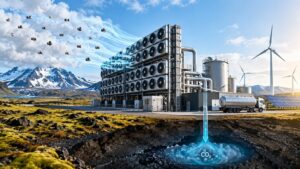
Pulling carbon dioxide directly out of the atmosphere sounds straightforward, but it is one of the more technically demanding approaches being explored to address climate change. Unlike conventional carbon capture, which removes CO₂ from concentrated industrial exhaust streams, direct air capture (DAC) has to separate a relatively small amount of carbon dioxide from ordinary air.
Recent results from Climeworks’ Mammoth facility in Iceland are offering a useful look at how the technology is evolving. The company reported that the plant captured 675 tonnes of CO₂ during the first six months of 2026, compared with 119 tonnes during the same period in 2025. The increase has been linked to changes in the capture material and improvements to the plant’s mechanical systems.
The numbers are still small compared with global emissions, but the more important question is what is happening inside the technology.
DAC systems generally use large fans or air-contacting structures to move atmospheric air across a material known as a sorbent. The sorbent selectively binds with CO₂ while allowing most of the other gases in the air to pass through.
Once the material becomes saturated, the process is reversed. Heat, vacuum or a combination of both can be used to release the concentrated CO₂ from the sorbent. The captured gas can then be compressed and transported for permanent storage or, in some applications, used as a feedstock.
At Mammoth, the system uses solid sorbent-based collector units. Captured CO₂ is processed and sent for underground storage through mineralisation, where it can ultimately be converted into stable carbonate minerals. The facility has a design capacity of up to 36,000 tonnes of CO₂ a year, although actual net removal is lower during its operational ramp-up.
The biggest technical problem is concentration. Atmospheric air contains only around 0.04% CO₂. That means enormous quantities of air have to pass through the system to remove a relatively small quantity of carbon.
This makes energy use, sorbent performance, equipment size and operating costs central to the technology’s future.
The latest changes at Mammoth illustrate where engineering improvements can make a difference. Climeworks says modifications to its sorbent have increased its capacity and improved its performance under real operating conditions. Mechanical changes and adjustments to plant operation have also increased throughput. The company says operating costs at Mammoth have fallen by more than 50% over the past year.
Sorbent durability is another important issue. If the material loses its ability to capture CO₂ after repeated cycles, it must be replaced more frequently, increasing both costs and the material footprint of the plant. Research into longer-lasting sorbents is therefore as important as increasing the amount of CO₂ captured in each cycle.
Improving individual components does not automatically make DAC commercially viable. The industry still has to demonstrate that thousands of collectors can operate reliably together, while keeping energy demand and costs under control.
Recent research identifies contactor design, heat management, sorbent performance and system integration as major engineering challenges for next-generation DAC.
Energy is particularly important. If a DAC plant uses carbon-intensive electricity or heat, part of the climate benefit of removing CO₂ can be undermined by emissions associated with its operation. This is why DAC facilities need access to low-carbon energy sources and efficient heat-management systems. There is also the question of permanence. Capturing CO₂ is only the first step in carbon removal. To count as durable removal, the carbon needs to remain out of the atmosphere for very long periods. Geological storage and mineralisation are among the approaches being developed for this purpose.
The progress at Mammoth therefore matters less as a story about one company and more as a demonstration of the broader learning curve for direct air capture. Operating a large system exposes problems that may not appear in laboratories, from maintenance requirements and weather effects to sorbent degradation and the efficiency of individual components.
DAC is not a substitute for cutting fossil-fuel emissions. Preventing CO₂ from entering the atmosphere remains far more important than attempting to remove it later. But some residual emissions may be difficult to eliminate completely, creating a potential role for durable carbon removal. The central challenge now is no longer simply proving that CO₂ can be extracted from air. It is proving that the process can be made efficient, durable, energy-conscious and affordable enough to operate at a scale relevant to the climate problem. Mammoth’s latest performance provides another set of real-world data for that much larger engineering challenge.
https://www.sciencedirect.com/science/article/pii/S235218642200414X
https://pubs.rsc.org/cs/article/55/15/8073/1274129/Direct-air-capture-technologies-innovations
https://link.springer.com/article/10.1007/s43994-025-00297-4
https://www.sciencedirect.com/science/article/pii/S0360128522000764
Banner Image: AI-generated
Sections of this article may have been developed with the assistance of artificial intelligence tools to support research, drafting, and language refinement. All information has been reviewed, edited, and verified by the author/editor to ensure accuracy, context, and editorial integrity. The responsibility for the final content, interpretations, and conclusions rests solely with the publisher.