Physical Address
23,24,25 & 26, 2nd Floor, Software Technology Park India, Opp: Garware Stadium,MIDC, Chikalthana, Aurangabad, Maharashtra – 431001 India
Physical Address
23,24,25 & 26, 2nd Floor, Software Technology Park India, Opp: Garware Stadium,MIDC, Chikalthana, Aurangabad, Maharashtra – 431001 India

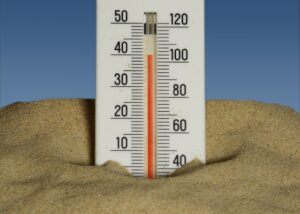
A scorching heatwave that engulfed India and Pakistan in mid-April 2025, pushing temperatures to alarming highs, has been largely driven by human-induced climate change, according to a new ClimaMeter study. The extreme weather event, marked by temperatures soaring up to 49°C in parts of Pakistan and over 40°C in New Delhi, was found to be up to 4°C hotter than similar events in the pre-1987 period.
The report, authored by scientists from institutions in Singapore, France, and the UK, concludes that the heatwave’s intensity can mostly be attributed to anthropogenic global warming, with minimal influence from natural climate variability.
“We interpret the April 2025 India and Pakistan heatwave as an event driven by very exceptional meteorological conditions, whose characteristics can mostly be ascribed to human-driven climate change,” the researchers wrote in the study.
A Heatwave with Dire Consequences
The early and intense heatwave struck from April 14 to 15, severely affecting regions across Pakistan and northern India. In Balochistan, Pakistan, the mercury spiked to 49°C, triggering prolonged power outages. In India, cities like New Delhi and Jaipur experienced temperatures 5°C above seasonal norms, disrupting daily life, education, and agriculture.
Farmers reported crop failures due to early heat and water scarcity, while hospitals documented a rise in heat-related illnesses. Vulnerable populations—including outdoor laborers, pregnant women, and children—were especially at risk.
Climate Fingerprints All Over
Using historical weather analogs from 1950–1986 compared with data from 1987–2023, the study found:
Although El Niño-Southern Oscillation (ENSO) can influence such events, the researchers noted that April 2025 occurred during an ENSO-neutral phase—indicating that the record-breaking heat was unlikely to be the result of natural variability alone.
“Sources of natural climate variability, notably the El Niño–Southern Oscillation, may have influenced the event. However, since the current phase is ENSO-neutral, the observed changes are likely due to anthropogenic climate change, with only a minor contribution from natural variability,” the researchers wrote.
A Warning for the Future
This heatwave follows a growing pattern in South Asia, where pre-monsoon heatwaves are becoming more frequent and severe. The IPCC has already identified the region as highly vulnerable to climate extremes, exacerbated by rapid urbanization and population growth.
“Events like the April 2025 heatwave are no longer anomalies—they’re becoming the new normal,” the authors warn, emphasizing the urgent need for climate adaptation measures, particularly in urban planning, agriculture, and public health infrastructure.
References:
https://doi.org/10.5281/zenodo.15240277
https://edition.cnn.com/2025/04/15/asia/india-pakistan-heatwave-climate-crisis-intl-hnk/index.html
Banner Image: Photo by Immo Wegmann on Unsplash