Physical Address
23,24,25 & 26, 2nd Floor, Software Technology Park India, Opp: Garware Stadium,MIDC, Chikalthana, Aurangabad, Maharashtra – 431001 India
Physical Address
23,24,25 & 26, 2nd Floor, Software Technology Park India, Opp: Garware Stadium,MIDC, Chikalthana, Aurangabad, Maharashtra – 431001 India

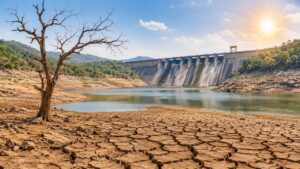
India’s reservoirs lost 5 billion cubic metres of water in a week. See what CWC data shows, which regions are worst hit and what it means for water security.
India’s water reserves are showing signs of growing stress, with the country’s 178 major reservoirs losing more than 5 billion cubic metres (BCM) of water in just one week. The sharp decline has brought the national reservoir storage down to 63.25 per cent of its total usable capacity, raising fresh concerns about water availability across several regions.
According to the recently released Central Water Commission’s (CWC) reservoir storage bulletin, the combined water storage in these reservoirs stood at 116.854 BCM, compared with 121.926 BCM recorded on November 5. The loss of 5.07 BCM within seven days reflects the mounting pressure on India’s water resources as several states continue to experience below-normal storage levels.
The situation becomes more concerning when compared with previous years. Current reservoir storage is nearly 29.65 per cent lower than the corresponding period last year, when the reservoirs held 166.101 BCM. It is also 19.86 per cent below the normal storage level of 145.811 BCM. Together, the 178 reservoirs have a total usable capacity of 184.762 BCM, making the present shortfall significant for a country where millions of people depend on stored water for agriculture, drinking and industrial activities.
Southern India Faces the Sharpest Storage Deficit
The regional distribution of water storage reveals that southern India is facing the most serious shortage. The 50 major reservoirs across the region currently hold only 22.206 BCM of water against their combined capacity of 55.879 BCM. This means that storage has fallen to just 39.74 per cent of capacity, nearly 47 per cent below the normal level.
Andhra Pradesh, Telangana and Tamil Nadu are among the worst-affected states. Andhra Pradesh’s seven major reservoirs are operating at only 27.54 per cent of their capacity, while Telangana’s eight reservoirs have retained 33.49 per cent. Tamil Nadu’s nine reservoirs are at 36.28 per cent. Karnataka is relatively better placed at 44.89 per cent, while Kerala has comparatively healthier storage at 65.55 per cent.
The situation is not limited to the southern region. Northern India’s 11 major reservoirs across Himachal Pradesh, Punjab and Rajasthan are holding 55.19 per cent of their total usable capacity, which is still nearly 25 per cent below normal. Punjab’s reservoir storage is particularly concerning, standing 27.12 per cent below its normal level.
Maharashtra and Gujarat are also witnessing water stress. Maharashtra’s 38 major reservoirs hold 71.63 per cent of their capacity, but storage remains 19.26 per cent below normal. The state government has declared 305 talukas across 33 districts drought-affected. In Gujarat, four districts: Devbhoomi Dwarka, Porbandar, Jamnagar and Kutch, have been declared drought-hit, while 80 tehsils across 14 districts have been classified as drought-affected. Eastern India presents a mixed picture. Although the region’s overall reservoir storage stands at 75.04 per cent of capacity, several states remain vulnerable. Reservoirs in Assam, Bihar, Meghalaya and West Bengal are holding less than half of their usable capacity. This uneven distribution highlights how water stress is affecting different parts of the country in different ways.
A Warning for India’s Long-Term Water Security
Declining reservoir levels are more than just a statistical concern. They directly influence the availability of water for households, farmers, industries and ecosystems. Reservoirs serve as important buffers between seasonal rainfall and year-round demand. When their storage declines, the pressure on groundwater sources, rivers and local water supply systems can increase.
Agriculture is particularly vulnerable. Farmers depend on reservoirs for irrigation, especially during periods when rainfall becomes insufficient or irregular. Reduced water availability can affect crop planning, agricultural productivity and rural livelihoods. Urban areas may also face greater pressure on drinking water supplies, potentially leading to restrictions and increased dependence on alternative sources. The situation also draws attention to the changing nature of India’s water challenges. While monsoon rainfall plays an important role in replenishing reservoirs, the availability of water is equally influenced by its distribution, consumption patterns, storage infrastructure and management. A region may receive rainfall but still experience water shortages if rainfall is uneven or available storage is insufficient to meet demand.
There is therefore a need to look beyond reservoir replenishment and focus on managing water more efficiently. Rainwater harvesting, restoration of traditional water bodies, watershed development, groundwater recharge and the reuse of treated wastewater can help reduce dependence on reservoir storage. Improving irrigation efficiency and encouraging less water-intensive agricultural practices are equally important. The latest CWC figures underline an important reality: India’s water security cannot depend solely on the success of one monsoon season. With reservoirs losing billions of cubic metres of water within a week, the challenge is not simply to store more water but also to use existing resources responsibly.
As regional shortages deepen, strengthening water conservation and long-term planning will be essential to ensure that water remains available not just for immediate needs, but for future generations as well.
References:
https://rsms.cwc.gov.in/frameWork/web/public-dashboard
Banner Image: AI generated
Sections of this article may have been developed with the assistance of artificial intelligence tools to support research, drafting, and language refinement. All information has been reviewed, edited, and verified by the author/editor to ensure accuracy, context, and editorial integrity. The responsibility for the final content, interpretations, and conclusions rests solely with the publisher.