Physical Address
23,24,25 & 26, 2nd Floor, Software Technology Park India, Opp: Garware Stadium,MIDC, Chikalthana, Aurangabad, Maharashtra – 431001 India
Physical Address
23,24,25 & 26, 2nd Floor, Software Technology Park India, Opp: Garware Stadium,MIDC, Chikalthana, Aurangabad, Maharashtra – 431001 India

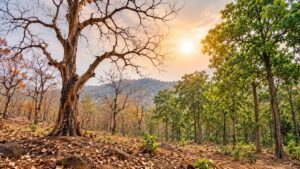
More than 25,000 mature teak trees have died across forests in Madhya Pradesh’s Betul district over the past three years, raising fresh concerns about the growing vulnerability of India’s forests to changing climatic conditions. What makes the large-scale mortality particularly alarming is that investigators have found no clear evidence of pest attacks or fungal infections, pointing instead towards prolonged drought, rising temperatures and severe moisture stress.
The deaths have been recorded across approximately 16,800 hectares in five ranges of the West Betul forest division. A detailed tree-by-tree survey, led by forest officials and supported by satellite imagery and laboratory investigations, has revealed a pattern that could have significant implications for forest conservation and management.
According to forest officials, the scale of teak mortality is unprecedented in the region over the past two decades. The first signs of the problem emerged around 2023, but the situation became increasingly visible during 2025 and 2026. During a field visit in April 2026, forest officials observed large teak trees standing completely dry, without visible signs of insect infestation, fungal growth or decay. Even when examined, the wood appeared sound rather than hollow or rotten.
The affected trees were largely mature specimens, with girths ranging from 60 to 150 centimetres and estimated ages of 40 to more than 120 years. Their loss is particularly significant because teak generally takes between 60 and 80 years to reach commercial maturity.
When trees die without pests or disease
The absence of conventional biological causes has shifted attention towards environmental stress. Investigations identified three striking characteristics of the affected forests: dead trees were scattered among healthy ones rather than concentrated in specific patches, older and larger trees appeared more vulnerable, and mortality was generally higher in comparatively dry locations.
Laboratory investigations by the Tropical Forest Research Institute (TFRI) in February 2025 found no evidence of fungal or other pathogenic infections in the tested samples, including Phomopsis tectonae, a fungus associated with teak dieback. However, the investigation also highlighted the possible role of changing soil moisture conditions. Excessive waterlogging during the monsoon months, particularly between June and September, can deprive tree roots of oxygen. This may be followed by prolonged dry spells between April and June, damaging the fine roots responsible for absorbing water and nutrients.
Such alternating conditions could gradually weaken trees, making them less capable of surviving prolonged periods of heat and drought. Forest officials suspect that hydraulic failure could be a major reason behind the deaths. This occurs when a tree’s internal water transportation system becomes damaged, preventing water from reaching its leaves.
Trees normally transport water from their roots to their leaves through specialised tissues known as xylem. Under severe drought conditions, the water inside these channels comes under extreme tension, allowing air bubbles to form. These bubbles can block the movement of water, disrupting the tree’s ability to maintain essential functions. If the damage becomes extensive, the tree may not recover even after rainfall returns. Research has also highlighted the vulnerability of teak to extreme temperatures. A 2017 study published in Scientific Reports identified a thermal tolerance threshold of approximately 45.5 degrees Celsius for the species. Another study, published in Nature in 2015, found that hydraulic failure was a major cause of tree mortality during prolonged drought conditions, with larger trees particularly susceptible.
Climate stress poses a challenge to forest management
Satellite observations have provided another important clue. Data indicated signs of vegetation and moisture stress in the affected region as early as 2022-23, suggesting that the forests may have been experiencing environmental pressure well before large-scale tree deaths became apparent. Betul is already considered a drought-prone district. Studies have documented declining monsoon rainfall trends in Madhya Pradesh over several decades. The situation was further aggravated in 2026, when the district received only around 69 per cent of its normal monsoon rainfall, according to forest officials.
However, investigators have cautioned against attributing every instance of teak mortality to a single cause. The TFRI investigation in South Betul found that dieback was restricted to a few locations and did not indicate an alarming situation across the entire division. Trees growing near dead specimens were generally healthy or showed only limited signs of deterioration. The distinction highlights the need for location-specific investigations rather than assuming that the same conditions are affecting every forest equally.
The deaths also carry economic consequences. Betul is among India’s important teak-producing districts, generating more than Rs 100 crore annually through timber harvesting. The loss of thousands of mature trees could significantly affect estimates of available timber and future harvesting plans. Forest officials are now planning to incorporate the findings into the division’s next 10-year Working Plan, which guides timber extraction, forest protection and regeneration activities. They have also emphasised the timely removal of dead standing trees to prevent further deterioration of timber quality and reduce fire risks.
Beyond the immediate economic loss, the incident raises a larger question about whether existing forest management strategies are adequately prepared for increasingly unpredictable climatic conditions.
Teak is known for its durability and natural resistance to several pests and diseases. Yet, its apparent resilience against biological threats has not necessarily protected it from prolonged environmental stress.
The deaths in Betul offer a reminder that forests can deteriorate even without visible signs of disease or direct human interference. As temperatures rise and rainfall patterns become increasingly uncertain, understanding how different tree species respond to prolonged heat, drought and changing soil conditions will become essential.
The challenge ahead is not simply to replace the trees that have died, but to understand why they could not survive and ensure that future forest management accounts for the climatic realities forests are increasingly facing.
References:
https://www.nature.com/articles/s41598-017-11343-5
https://link.springer.com/article/10.1186/s12302-025-01195-6
https://www.itto.int/files/user/pdf/publications/PD%20151%2002/pd151-02%20(I)%20e.pdf
Banner Image: AI generated
Sections of this article may have been developed with the assistance of artificial intelligence tools to support research, drafting, and language refinement. All information has been reviewed, edited, and verified by the author/editor to ensure accuracy, context, and editorial integrity. The responsibility for the final content, interpretations, and conclusions rests solely with the publisher.