Physical Address
23,24,25 & 26, 2nd Floor, Software Technology Park India, Opp: Garware Stadium,MIDC, Chikalthana, Aurangabad, Maharashtra – 431001 India
Physical Address
23,24,25 & 26, 2nd Floor, Software Technology Park India, Opp: Garware Stadium,MIDC, Chikalthana, Aurangabad, Maharashtra – 431001 India


India knows heatwaves, but what is a heat storm? Discover how giant 5.1M sq km heat storms have surged from 5 to 102 a year- and what it means for India.
India is no stranger to heat waves. Every summer, weather forecasts warn of unusually high temperatures, while millions brace for scorching afternoons, water shortages and rising health risks. But a new analysis of global temperature data suggests that extreme heat is changing in a more dramatic way: heat waves are becoming larger, longer and increasingly capable of spreading across enormous parts of the planet.
This has led researchers and climate analysts to use a new term for some of the most extensive events, “heat storms.” The term is intended to describe the extraordinary geographical scale of extreme heat, rather than introduce a new official weather category.
From a Heat Wave to a Heat Storm
A heat wave is generally understood as a prolonged period of unusually hot weather, but there is no single universally accepted global definition. Different countries and meteorological agencies use different temperature thresholds and durations depending on their local climate. The analysis developed a common framework after examining temperature data dating back to 1960. Under this approach, a heat wave occurs when temperatures in a location remain unusually high for at least five consecutive days. Temperatures are compared with historical conditions for that particular place and time of year.
A heat storm is essentially a heat wave on a vastly larger scale. Under the methodology used in the analysis, a heat wave becomes a heat storm when the affected area reaches at least 1% of Earth’s surface at its peak that is roughly 5.1 million square kilometres, or about half the size of Canada.
The threshold is an analytical definition, not an internationally recognised meteorological classification. The distinction is therefore not simply about how many degrees the thermometer records. It is about how widespread the extreme heat becomes. That matters because a 45°C day affecting one city and an enormous region simultaneously experiencing unusually high temperatures represent very different scales of risk.
Why Are Heat Storms Becoming More Common?
The numbers emerging from the analysis are striking. In the 1960s, heat storms averaged around five active events a year. In the current decade, that figure has risen to roughly 102 a year. At the same time, the area affected by heat waves and heat storms has expanded dramatically. The largest event identified in the analysis, called Heat Storm Vera, lasted for 367 days during 2023–24 and at some point affected almost 85% of the globe.
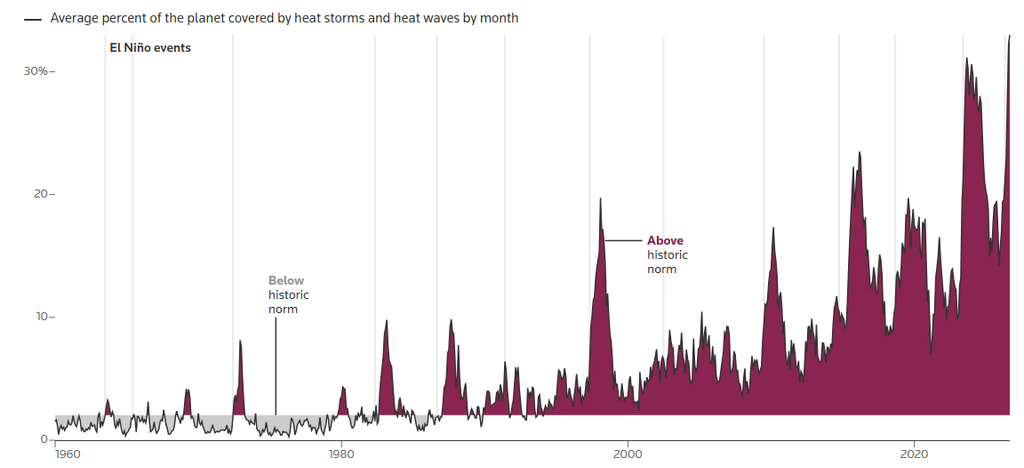
That does not mean every location was experiencing its highest temperatures for an entire year. Instead, the enormous heat event moved and evolved, covering different parts of the planet over its lifetime. The broader explanation is familiar: a warmer atmosphere raises the baseline from which extreme heat occurs.
Human-caused greenhouse gas emissions have increased global temperatures, making unusually hot conditions more likely and allowing extreme heat events to become more extensive and persistent. Natural climate patterns such as El Niño can further intensify heat in particular years and regions. The result is a climate in which conditions that were once considered unusually rare can occur more frequently.
A Changing Geography of Extreme Heat
Heat storms do not respect national borders. They can stretch across countries, continents and climatic zones. That means the geography of extreme heat is changing too. Regions already accustomed to high temperatures, including South Asia, the Middle East and parts of Africa that remain highly exposed. But extreme heat is also increasingly affecting places where populations, infrastructure and institutions may be less prepared for prolonged high temperatures.
Europe provides an important example. In recent years, extreme heat has produced record-breaking temperatures in several countries and placed pressure on transport infrastructure, public health systems and agriculture. The impacts extend beyond human health. Prolonged heat can dry vegetation and increase wildfire risks, intensify drought, stress water supplies and damage crops. It can also compound other climate hazards, creating conditions in which one extreme event makes another more damaging. The changing geography also matters because vulnerability is not determined by temperature alone. A community’s ability to cope depends on access to cooling, electricity, healthcare, water, housing and early-warning systems. A temperature that is manageable in one location can become dangerous in another.
What Does a Heat Storm Mean for India?
For India, the concept is particularly relevant because heat waves are already a recurring hazard. The India Meteorological Department uses its own criteria to identify and issue warnings for heat-wave conditions, based on factors such as temperatures exceeding specified thresholds and departures from normal conditions. A “heat storm” is not an IMD warning category and does not replace India’s existing heat-wave classification. It is instead a way of describing the enormous spatial scale of an extreme heat event. India’s experience also illustrates why looking only at the thermometer can be misleading.
People can face severe heat stress even when temperatures are not at an absolute record if unusually high temperatures persist for several days, nighttime temperatures remain elevated or humidity makes it harder for the human body to cool itself. This becomes particularly important as cities grow and more people live in densely built environments. Concrete surfaces, limited vegetation and heat generated by buildings and vehicles can make urban areas considerably hotter than their surroundings. For a country with a large outdoor workforce and millions of people living in heat-prone regions, prolonged extreme heat can affect not only health but also productivity, agriculture, energy demand and water availability.
The Bigger Concern: Heat That Lasts and Spreads
The significance of heat storms is not simply that individual heat waves are becoming hotter. It is that extreme heat may increasingly cover larger areas, last longer and affect more people simultaneously. That creates challenges for governments and communities. A short heat wave affecting one region can strain local hospitals and electricity systems. A much larger event occurring across several regions at the same time can put pressure on national resources and supply chains.
Heat also has a cumulative effect. Repeated episodes give people and ecosystems less time to recover. Crops can suffer from consecutive periods of high temperatures, reservoirs can lose water more rapidly and forests can become increasingly vulnerable to fire. For humans, the greatest danger can come when nights remain unusually warm. Cooler nights normally provide the body with an opportunity to recover from daytime heat. When temperatures remain elevated after sunset, that recovery becomes more difficult.
A New Name for an Old Warning
“Heat storm” is a new term, but the underlying phenomenon is not a new type of weather system. There is no eye, wind circulation or rainfall structure comparable to a tropical cyclone. The term is instead meant to communicate the extraordinary scale and persistence of extreme heat. And that may be its most important purpose.
Global warming is often expressed through abstract numbers like fractions of a degree, global averages and future temperature scenarios. Heat waves translate those changes into something people can actually experience. The emergence of increasingly large heat events offers another way to understand what a warming planet looks like: not just hotter days, but extreme heat spreading farther, lasting longer and becoming harder to escape.
References:
https://www.reuters.com/investigates/special-report/climate-heatstorms-methodology
https://www.reuters.com/investigates/special-report/climate-heatstorms-science
https://www.researchgate.net/publication/404110485_EXTREME_HEAT_AND_AGRICULTURE_FAO-WMO_joint_report
https://www.sciencedirect.com/science/article/pii/S0048969723078919
Banner Image: AI generated
Sections of this article may have been developed with the assistance of artificial intelligence tools to support research, drafting, and language refinement. All information has been reviewed, edited, and verified by the author/editor to ensure accuracy, context, and editorial integrity. The responsibility for the final content, interpretations, and conclusions rests solely with the publisher.