Physical Address
23,24,25 & 26, 2nd Floor, Software Technology Park India, Opp: Garware Stadium,MIDC, Chikalthana, Aurangabad, Maharashtra – 431001 India
Physical Address
23,24,25 & 26, 2nd Floor, Software Technology Park India, Opp: Garware Stadium,MIDC, Chikalthana, Aurangabad, Maharashtra – 431001 India

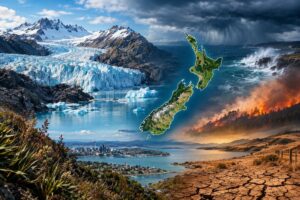
New Zealand’s reputation for dramatic mountains, glaciers, cool temperatures and pristine coastlines is facing a growing climate threat. A new government assessment has found that the country is already experiencing significant warming, while future climate projections point towards more intense heatwaves, shrinking glaciers, rising seas and increasingly severe extreme weather.
The findings come from Our Atmosphere and Climate 2026, a comprehensive assessment released by the New Zealand government. The report brings together long-term observations, climate indicators and scientific projections to show how the country’s climate is changing and what those changes could mean for communities and ecosystems. The picture emerging from the assessment is stark: New Zealand is getting warmer, and the changes are beginning to affect almost every part of the country’s climate system.
New Zealand has already warmed significantly
New Zealand’s average annual temperature has increased by about 1.36°C since nationwide measurements began in 1909. The warming trend has become particularly evident in recent years, with seven of the country’s ten warmest years occurring between 2016 and 2025. The increase is not limited to annual averages. Long-term observations show warming across different seasons and locations, with winter showing particularly widespread increases. Scientists expect temperatures to rise further in the decades ahead.
By the middle of this century, average temperatures could be between 0.75°C and 1.2°C above the 1995–2014 average, depending on how global greenhouse gas emissions develop. By the end of the century, the increase could range from around 0.8°C under a low-emissions pathway to as much as 3.2°C under a high-emissions scenario. One of the clearest consequences will be more heatwaves. They are expected to become more frequent, last longer and reach greater intensity, with northern parts of the North Island particularly exposed.
The warming is also transforming New Zealand’s glaciers. Glacier ice volume peaked at around 56 cubic kilometres in 1997 but had fallen to approximately 30 cubic kilometres by 2023. The losses are expected to accelerate. Depending on future emissions, New Zealand could lose a substantial share, and potentially almost all of its present glacier volume by 2100. That would represent not only a major change to the country’s iconic landscape but also a warning about wider changes in water systems and mountain ecosystems.
Rising seas and more dangerous extremes
The changes are not confined to the land. The oceans surrounding New Zealand are warming, with sea-surface temperatures projected to rise substantially by mid-century. Marine heatwaves are also expected to become more intense, placing additional pressure on marine ecosystems.
Sea levels present another major concern. The assessment projects that absolute sea levels around New Zealand could rise by more than 20 centimetres above the 1995–2014 average between 2045 and 2050, depending on the emissions pathway. The actual impact will vary from place to place because some parts of the country are sinking while others are experiencing land uplift. Rainfall patterns are also expected to shift. Much of the North Island could become drier by the end of the century, while western and southern parts of the South Island may receive more rainfall. But fewer rainy days will not necessarily mean less dangerous rain. Climate projections indicate that rainfall occurring during individual wet days is likely to become heavier. Under a high-emissions scenario, the maximum one-day rainfall could increase by 8–28 per cent by the end of the century compared with the 1985–2014 period.
Some extreme rainfall events could become much more common. Atmospheric rivers are long, concentrated corridors of moisture capable of producing intense rainfall, and are also projected to strengthen. In the South Island, the most extreme atmospheric-river events could occur nearly twice as often within the coming decades. Tropical cyclones may not become more frequent, but the rainfall associated with them is expected to become considerably heavier.
At the same time, New Zealand is facing a growing wildfire risk. More parts of the country are projected to experience weather conditions conducive to severe fires, while wildfire seasons are expected to become longer. The report ultimately highlights how climate change is not a single environmental problem. Rising temperatures are interacting with rainfall, oceans, glaciers, drought, storms and fire conditions, creating a complex chain of risks. For New Zealand, the findings underline the importance of cutting greenhouse gas emissions while preparing communities and infrastructure for a climate that is already changing. The scale of future impacts will depend heavily on the emissions pathway chosen today.
What once seemed like distant climate projections are increasingly becoming measurable changes in New Zealand’s mountains, seas, weather and landscapes.
References:
https://environment.govt.nz/publications/our-atmosphere-and-climate-2026
https://rmets.onlinelibrary.wiley.com/doi/10.1002/joc.70457
https://doi.org/10.1111/risa.17664Banner Image: AI generated
Sections of this article may have been developed with the assistance of artificial intelligence tools to support research, drafting, and language refinement. All information has been reviewed, edited, and verified by the author/editor to ensure accuracy, context, and editorial integrity. The responsibility for the final content, interpretations, and conclusions rests solely with the publisher.