Physical Address
23,24,25 & 26, 2nd Floor, Software Technology Park India, Opp: Garware Stadium,MIDC, Chikalthana, Aurangabad, Maharashtra – 431001 India
Physical Address
23,24,25 & 26, 2nd Floor, Software Technology Park India, Opp: Garware Stadium,MIDC, Chikalthana, Aurangabad, Maharashtra – 431001 India

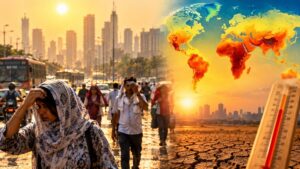
Climate change and extreme heat are reshaping daily life. Explore 2026 heat data, health risks and ways communities can stay safer.
Heat is becoming more than a short-lived summer inconvenience. A new global analysis shows how human-caused climate change is increasingly adding days of unusually high temperatures to people’s everyday lives, turning what was once occasional extreme heat into a more persistent risk.
More than 1.5 billion people experienced at least 30 days of risky heat between June and August 2026, according to an analysis by Climate Central. In India alone, 117 million people were exposed to at least 30 such days that were made more likely by climate change. China and Indonesia followed in Asia, with 94 million and 83 million people respectively. The analysis is significant because it does not simply count record-breaking temperatures. Instead, it looks at how climate change has altered the likelihood of the temperatures people actually experienced.
What counts as “risky heat”?
Climate Shift Index (CSI) examines daily average temperatures between June 1 and August 31, 2026, across 252 countries, territories and dependencies and 949 cities.
The study defines a “risky heat day” as a day when temperatures are hotter than 90 per cent of the temperatures historically recorded in a particular location during the same period between 1991 and 2020. This threshold is intended as a conservative approximation of the temperature range beyond which heat-related health risks begin to rise. The distinction matters. A temperature that is dangerous in one region may be relatively normal in another. People living in consistently hot climates can also have different levels of physiological and societal adaptation than populations accustomed to cooler conditions. By using local historical temperatures, the analysis attempts to account for these differences rather than applying one global temperature threshold. The CSI then examines how much more likely a particular temperature was in today’s climate compared with a world without human-caused climate change. A CSI level of 2, for example, means climate change made that temperature at least twice as likely. The findings show that the extra heat was widespread. More than one-quarter of the global population experienced temperatures with a strong climate-change influence on every day during the three-month period. Asia had the largest absolute population exposed to risky heat, with around 2.8 billion people experiencing at least 30 risky heat days.
Europe, however, experienced some of the strongest departures from its historical climate. Nearly 89 per cent of Europeans experienced at least a month of risky heat, while France and the Holy See recorded average summer temperatures around 3.5°C above their historical norms. Fifty-four countries also recorded their hottest June-August period in the 1970-2026 record.
India’s exposure shows why heat is a growing public-health concern
For India, the figure of 117 million people is particularly important because heat exposure is not distributed evenly across the population. Outdoor workers, agricultural labourers, construction workers, street vendors and people living without reliable access to cooling can face much greater exposure than the headline national number suggests.
Heat also does not operate in isolation. High temperatures can increase pressure on electricity systems as demand for cooling rises, affect labour productivity, worsen drought conditions and place additional strain on health services. When high temperatures persist overnight, the body also gets less opportunity to recover from daytime heat. The analysis found that prolonged heat coincided with impacts including wildfires, drought and additional pressure on emergency and health services in several parts of the world.
The findings also illustrate an important feature of climate change: its effects are not limited to dramatic one-day temperature records. A warming climate can gradually shift the baseline, increasing the frequency with which temperatures cross locally unusual or health-relevant thresholds. That makes adaptation increasingly important. Heat-health warning systems, cooler urban design, tree cover, access to drinking water, changes in working hours and stronger protection for vulnerable workers can reduce exposure. But adaptation has limits if the underlying temperature trend continues upward.
The analysis does not suggest that every hot day is caused by climate change. Weather patterns and natural climate variability still influence temperatures from day to day. Instead, attribution methods estimate how human-caused warming has changed the odds of experiencing particular temperatures. That distinction is crucial. Climate change is not replacing natural weather variability; it is shifting the baseline on which that variability operates. The result is a world in which temperatures that were once unusual are becoming more common. The growing number of risky heat days therefore represents not just a record of hotter summers, but a changing exposure to heat that governments, cities, employers and health systems will increasingly have to plan for.
References:
https://www.climatecentral.org/climate-matters/risky-summer-heat
https://pmc.ncbi.nlm.nih.gov/articles/PMC9281079
https://www.sciencedirect.com/science/article/pii/S0095069624000743
Banner Image: AI Generated
Sections of this article may have been developed with the assistance of artificial intelligence tools to support research, drafting, and language refinement. All information has been reviewed, edited, and verified by the author/editor to ensure accuracy, context, and editorial integrity. The responsibility for the final content, interpretations, and conclusions rests solely with the publisher.