Physical Address
23,24,25 & 26, 2nd Floor, Software Technology Park India, Opp: Garware Stadium,MIDC, Chikalthana, Aurangabad, Maharashtra – 431001 India
Physical Address
23,24,25 & 26, 2nd Floor, Software Technology Park India, Opp: Garware Stadium,MIDC, Chikalthana, Aurangabad, Maharashtra – 431001 India

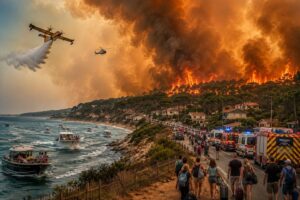
France is battling one of its most severe wildfire emergencies of the year, with thousands of residents and tourists forced to flee the scenic Cap Ferret peninsula as fast-moving flames engulf forests and threaten coastal communities. Fueled by scorching temperatures, strong winds and prolonged dry weather, the wildfire has prompted one of the country’s largest evacuation efforts in recent years.
Located along France’s Atlantic coast near Bordeaux, the Cap Ferret peninsula is famous for its sandy beaches, pine forests and vibrant summer tourism. However, the region has transformed into an emergency zone as the wildfire spread rapidly through dense woodland. Authorities evacuated villages, campsites and holiday accommodations, urging people to leave immediately as the blaze advanced toward inhabited areas.
The evacuation posed unique logistical challenges because the peninsula is connected to the mainland by a single main road. To avoid traffic congestion and ensure people could leave safely, emergency officials coordinated evacuations by both road and sea. Hundreds of boats were deployed to transport residents and visitors, while police managed vehicle movement to prevent bottlenecks. The coordinated response helped thousands escape before the flames reached populated areas.
Firefighters have been working tirelessly to contain the blaze despite difficult conditions. Hundreds of emergency personnel, supported by firefighting aircraft, helicopters and specialized vehicles, have been deployed to battle the flames. France has also sought assistance through European emergency cooperation mechanisms to strengthen firefighting efforts as the fire continued to spread across vast stretches of forest.
Extreme Weather Intensifies the Wildfire Crisis
Experts say the wildfire has been intensified by an extended period of hot, dry weather that has left forests extremely vulnerable. Southwestern France has experienced unusually low rainfall and persistent heat, creating ideal conditions for vegetation to ignite and burn rapidly. Strong winds have further complicated firefighting efforts by carrying burning embers over long distances, allowing new fires to ignite far ahead of the main blaze.
The Cap Ferret wildfire is part of a broader pattern of devastating fires affecting southern Europe this summer. Several regions in neighboring Spain have also experienced major wildfires, leading to large-scale evacuations and stretching emergency response resources. The growing number of simultaneous fires has highlighted the increasing challenges European countries face during the summer fire season.
Scientists have repeatedly warned that climate change is making wildfires more frequent, intense and difficult to control. Rising global temperatures, prolonged droughts and longer heatwaves have extended the traditional wildfire season across many parts of Europe. As forests become drier for longer periods, even small ignition sources can quickly develop into large and destructive fires.
Environmental and Economic Impact
Beyond the immediate danger to human life, the wildfire is expected to have lasting environmental and economic consequences. The Gironde region, home to Cap Ferret, relies heavily on tourism during the summer months. Hotels, restaurants, campsites and local businesses have been forced to suspend operations as visitors were evacuated, resulting in significant financial losses during the peak holiday season.
The destruction of large forested areas also threatens local biodiversity. Although some Mediterranean and Atlantic coastal forests can regenerate naturally, repeated high-intensity wildfires can permanently damage ecosystems, reduce wildlife habitats and increase the risk of soil erosion. Smoke from the fires has also affected air quality, posing health risks for nearby communities, particularly children, older adults and individuals with respiratory illnesses.
Authorities continue to monitor weather conditions closely, warning that shifting winds could alter the fire’s direction and require additional evacuations. Emergency crews remain focused on protecting homes, infrastructure and lives while working to prevent the flames from spreading further.
The wildfire crisis at Cap Ferret underscores Europe’s growing vulnerability to climate-driven natural disasters. As extreme weather events become more common, governments are placing greater emphasis on wildfire prevention, improved forest management, early warning systems and international cooperation in disaster response. For now, thousands of displaced residents remain hopeful that firefighters will soon bring the blaze under control, allowing them to return safely to their homes and begin the long process of recovery.
References:
https://www.theguardian.com/world/2026/jul/24/france-evacuation-cap-ferret-peninsula-wildfire
Banner Image: AI generated
Sections of this article may have been developed with the assistance of artificial intelligence tools to support research, drafting, and language refinement. All information has been reviewed, edited, and verified by the author/editor to ensure accuracy, context, and editorial integrity. The responsibility for the final content, interpretations, and conclusions rests solely with the publisher.