Physical Address
23,24,25 & 26, 2nd Floor, Software Technology Park India, Opp: Garware Stadium,MIDC, Chikalthana, Aurangabad, Maharashtra – 431001 India
Physical Address
23,24,25 & 26, 2nd Floor, Software Technology Park India, Opp: Garware Stadium,MIDC, Chikalthana, Aurangabad, Maharashtra – 431001 India

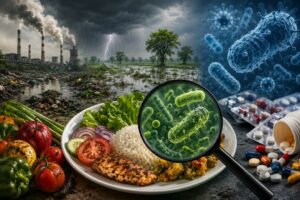
Food poisoning is no longer just a matter of eating contaminated food and suffering from a stomach infection. Experts are warning that food-borne illnesses in India are becoming increasingly complicated due to a dangerous mix of chemical contaminants, climate change, and antimicrobial resistance (AMR). These emerging challenges are making food safety a far more serious public health issue and demand urgent action from policymakers and health authorities.
India already faces a significant burden of food-borne diseases. Millions of cases of food-related illnesses occur every year, with diarrhoeal diseases and bacterial infections remaining common causes of sickness and even death. However, the factors driving these illnesses are changing rapidly, making prevention and treatment much more difficult than before.
Climate Change and Chemical Contaminants Add New Risks
Climate change is altering the way food-borne pathogens survive and spread. Rising temperatures, changing rainfall patterns, floods and prolonged periods of heat create favourable conditions for bacteria, viruses and parasites that contaminate food and water. Experts say that warmer conditions can increase the growth of harmful microorganisms and extend the period during which food contamination can occur.
Extreme weather events are also disrupting food production systems. Flooding can contaminate crops and drinking water with sewage and disease-causing organisms, while droughts can reduce water availability and affect hygiene practices. These environmental changes increase the likelihood of outbreaks of food-borne diseases and place additional pressure on already-strained public health systems.
Another major concern is the growing presence of chemical contaminants in the food chain. Heavy metals, pesticides, industrial pollutants and naturally occurring toxins can accumulate in food products and pose serious health risks. Scientists have also warned that the increasing frequency of harmful algal blooms in Indian waters could expose consumers to toxins through seafood consumption. Such contaminants not only cause immediate health problems but can also lead to long-term illnesses, including neurological disorders and cancers.
The complexity of food safety is further heightened by globalisation and changing dietary habits. As food travels across longer supply chains and consumer demand for processed and ready-to-eat products increases, the chances of contamination at multiple stages of production and distribution also rise. Ensuring food safety, therefore, requires a coordinated approach that addresses risks from farms to dining tables.
The Challenge of Antimicrobial Resistance
Perhaps the most alarming threat linked to food-borne diseases is antimicrobial resistance. AMR occurs when bacteria evolve and become resistant to antibiotics that once effectively killed them. This means that infections caused by these resistant microbes become harder, and sometimes impossible, to treat.
India is considered one of the countries most affected by AMR. Experts have warned that antibiotic misuse in humans, livestock and agriculture is accelerating the emergence of resistant bacteria. Resistant microorganisms can spread through contaminated food, water and the environment, turning routine food poisoning cases into serious medical emergencies.
The situation is particularly concerning because the pipeline for developing new antibiotics is extremely limited. Many common antibiotics are losing their effectiveness while very few new drugs are being developed to replace them. As a result, infections that were once easily treatable may become increasingly difficult and expensive to manage.
Experts argue that India needs to strengthen its food safety and disease surveillance systems. Better monitoring of food contamination, stronger laboratory networks, improved data sharing between health and agriculture sectors, and greater public awareness are essential steps. Adopting a “One Health” approach, which recognises the interconnectedness of human, animal and environmental health, could also play a critical role in addressing these emerging threats.
Food safety can no longer be viewed solely through the lens of hygiene and sanitation. Climate change, environmental pollution and antimicrobial resistance have fundamentally changed the nature of food-borne illnesses. As these challenges continue to grow, India faces an urgent need to modernise its food safety systems and invest in preventive measures. Failure to act now could make food-borne diseases more frequent, more severe and far harder to treat in the years ahead.
References:
https://pmc.ncbi.nlm.nih.gov/articles/PMC10278375
https://pmc.ncbi.nlm.nih.gov/articles/PMC11042131
https://www.who.int/news-room/fact-sheets/detail/antimicrobial-resistance
https://www.sciencedirect.com/science/article/pii/S0956713525004001
https://www.sciencedirect.com/science/article/pii/S2666027X25000544
Banner Image: AI Generated
Sections of this article may have been developed with the assistance of artificial intelligence tools to support research, drafting, and language refinement. All information has been reviewed, edited, and verified by the author/editor to ensure accuracy, context, and editorial integrity. The responsibility for the final content, interpretations, and conclusions rests solely with the publisher.