Physical Address
23,24,25 & 26, 2nd Floor, Software Technology Park India, Opp: Garware Stadium,MIDC, Chikalthana, Aurangabad, Maharashtra – 431001 India
Physical Address
23,24,25 & 26, 2nd Floor, Software Technology Park India, Opp: Garware Stadium,MIDC, Chikalthana, Aurangabad, Maharashtra – 431001 India

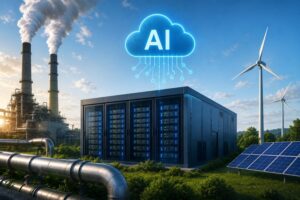
The rapid expansion of artificial intelligence is creating a new energy challenge in the United Kingdom. As technology companies compete to build advanced data centres for AI systems, many are now considering an unexpected solution to electricity shortages: generating their own power by burning natural gas. What was once seen only as an emergency backup option is gradually becoming part of long-term infrastructure planning. This shift has sparked concerns about climate commitments, rising emissions, and the environmental cost of the AI revolution.
The demand for data centres has increased sharply over the last two years. Industry experts say more than 100 proposed data centre projects in the UK have applied for gas connections because of delays in securing access to the National Grid. Together, these facilities are expected to require enormous amounts of electricity every year. AI systems depend on thousands of high-performance computer chips operating continuously, making them far more energy-intensive than traditional digital services.
Britain’s electricity infrastructure is struggling to meet this sudden growth in demand. Energy regulators have reportedly received requests for data centre projects requiring far more power than the current system can provide. Developers fear that waiting several years for grid approvals could delay investments and reduce the country’s competitiveness in the global AI race. As a result, many companies are exploring private gas-powered generation systems to ensure a stable energy supply.
This marks a major shift in the technology industry’s approach to power generation. In earlier years, gas systems were mainly used only during emergencies. However, some companies are now planning permanent gas-powered facilities capable of generating large amounts of electricity on-site. While this may solve short-term energy problems, it also raises serious environmental concerns.
Environmental Concerns and Climate Commitments
Environmental organisations argue that increasing dependence on gas-powered energy directly threatens the UK’s climate goals. Britain has committed to reducing fossil fuel use and moving toward cleaner energy systems under its long-term net-zero strategy. Experts warn that if AI infrastructure continues to rely on natural gas, carbon emissions could rise significantly at a time when the country is trying to accelerate decarbonisation.
The issue also highlights a larger global debate about the hidden environmental impact of artificial intelligence. Recent studies suggest that data centres already consume a substantial share of electricity supplies in countries such as the UK and the United States. The rapid growth of AI technologies has increased energy demand much faster than many experts expected. Without major improvements in renewable energy generation and electricity infrastructure, energy systems may struggle to keep pace.
Similar concerns have already emerged in the United States, where several AI-related facilities reportedly depend heavily on gas-fired electricity. Environmental groups have criticised companies for prioritising rapid expansion over sustainability. Critics fear the UK may now follow the same path as governments and businesses compete to secure leadership in artificial intelligence technologies.
Public opinion on the issue remains divided. Some people believe the energy demands of AI are becoming unrealistic and unsustainable. Others argue that not all proposed projects will eventually be completed because of financial, environmental, and infrastructure limitations. At the same time, supporters of AI expansion view data centres as essential national infrastructure similar to transportation or communication networks. They believe artificial intelligence could drive economic growth, scientific research, healthcare improvements, and industrial innovation.
Balancing Economic Growth and Sustainability
The UK now faces a difficult balancing act between economic growth, digital expansion, and environmental responsibility. Artificial intelligence promises major benefits for businesses and society, but supporting this technological growth requires enormous amounts of reliable electricity. If renewable energy and grid expansion cannot keep up with demand, fossil fuels may continue filling the gap despite climate concerns.
The situation reveals an important reality about modern digital technology. Although AI often appears virtual and invisible, the systems behind it rely heavily on physical infrastructure, including electricity, cooling systems, land, water, and industrial-scale computing equipment. The environmental impact of these systems is becoming increasingly difficult to ignore.
As the AI boom continues, governments around the world will likely face similar challenges. The future of artificial intelligence may depend not only on technological innovation but also on whether countries can build sustainable energy systems that support the digital age without increasing environmental damage.
References:
https://www.sciencedirect.com/science/article/pii/S2666519025000950
https://www.oxfordenergy.org/wpcms/wp-content/uploads/2025/05/OEF-145.pdf
https://www.sciencedirect.com/science/article/pii/S266679242500037X
https://researchbriefings.files.parliament.uk/documents/CBP-10315/CBP-10315.pdf
Banner Image: AI Generated
Sections of this article may have been developed with the assistance of artificial intelligence tools to support research, drafting and language refinement. All information has been reviewed, edited and verified by the author/editor to ensure accuracy, context and editorial integrity. The responsibility for the final content, interpretations and conclusions rests solely with the publisher.