Physical Address
23,24,25 & 26, 2nd Floor, Software Technology Park India, Opp: Garware Stadium,MIDC, Chikalthana, Aurangabad, Maharashtra – 431001 India
Physical Address
23,24,25 & 26, 2nd Floor, Software Technology Park India, Opp: Garware Stadium,MIDC, Chikalthana, Aurangabad, Maharashtra – 431001 India
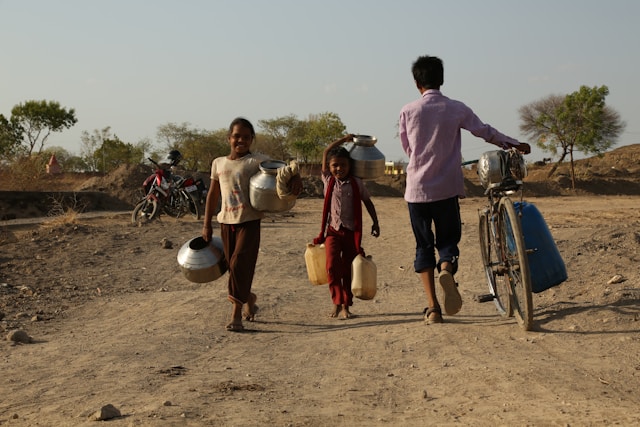
As the world marks World Water Day 2026 on March 22, a new survey by Climate Fact Checks reveals a quiet but accelerating urban crisis, one that is no longer confined to parched villages or drought headlines. It is unfolding inside homes, across apartment complexes, and through the everyday uncertainty of turning on a tap.
The findings are stark. A staggering 85% of respondents say they would consider leaving their cities if water becomes scarce or unsafe. This is not a distant fear. It is a present calculation.
Behind this statistic lies a deeper breakdown of trust, infrastructure, and predictability. Residents across cities report erratic rainfall, shrinking groundwater reserves, unreliable supply, and a growing dependence on private water markets. What emerges is not just a resource shortage, but a systemic failure that is quietly reshaping how people live, spend, and plan their futures.
At Climate Fact Checks, we believe that data-driven awareness is the first step toward meaningful change. To bridge the gap between global policy and local reality, we circulated a survey to capture the experiences, fears, and ideas of our community.
This investigation, based on responses from a diverse urban cross-section, goes beyond surface-level data. It captures something harder to quantify: a collective anxiety about whether cities themselves can remain habitable in a warming world.
Because this is no longer just about water.
It is about the point at which scarcity turns into displacement and whether we are closer to that threshold than we think.
Why We Surveyed: Mapping the Local Crisis
Climate change is often discussed in terms of melting glaciers or rising sea levels, but for many, it is first experienced as a change in water availability. We launched this survey to document how urban water systems are holding up under the pressure of erratic weather patterns and growing populations. We wanted to move beyond anecdotal evidence and look at the hard numbers: How often are people facing shortages? Do they trust their city’s infrastructure? And how far are they willing to go, including relocating their families, if the taps run dry?
Our survey captured a diverse cross-section of urban experiences, providing a localized snapshot of the water crisis across India and beyond. These results serve as both a diagnostic tool for our current infrastructure and a definitive wake-up call for our future.
What We Found: A Community in Transition
The data from our survey reveals a deep-seated anxiety about the future, coupled with a daily struggle for basic access.
1. The End of Predictable Rainfall
One of the most striking findings is the perception of changing weather.
When asked about the rainfall pattern change in the last 5-10 years in the respondent’s city:
Nearly 48% of respondents reported that rainfall has become more erratic, characterized by heavy bursts followed by long dry spells. Another 35% noted that there is simply less rain overall compared to a decade ago. This shift makes it incredibly difficult for traditional urban drainage and storage systems to function effectively, leading to the dual threats of flooding and drought.
2. The 24-Hour Myth
While half of our respondents (50%) enjoy 24-hour piped water, the other half lives in a state of “water rationing.” Approximately 30% receive water for only 8 to 12 hours a day, and a significant 13% must manage with less than 4 hours of supply. This discrepancy highlights a growing “water divide” in our cities. Furthermore, 61% of participants reported experiencing water shortages either “occasionally” or “frequently” in the last three years.
3. The Rising Cost of Scarcity
When the municipal taps fail, the private market steps in, at a price. Over 72% of respondents have had to buy water from tankers or cans in the last two years. For nearly 19%, this has become a “frequent” necessity. This hidden tax on citizens is a direct result of failing infrastructure and depleted groundwater.
4. A Vote of No Confidence
When asked would they consider relocating If water became scarce or polluted in their area:
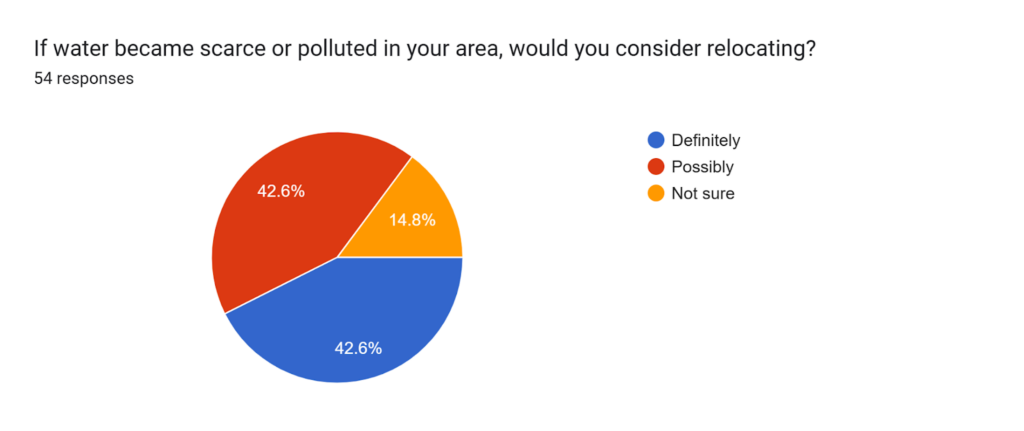
Perhaps most concerning is the lack of faith in urban preparedness. A staggering 66.7% of respondents believe their city is “not prepared” for future climate-driven water challenges. This fear is translating into drastic life choices: 85% of people admitted they would “definitely” or “possibly” consider relocating if water became scarce or polluted in their area. We are no longer talking about a resource issue; we are talking about the potential for mass migration driven by water insecurity.
Qualitative Voices: From the Frontline
While the percentages provide a bird’s-eye view of the crisis, the true gravity of the situation is found in the individual stories of those living through it. Our respondents’ exact words reveal a pattern of failing infrastructure and environmental neglect that spans the entire country.
In the rapidly expanding technology hubs of the south, the pressure on natural ecosystems has reached a breaking point. Rajshree Sharma from Bengaluru highlighted the exhausting daily struggle for a basic necessity:
“…we have to rely on tankers for freshwater supply due to water shortage in the city.”
In the arid regions of Rajasthan, the concern shifts from the surface to what is happening beneath our feet. In Jaipur, Radhika Sharma pointed to a seasonal crisis that is becoming the new norm:
“Water shortage in summers.” Others in the same region, like Sangita Charovarty, noted that this isn’t just a seasonal dip but a permanent loss, citing “ground water resources depletion” as the primary threat to her city’s survival.
In the Chhatrapati Sambhajinagar area of Maharashtra, the frustration is directed toward the management of resources. Harish provided a stark description of life under extreme rationing and a perceived lack of accountability:
“Water supply is erratic. The local body and state government have done massive corruption over the years leaving the city with water supply for 1 hour every week. The water crisis is extreme in our city.”
Finally, in Assam, the challenge is not just the quantity of water, but its safety. While the region is often associated with high rainfall, the chemical quality of groundwater is a major health hazard. Ranjan Goswami from Jorhat highlighted a dangerous, invisible reality:
“Presence of iron and arsenic in ground water.”
These voices prove that the water crisis is not a singular problem with a singular solution. It is a complex web of rapid urbanization, mismanagement, and environmental degradation that requires urgent, localized action.
Measures to Take: A Shared Path Forward
The survey results paint a challenging picture, but they also point toward a consensus on how to move forward. 57.4% of respondents believe that solving the water crisis is a “shared responsibility” between the government and citizens.
1. Aggressive Rainwater Harvesting
Something that a majority of our respondents have stressed upon is Rainwater Harvesting. Given that rainfall is becoming more erratic (heavy bursts), we must mandate and subsidize rainwater harvesting at every level. We cannot afford to let “flash floods” go to waste; that water must be captured to recharge our depleting aquifers.
2. Decentralized Technology
Respondents suggested “adapting technology for water distribution” to ensure equitable access. Smart meters and AI-driven leak detection can help municipal bodies reduce the massive amounts of water currently lost to “mismanagement.”
3. Transparency and Accountability
The fear of corruption and poor governance is a major barrier to progress. We need “Water Audits” for every ward, where the quality and quantity of supply are publicly reported. If citizens are to pay for water, they must be assured it is not contaminated with sewage or heavy metals.
4. Youth Engagement through Innovation
To encourage the next generation, we must move beyond posters and slogans. Our community suggested “gamifying” water saving and creating “youth-led water patrols” that use technology to map and report leaks in real-time.
Conclusion: Every Drop is a Decision
World Water Day 2026 is not just a date on the calendar; it is a deadline. Our survey shows that while climate change is the catalyst, our vulnerability is a choice. We have a community that is aware, concerned (with an average seriousness rating of 4.3/5), and ready to take action.The data is in our hands.
Now, the question is whether we will wait for the next shortage to act, or if we will use this insight to build cities that can withstand the storms and droughts of the future. Let’s make 2026 the year we stop taking water for granted.
Banner Image: Photo by Luis Tosta on Unsplash