Physical Address
23,24,25 & 26, 2nd Floor, Software Technology Park India, Opp: Garware Stadium,MIDC, Chikalthana, Aurangabad, Maharashtra – 431001 India
Physical Address
23,24,25 & 26, 2nd Floor, Software Technology Park India, Opp: Garware Stadium,MIDC, Chikalthana, Aurangabad, Maharashtra – 431001 India

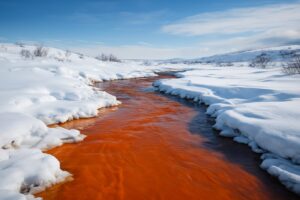
A recent study highlights the increasingly complex effects of climate change, researchers have uncovered a phenomenon that is transforming the color and composition of Arctic rivers. A new study from Umeå University in Sweden reveals that ice, as it freezes and thaws in extreme cold, fuels hidden chemical reactions that could explain why many Arctic rivers are now turning rusty orange. This unexpected shift in water color is linked to the release of iron from minerals in the soil and permafrost as the region warms, providing a stark visual cue of how climate change is impacting the environment.
Ice as a Hidden Chemical Reactor
For decades, scientists have believed that freezing temperatures slow down chemical reactions. But according to this groundbreaking study, ice actually plays an active role in dissolving iron minerals—more effectively than liquid water at slightly warmer temperatures. In fact, the research shows that ice at minus 10 degrees Celsius (14 degrees Fahrenheit) can dissolve iron from minerals at a faster rate than liquid water at 4 degrees Celsius (39.2 degrees Fahrenheit), challenging conventional wisdom about frozen environments.
Jean-François Boily, Professor at Umeå University and co-author of the study, explains that this finding is counterintuitive but significant. “Ice is not just a passive frozen block,” he says. “It creates microscopic pockets of liquid water between ice crystals, which act like chemical reactors. In these pockets, compounds become concentrated and extremely acidic, allowing them to react with iron minerals, even at temperatures as low as minus 30 degrees Celsius (-22 degrees Fahrenheit).”
The Role of Freeze-Thaw Cycles
What makes this discovery even more alarming is the role of freeze-thaw cycles. As temperatures in the Arctic warm and cool more frequently, these cycles become more common. Researchers found that the repeated freezing and thawing of ice enhances the process of iron dissolution. During these cycles, organic compounds that were previously trapped in the ice are released, further fueling chemical reactions that dissolve iron from minerals in the soil and permafrost.
Angelo Pio Sebaaly, a doctoral student and first author of the study, notes that “as the climate warms, freeze-thaw cycles become more frequent. Each cycle releases more iron from soils and permafrost into the water.” This ongoing process can have significant implications for water quality and aquatic ecosystems across vast areas, particularly in Arctic regions where rivers and lakes are already struggling to cope with the challenges of climate change.
How Ice Interacts with Iron Minerals
To better understand how this process works, the researchers focused their attention on a common iron oxide mineral called goethite, which is widespread in the Arctic and other cold regions. They combined goethite with a naturally occurring organic acid and used advanced microscopy and experimental techniques to observe how ice interacted with the mineral at various temperatures.
Their findings revealed that the freeze-thaw cycles make iron dissolve more efficiently. At freezing temperatures, the acidic liquid pockets that form between the ice crystals dissolve iron at a faster rate, releasing it into surrounding soils and rivers. This dissolved iron can then stain the water with a rusty orange hue, a visible sign of the changing landscape.
Salinity, too, plays an important role in this process. Freshwater and brackish water are more effective at dissolving iron, while seawater can suppress the dissolution. This suggests that the phenomenon may vary depending on the composition of the water in different Arctic regions.
Furthermore, the release of iron into these systems can alter the chemical makeup of the soil and water, affecting everything from microbial communities to plant growth. With the Arctic warming faster than other parts of the world, these changes could accelerate, creating cascading effects on local ecosystems and even global atmospheric systems, given the Arctic’s crucial role in the Earth’s climate.
A Broader Environmental Concern
This study also highlights the broader environmental impact of ice in polar and mountainous regions. As these areas warm, the frequency of freeze-thaw cycles is expected to increase, not just in the Arctic but across mountain ranges around the world. Such changes could affect a variety of ecosystems and contribute to the natural cycling of elements in ways that were previously underestimated.
Moreover, the findings may have implications beyond the Arctic. Acidic environments such as mine drainage sites, acid sulfate soils along the Baltic Sea coast, and even frozen dust in the atmosphere could be similarly affected by freeze-thaw cycles. The dissolution of iron from minerals in these areas could lead to a variety of environmental challenges, particularly as human activities continue to exacerbate climate change.
Looking Ahead: Ongoing Research
As researchers continue to study the dynamics of iron dissolution in freezing environments, their next step is to determine whether the same process occurs with all iron-bearing ice, not just in Arctic regions. The Boily laboratory is already working on further experiments to answer this question, with the goal of understanding the broader implications of this phenomenon for environmental science and policy.
In conclusion, the discovery of how ice triggers chemical reactions that release iron into Arctic rivers is both shocking and enlightening. As climate change accelerates and freeze-thaw cycles become more frequent, these once-hidden processes could have profound effects on the Arctic’s ecosystems and beyond. The rusty orange rivers are a visible sign of just how much the world’s coldest regions are changing—and how much more there is to learn about the complex interplay between climate change and the natural world.
References:
https://www.pnas.org/doi/10.1073/pnas.2507588122
https://www.sciencedaily.com/releases/2025/09/250922074938.htm
https://pmc.ncbi.nlm.nih.gov/articles/PMC10793949
Banner Image: AI Generated

Comments are closed.





I could not refrain from commenting. Perfectly written!