Physical Address
23,24,25 & 26, 2nd Floor, Software Technology Park India, Opp: Garware Stadium,MIDC, Chikalthana, Aurangabad, Maharashtra – 431001 India
Physical Address
23,24,25 & 26, 2nd Floor, Software Technology Park India, Opp: Garware Stadium,MIDC, Chikalthana, Aurangabad, Maharashtra – 431001 India

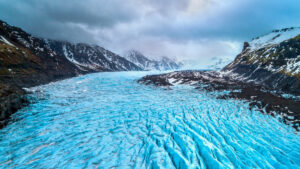
Glaciers have long stood as symbols of stability — slow-moving rivers of ice that shaped landscapes and sustained ecosystems for centuries. Today, that sense of permanence is rapidly fading. Scientists now warn that the world is approaching a dangerous milestone in climate change: a period when thousands of glaciers could vanish entirely each year. If global warming continues unchecked, this wave of glacier loss may peak around the middle of this century, marking one of the most visible and irreversible consequences of a heating planet.
Recent research shows that the planet could soon experience what scientists call “peak glacier extinction” — the point at which the number of glaciers disappearing annually reaches its highest level. Under the most severe warming scenarios, as many as 4,000 glaciers could disappear every year by the 2050s. Even under more optimistic climate pathways, the annual loss would still be staggeringly high, far beyond anything observed in the past.
Unlike gradual thinning or retreat, glacier extinction refers to glaciers shrinking so much that they effectively cease to exist. These are not just losses of ice mass; they are permanent erasures of distinct natural features. While many of the glaciers at greatest risk are small, their disappearance carries outsized consequences for local communities, ecosystems, and cultural heritage.
A New Way of Measuring Climate Loss
Traditionally, scientists have tracked glacier health by measuring how much ice they lose each year. This remains vital for understanding sea-level rise and freshwater availability. However, counting how many glaciers disappear altogether offers a different and deeply human perspective on climate change. Each lost glacier represents a unique landscape feature that will never return within human timescales.
Many small glaciers contribute little to global sea levels, yet they play critical roles locally. They regulate mountain ecosystems, support tourism, and serve as important water sources during dry seasons. In several regions, glaciers are also deeply woven into cultural and spiritual traditions. Their disappearance, therefore, represents not only an environmental loss but also a social and emotional one.
Warming Levels Matter — But No Scenario Is Safe
The speed and scale of glacier loss depend heavily on how much the planet warms. If global temperature rise is limited to around 1.5°C above pre-industrial levels, the annual disappearance of glaciers would still roughly double compared to today, peaking at around 2,000 per year in the early 2040s. While this scenario would preserve more ice overall, it would not prevent widespread glacier extinction.
Under current climate policies, which put the world on track for roughly 2.5–3°C of warming, the peak could reach about 3,000 glaciers lost per year between 2040 and 2060. In the most extreme scenario, where warming approaches 4°C, annual glacier losses could soar to around 4,000. By the end of the century, these differences become even more stark. With strong climate action, roughly half of today’s glaciers could survive. Under current trends, only about one-fifth may remain. In the highest warming scenario, glaciers could all but disappear from most regions of the world.
Uneven Impacts Across Regions
Glacier loss will not occur evenly. Regions dominated by small glaciers — such as the European Alps, parts of the Andes, and northern Asia — are expected to experience the fastest and earliest losses. In many of these areas, more than half of existing glaciers could vanish within the next two decades.
Larger glaciers and ice fields, including those in Greenland, Alaska, and parts of High Mountain Asia, are likely to persist longer. However, even these massive ice bodies are expected to shrink dramatically later in the century as warming intensifies. These regional differences have real-world consequences. Millions of people depend on glacier meltwater to support agriculture, hydropower, and drinking water supplies. As glaciers disappear, water availability may become more unpredictable, increasing the risk of shortages during dry seasons and contributing to long-term water stress.
References:
https://www.cnn.com/2025/12/15/climate/glaciers-disappearing-4000-a-year
https://education.nationalgeographic.org/resource/glacier-moving-rivers-ice
https://www.newscientist.com/article/2508713-the-world-will-soon-be-losing-3000-glaciers-every-year/
Banner Image: Photo by tawatchai07 on Freepik