Physical Address
23,24,25 & 26, 2nd Floor, Software Technology Park India, Opp: Garware Stadium,MIDC, Chikalthana, Aurangabad, Maharashtra – 431001 India
Physical Address
23,24,25 & 26, 2nd Floor, Software Technology Park India, Opp: Garware Stadium,MIDC, Chikalthana, Aurangabad, Maharashtra – 431001 India

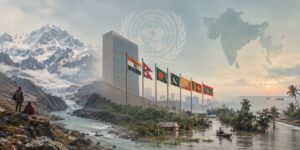
As world leaders gathered in New York for the 81st session of the United Nations General Assembly, climate change emerged as a recurring concern in the main General Debate speeches of several South Asian leaders
For countries ranging from the Himalayan mountains to the low-lying delta of Bangladesh, climate change is no longer presented simply as a future environmental problem. The leaders’ speeches framed it as a threat to infrastructure, food and water security, development, livelihoods and, increasingly, national resilience.
Among the region’s leaders, Nepal’s Prime Minister Balendra Shah placed climate change particularly prominently at the centre of his UNGA address, while the prime ministers of Bangladesh, Pakistan and Bhutan also referred to climate-related challenges and the need for international cooperation.
Nepal: A warning from the Himalayas
Nepal’s Prime Minister Balendra Shah delivered perhaps the most direct climate-focused speech among the South Asian leaders at UNGA 81.
Speaking on 24 September, Shah began by describing the catastrophic flash floods that had recently struck Nepal’s mountain communities. He presented the disaster not simply as a national tragedy but as a warning about the consequences of a changing climate.
“The Bhotekoshi-Trishuli disaster was not just a local tragedy, it was a warning to the world.”
Shah connected the disaster to a warming climate and the destabilisation of the Himalayan environment. His speech referred to melting permafrost, unstable mountain slopes, glaciers, floods, landslides and cascading hazards.
He also stressed that climate change does not respect national borders. The impacts of Himalayan disasters can extend across Nepal, China and India through interconnected river systems and ecosystems.
Read the full speech from Nepal’s Ministry of Foreign Affairs
For Shah, however, the issue went beyond disaster preparedness. He framed it as a question of climate justice.
Nepal, he noted, contributes only a small share of global greenhouse-gas emissions, yet faces severe consequences from climate change. He argued that countries with greater historical contributions and greater capacity should do more to address the crisis. In his address, he mentioned about Sri Lanka too and said Sri Lanka also facing challenges related to climate change as a small country in South Asia who contribute a little to the global climate change.
His proposed response included the establishment of a Himalayan Climate Resilience Mechanism involving Nepal, India, and China. The proposed mechanism would facilitate the sharing of satellite information and expertise, monitoring of dangerous glacial lakes and stronger cross-border early-warning systems.
The proposal reflects a broader argument in Shah’s speech: Himalayan countries cannot manage a rapidly changing mountain environment through national action alone.
Bangladesh: Climate justice and adaptation
Bangladesh’s Prime Minister Tarique Rahman also placed climate change among the country’s major concerns in his first address to the General Debate of the UNGA.Bangladesh is particularly exposed to flooding, cyclones, sea-level rise and other climate-related hazards because of its low-lying geography and dense population.
In his 24 September address, Rahman said Bangladesh is among the countries most vulnerable to climate change despite making only a small contribution to global carbon emissions.Rather than focusing exclusively on international demands, however, he also outlined measures Bangladesh is taking domestically.
These include a programme to plant 250 million trees over five years, increased emphasis on clean and solar energy, and plans to excavate 20,000 kilometres of canals to help address flooding and drought.
Bangladesh also highlighted the importance of protecting the Sundarbans, the world’s largest mangrove forest, and improving water management through projects including the Teesta Master Plan and Padma Barrage project.At the international level, Rahman called for stronger action on climate justice, climate finance and adaptation assistance, particularly as countries prepare for COP31.
Full text of Prime Minister Tarique Rahman’s UNGA speech
Bangladesh’s message therefore combined two arguments: vulnerable countries need greater international support, but they are also pursuing their own adaptation and environmental measures.
Pakistan: Climate responsibility and finance
Pakistan’s Prime Minister Shehbaz Sharif also brought climate change into his UNGA 81 address on 25 September.
Pakistan has experienced repeated climate-related disasters in recent years, including devastating floods. In his speech, Sharif emphasised the disparity between Pakistan’s relatively small contribution to global greenhouse-gas emissions and the severity of the climate impacts it experiences.He called on developed countries to meet their climate-finance commitments, accelerate support for loss and damage, and assist developing countries with adaptation and resilience.
Sharif connected climate action with the broader theme of the 81st General Assembly: restoring trust in multilateral cooperation.
“We will restore trust when those who fueled the climate crisis protect those who suffer most from its devastating consequences.”
The statement reflects a position that has become increasingly common among developing countries: climate action cannot be separated from questions of responsibility, financing and equity.
Pakistan’s position was also visible elsewhere during the UNGA week. At the high-level meeting on sea-level rise, Pakistan’s representative described sea-level rise as a direct consequence of climate change and highlighted risks to the Indus Delta and Sindh, including salinity intrusion, ocean warming and impacts on fisheries and coastal livelihoods.
Bhutan: Development without abandoning nature
Bhutan’s Prime Minister Tshering Tobgay approached climate and environmental issues somewhat differently.
His main UNGA 81 speech focused heavily on Bhutan’s proposed Gelephu Mindfulness City, presenting it as a model for combining economic development, technology and environmental protection.
Tobgay described the proposed city as being developed within a landscape that includes forests, rivers and wildlife. He stressed that Bhutan does not see nature as an obstacle to economic development.
The country’s renewable-energy ambitions also featured in the speech. Bhutan is seeking to expand its renewable energy capacity significantly, with the electricity intended to support new economic activities, including advanced manufacturing, scientific research and data centres.
The speech therefore presented a somewhat different climate narrative from those of Nepal, Bangladesh and Pakistan: rather than focusing primarily on climate losses and finance, Bhutan emphasised how economic transformation could take place while retaining environmental values.
Four countries, different vulnerabilities
The speeches reveal how diverse South Asia’s climate vulnerabilities are.
For Nepal, the focus is on mountains, glaciers, floods and the stability of the Himalayan ecosystem.For Bangladesh, low-lying geography, floods, water management and the vulnerability of densely populated communities are central concerns.For Pakistan, climate disasters, adaptation, resilience and the question of climate finance dominate the discussion.For Bhutan, the emphasis is more closely connected to maintaining environmental integrity while pursuing economic transformation and renewable energy.
Yet there is a common thread running through all four speeches: climate change is increasingly being discussed as a development and security issue rather than solely as an environmental issue.
A shared demand for international actionThe speeches also demonstrate a familiar South Asian argument in international climate diplomacy.The region’s countries have contributed relatively little to historical global greenhouse-gas emissions compared with major industrialised economies, while facing substantial exposure to climate-related hazards.That imbalance underpins calls for greater climate finance, adaptation assistance, technology transfer and international cooperation.
Nepal’s proposal for a Himalayan resilience mechanism illustrates the regional dimension of the problem. Bangladesh’s emphasis on adaptation and climate finance highlights the financial dimension. Pakistan’s demand for support for loss and damage brings questions of responsibility and equity to the forefront. Bhutan’s approach highlights the possibility of linking environmental protection with economic development.
What Sri Lanka and India Foreign Ministers Said at UNGA
Prime Ministers or Presidents of both India and Sri Lanka did not attend the 81st UNGA, national statements were delivered by the foreign ministers.
India and Sri Lanka also brought climate concerns into their national statements at UNGA 81, although neither speech was devoted primarily to climate change. India was represented by External Affairs Minister S. Jaishankar, who delivered the country’s national statement, while Sri Lanka’s Foreign Minister Vijitha Herath addressed the General Debate on 28 September. India’s statement placed climate action within its broader emphasis on the concerns of developing countries and global cooperation, while Sri Lanka directly linked the climate crisis to the recent cyclone that devastated parts of the country. Herath said the disaster, which killed hundreds and affected more than two million people, demonstrated the “enormous human and economic cost of climate change” and stressed that its harshest consequences continue to fall on countries that have contributed least to global emissions. He called for climate justice and said Sri Lanka is on track to achieve 70% renewable energy by 2030 and carbon neutrality by 2050.
India’s national statement similarly placed climate action within the wider concerns of the developing world, emphasising the need for equitable approaches to global challenges and international cooperation. India’s broader UN position has consistently highlighted climate justice, equity and the principle of Common but Differentiated Responsibilities and Respective Capabilities (CBDR-RC), while promoting initiatives such as the International Solar Alliance and the Coalition for Disaster Resilient Infrastructure. Together, the Indian and Sri Lankan statements show how the region’s larger countries and smaller island states are approaching climate change not only as an environmental issue, but also through questions of development, resilience, equity and international responsibility.
The differences matter, but so does the common message.For South Asia, climate change is no longer a distant threat discussed primarily in climate negotiations. It is increasingly being presented by national leaders as an immediate challenge to development, infrastructure, food and water security, ecosystems and livelihoods.
As UNGA 81 continues to unfold, the question is whether these warnings will translate into stronger international commitments—or remain, once again, statements made from the General Assembly podium.
References
https://mofa.gov.np/content/1890/address-by-the-rt–hon–prime-minister
https://www.bnpbd.org/all-news/6ab65a308ae14b9107cf96a6?Zy9LJjeyGQzUD=zsj3E3UBFd
https://gadebate.un.org/en/81/sri-lanka
Banner Image: AI Generated
Sections of this article may have been developed with the assistance of artificial intelligence tools to support research, drafting and language refinement. All information has been reviewed, edited and verified by the author/editor to ensure accuracy, context and editorial integrity. The responsibility for the final content, interpretations and conclusions rests solely with the publisher.