Physical Address
23,24,25 & 26, 2nd Floor, Software Technology Park India, Opp: Garware Stadium,MIDC, Chikalthana, Aurangabad, Maharashtra – 431001 India
Physical Address
23,24,25 & 26, 2nd Floor, Software Technology Park India, Opp: Garware Stadium,MIDC, Chikalthana, Aurangabad, Maharashtra – 431001 India


A new Ipsos People and Climate Change Report released ahead of Earth Day 2025 reveals a concerning trend in India: while a majority of Indians remain worried about climate change, fewer now feel compelled to take action.
The report, based on a 32-country survey by global research firm Ipsos, shows that concern about climate change in India has dropped by 13 percentage points — from 78% in 2022 to 64% in 2025. More alarming is the decline in the sense of urgency to act, which has fallen 15 points, from 69% in 2021 to just 54% in 2025.
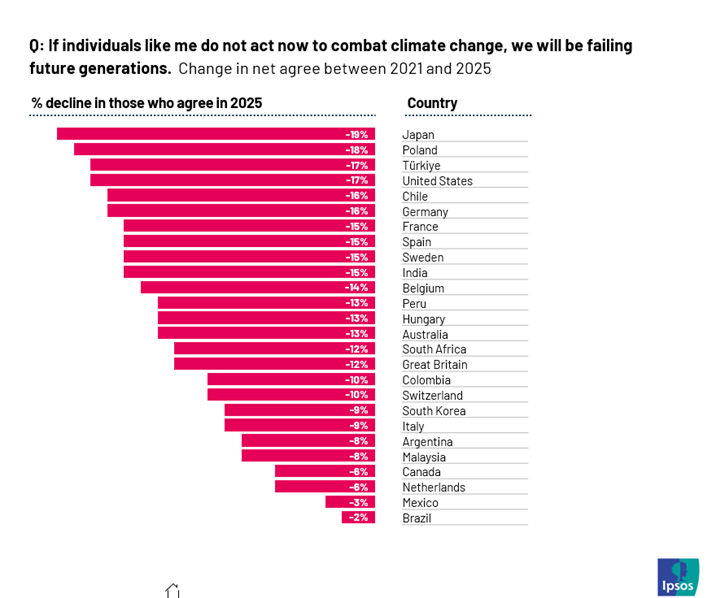
Commenting on the findings, Parijat Chakraborty, Group Service Line Leader, Public Affairs, Corporate Reputation, ESG and CSR at Ipsos India, said: “Every year we witness the impact of climate change through natural calamities, extreme weather conditions and pollution. What is more alarming to see is the trend of declining interest and concern among citizens around climate change and their complacency and lack of urgency in their need to act. Indians are by far losing interest and becoming disengaged.”
The data underscores this disengagement further: 37% of Indians believe a temperature rise of +1.5˚C is not a big deal — the highest percentage globally. In contrast, only 17% of global citizens share this view, while a majority (53%) actively disagree with it.
This is in direct contradiction to the targets laid out in the 2015 Paris Agreement, where world leaders agreed to cap global temperature rise at 1.5˚C above pre-industrial levels. Exceeding this threshold is known to significantly escalate the risk of extreme weather events, collapse of ecosystems like coral reefs, and disruption of ocean currents. Notably, 2024 marked the first calendar year in which this global temperature threshold was breached.
So why are Indians growing indifferent?
The survey points to some key reasons:
– 56% of Indians believe the country is already doing enough — or even too much — to tackle climate change.
– A shrinking number of citizens believe India is a global leader on climate action — down from 71% in 2023 to 56% in 2025.
– Meanwhile, 56% also feel that a comprehensive plan exists involving the government, businesses, and individuals — a perception partly driven by efforts like carbon reduction mandates and the push toward electric mobility. India’s ambitious target of phasing out internal combustion engine (ICE) vehicles by 2035 adds to this belief.
Yet financial concerns remain a significant barrier to meaningful change.
39% of Indians, along with 44% of global citizens, believe that transitioning to renewable energy will increase household energy costs. This sentiment echoes across much of Europe as well — with majorities in countries like Germany, France, and the Netherlands expressing similar apprehension. Europeans also show greater skepticism toward electric vehicles, with many believing they are just as harmful as conventional petrol or diesel cars.
As global temperatures rise and extreme weather becomes more frequent, the declining sense of urgency in India could have serious implications — both domestically and for the world. The Ipsos report offers a sobering look at how public perception is shifting, and highlights the urgent need to reignite climate engagement in one of the world’s most climate-vulnerable nations.
High concern among Indians on impact of climate change, but fewer think they need to act: Ipsos
Banner Image: Photo by Dibakar Roy on Unsplash