Physical Address
23,24,25 & 26, 2nd Floor, Software Technology Park India, Opp: Garware Stadium,MIDC, Chikalthana, Aurangabad, Maharashtra – 431001 India
Physical Address
23,24,25 & 26, 2nd Floor, Software Technology Park India, Opp: Garware Stadium,MIDC, Chikalthana, Aurangabad, Maharashtra – 431001 India

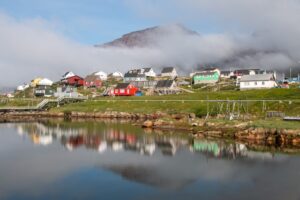
Lakes, particularly in northern regions, are amplifying local and regional warming by releasing more heat into the atmosphere, driven largely by the loss of ice cover, reveals new research.
Lakes, often considered passive recipients of climate change, are now being recognized as active agents intensifying atmospheric warming. A new study published in Nature Communications highlights that lakes worldwide — especially those in mid to high northern latitudes — are releasing more heat into the atmosphere than before, a process that is expected to intensify in the coming decades.
The international team, led by Yuanlin Qiu and Jie Chen from Wuhan University, found that global lake heat release has increased by an average of 1.5% since pre-industrial times. However, lakes north of 45° latitude showed a much sharper rise — 1.8%, about double the rate seen in low-latitude lakes.
The Ice Factor
The key driver behind this phenomenon is the loss of seasonal ice cover. Ice acts as a natural barrier, insulating lake water and limiting heat exchange with the colder atmosphere. With climate change causing thinner and shorter ice seasons, lakes are absorbing more solar energy and losing that heat more readily to the atmosphere, especially through upward thermal (longwave) radiation.
The study likens this pattern to Arctic amplification, where the loss of sea ice intensifies warming in the Arctic. Similarly, the disappearance of lake ice significantly enhances lakes’ ability to warm their surroundings.
“Lakes are not just responding to climate change; they are now actively feeding back into the climate system, especially in colder regions,” said Qiu.
Seasonal Patterns
The researchers also discovered that heat release from lakes varies with seasons. In ice-free lakes, heat release is greater during summer, driven by increased evaporation. However, in ice-covered lakes, the warming effects are more complicated: while greater evaporation happens in summer, enhanced radiation release occurs during winter due to thinning ice, balancing out the seasonal effect.
Future Projections: Even Stronger Warming
Using climate models, the study projects that by the end of the century, global lake heat release could increase by up to 7.5% under high-emission scenarios (RCP8.5). Northern lakes are expected to continue playing a disproportionate role in this intensification.
Importantly, the enhanced heat release is predicted to affect not just lakes themselves but also the regional atmosphere, potentially altering snowfall patterns and accelerating warming in nearby land areas.
Implications
The findings suggest that mid- and high-latitude lakes should be given greater consideration in climate models and adaptation strategies. Lakes could magnify regional warming, posing challenges for ecosystems, water resources, and communities relying on these water bodies for livelihoods, recreation, and transport.
The researchers call for the development of higher-resolution climate models that can better account for lake-atmosphere interactions, noting that current models may underestimate these effects due to coarse representations of lakes.
“Understanding lake heat release is critical for predicting future climate dynamics, especially in regions already vulnerable to rapid warming,” the authors conclude.
Reference:
https://www.nature.com/articles/s41467-025-59291-3
Image: Photo by ArcticDesire.com Polarreisen on Unsplash