Physical Address
23,24,25 & 26, 2nd Floor, Software Technology Park India, Opp: Garware Stadium,MIDC, Chikalthana, Aurangabad, Maharashtra – 431001 India
Physical Address
23,24,25 & 26, 2nd Floor, Software Technology Park India, Opp: Garware Stadium,MIDC, Chikalthana, Aurangabad, Maharashtra – 431001 India
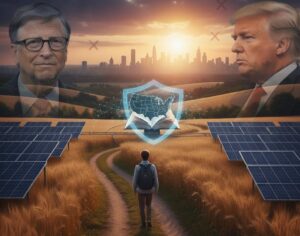
A post circulating on X claims that billionaire philanthropist Bill Gates called for converting farmland into solar panel fields to address climate change and global hunger. The post further alleges that Gates abandoned his climate campaign after former U.S. President Donald Trump described the Green New Deal as a “scam” or “hoax.” It also suggests that such policies caused lasting damage.
However, an examination of publicly available information and statements shows that these claims lack credible evidence and appear to misrepresent Gates’ position on climate policy.
Claim 1: Bill Gates demanded that farmland be converted into solar panel fields to fight climate change and world hunger.
Fact: There is no reliable evidence that Bill Gates has advocated converting farmland into large solar installations as a solution to climate change or hunger.
The claim appears to arise from broader discussions about Gates’ involvement in climate innovation and renewable energy initiatives. Over the past decade, Gates has invested heavily in research and development aimed at reducing greenhouse gas emissions. He has supported projects that explore new clean-energy technologies, including advanced nuclear power, carbon capture, and sustainable fuels.
In his public speeches and writings on climate change, Gates has consistently emphasized that solving the climate crisis will require breakthroughs in technology across multiple sectors, including electricity generation, transportation, agriculture, and manufacturing. His approach focuses on making low-carbon technologies affordable and scalable so they can replace existing high-emission systems.
While solar power is one of the many renewable energy sources discussed in climate policy debates, there is no record of Gates proposing that farmland should be systematically converted into solar fields. Claims suggesting such a demand appear to be unsupported interpretations circulating on social media.
Some online narratives also link the claim to Gates’ investments in farmland in the United States. However, the land associated with his investments represents only a very small share of total agricultural land in the country. Experts note that this does not support the claim that he is seeking to transform large agricultural areas into solar facilities.
Claim 2: Bill Gates abandoned his climate campaign after Donald Trump called the Green New Deal a “scam” or “hoax.”
Fact: There is no evidence that Gates ended or scaled back his climate advocacy because of statements made by Donald Trump about the Green New Deal.
Gates has been actively involved in climate-related initiatives for years and continues to support research and investment in technologies designed to reduce emissions. Through various organizations and partnerships, he has funded projects to accelerate the transition to cleaner energy systems.
His public comments in recent years continue to highlight climate change as a major global challenge. Gates has repeatedly stated that reducing emissions to net-zero levels will require cooperation between governments, businesses, and researchers. His work in this field has largely focused on innovation and long-term solutions rather than political debates around specific policies.
Although the Green New Deal has been a topic of political controversy in the United States, there is no evidence showing that Trump’s criticism of the proposal caused Gates to abandon or withdraw from climate-related work. On the contrary, Gates has continued to speak about climate issues and support initiatives aimed at reducing emissions and promoting sustainable technologies.
Claim 3: The alleged push to turn farmland into solar fields caused lasting “damage.”
Fact: Because the initial claim about Gates demanding farmland conversion is unsupported, the assertion that such actions caused widespread damage is also unsubstantiated.
Fact-checkers have noted that viral claims about Gates and environmental policies often emerge from misunderstandings or exaggerations of real research projects. For example, some online posts have incorrectly suggested that Gates supported plans to “block the sun” to combat climate change. In reality, discussions of solar geoengineering have focused on theoretical research into possible climate interventions, not on large-scale efforts to implement them.
Similarly, there is no credible evidence that Gates has advocated for, or that solar energy infrastructure has been converted from farmland in a way that caused widespread harm.
Without proof of the original policy proposal, claims about the damage it supposedly caused remain speculative and unsupported by facts.
Conclusion
The viral post circulating on social media combines several claims about Bill Gates, climate policy, and renewable energy that lack evidence.
There is no record of Gates demanding that farmland be converted into solar panel fields. There is also no indication that he abandoned climate advocacy in response to political criticism of the Green New Deal. Consequently, the claim that such policies caused lasting damage is also baseless.
Overall, the viral narrative appears to merge unrelated issues and present them as factual claims, leading to a misleading portrayal of Gates’ involvement in climate initiatives. Careful examination of credible information shows that these allegations lack substantiated evidence.
References:
https://energy.stanford.edu/news/bill-gates-climate-challenge-formidable-solvable
https://www.aljazeera.com/news/2019/3/27/what-is-the-green-new-deal-explaining-the-climate-proposal
Banner Image: AI Generated
Sections of this article may have been developed with the assistance of artificial intelligence tools to support research, drafting, and language refinement. All information has been reviewed, edited, and verified by the author/editor to ensure accuracy, context, and editorial integrity. The responsibility for the final content, interpretations, and conclusions rests solely with the publisher.