Physical Address
23,24,25 & 26, 2nd Floor, Software Technology Park India, Opp: Garware Stadium,MIDC, Chikalthana, Aurangabad, Maharashtra – 431001 India
Physical Address
23,24,25 & 26, 2nd Floor, Software Technology Park India, Opp: Garware Stadium,MIDC, Chikalthana, Aurangabad, Maharashtra – 431001 India

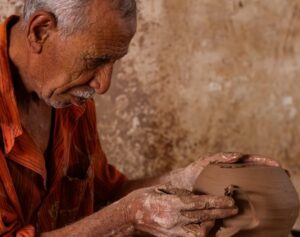
Kumbalgama is a village in Sri Lanka which is dedicated to pottery. Sri Lanka’s earthenware craft, dating back millennia, is rooted in local clay and hand-made techniques .In a conversation with us, a resident of the village, an experienced potter Galahitiyawage Nalani recalls that “years ago the river gave us rich red clay every year – but now the monsoon either washes it all away or barely comes.” In fact, Sri Lankan potters have crafted clay vessels for over 2,500 years. They still rely on simple wheels and sun-drying in village courtyards, using soil dug from nearby riverbeds. But that age-old rhythm is now breaking under a changing climate.
Changing Climate
Recent studies confirm Sri Lanka’s climate is growing hotter and more erratic. Monsoons arrive late or with unprecedented intensity, and dry spells lengthen. Higher day/night temperatures and extended droughts drastically reduce soil moisture and stress crops. For clay artisans, those shifts are destabilizing. The key clay properties – its composition and moisture –depend on weather conditions. In short, “environmental conditions like soil composition [and] moisture content… affect the quality and availability of clay”. That ancient linkage to the land has become a liability under today’s extremes.
What Industry Reports Say
Clay preparation itself is under siege. Potters report that available clay has changed in character – some seasons it’s too powdery, other seasons muddy and full of silt. A recent industry report bluntly states, “clay extraction is a lot vulnerable to the climate change process in Sri Lanka.” It explains that in a rainy season the pits flood and in drought the earth hardens, making excavation “affected” or “difficult”. That same report notes potters “cannot dry pottery products… due to both rain and drought”. In practice, Nalani’s village now scrambles to cover drying pots at the first drizzle, or faces weeks of delay when monsoon floods rush in. Every delay means more waste. Even fuel for firing is strained: wood supplies are scarcer in drought years, and high winds sometimes douse open-fire kilns. Altogether, climate upheaval is tearing holes in the process that was once reliably seasonal.
Social Economic Issues Related To Industry
These climate change related disruptions extend to livelihoods. Traditional potters already struggled with meager earnings, and climate stresses deepen the squeeze. South Asian artisans are living with lot of difficulties due to material costs and market pressures leaving many potters barely breaking even. This situation is common to Sri Lanka too. Nalini explained to us that after spending tens of thousands on clay, fuel and transport, “we hardly make any profits, even if all our produced goods are sold” . Researchers note that kiln fires now cost more (whether firewood or fuel), and global competition is fierce. Cheaper imported ceramics and plastic containers flood local markets, capturing customers with lower prices . The clay industry’s own report warns of a “shortage of clay as a raw material” (due to high industrial demand) and that substitutes from China and India have “captured” much market share . In other words, potters like Nalani are selling the same waterpots and lamps for far less than they cost to make. An academic study of Sri Lankan potters summarizes these ills: the pottery sector “grapples with… outdated techniques, marketing difficulties, and a lack of governmental support” . With no price supports or modern equipment, villagers face downward pressure on income even before factoring in climate losses.
The Social Fabric of Pottery Community
The social fabric of pottery communities is fraying. As work became unprofitable and unpredictable, younger generations have begun to leave. Echoes of this are heard in Sri Lanka, where reports note a “declining interest “among youth in traditional crafts. In Kumbalgama, many families worry that the next generation will move to cities once they learn other skills. The village’s communal identity – once tied to the potter’s wheel – is losing vitality. Even Nalani fears for her community: if the craft dies, so may the village’s economy and its proud legacy. “Currently, only ten families here in our village, who doing potteries”,Nalani added.
Resilience Efforts
Yet some adaptive responses are emerging. Government and community groups have begun to counter these challenges with creative strategies. Nationwide initiatives like “Creative Sri Lanka 2030” explicitly tie cultural crafts to sustainable development. The Export Development Board’s program will train artisans in ethical, eco-friendly production and help them develop higher-value, export-oriented products . Such capacity-building may open new markets for pottery—beyond the flooded local bazaars—to tourists and overseas buyers. Indeed, tourism may offer a lifeline: one travel report finds that roughly 62% of Sri Lanka visitors actively seek hands-on experiences with local crafts. More details can be read here and here
Gaps in the Process
Crucial gaps remain, however. No simple fix can replace sun-drying when the rain never comes, or keep kilns lit when floods rise. Some potters are experimenting with shade covers, water catchments for clay pits, or switching firing schedules, but these are ad-hoc. Others hope that highlighting pottery’s unique story –its history and sustainability – might bring fair-market prices. For example, researchers point out the inherent “earthy beauty” and eco-friendly aspects of clay crafts , suggesting that positioning pottery as both traditional art and green product could attract conscious consumers.
Way Forward
Nalani remains cautiously hopeful. “Our people have lived with nature’s whims for generations,” she says. If there are smarter kilns, better drying barns or steady buyers on the horizon, she’ll adapt. But she also sees the urgency: “This craft has survived droughts and floods before… but only if we can survive them now.” Sri Lanka’s policymakers and conservationists note that protecting this intangible heritage – a living link to the island’s past – will require combining climate action, economic support, and community initiative. In Nalani’s words, “As long as the clay flows and the wheel turns, our story continues.” Whether that legacy endures may depend on how quickly Sri Lanka can help potters turn the tide of a changing climate
References
Sri Lankan Clay Industry Challenges
Pots of trouble with increasing temperatures and shifting markets
https://pdfs.semanticscholar.org/e9a1/205f9e75184bdfabb9dd39c354b7d552511c.pdf
https://www.rofi.lk/blog/clay-culture-discovering-sri-lankas-traditional-pottery-villages/
Banner Image : Photo by Esraa Magdy on Unsplash

Comments are closed.







pvvgtz
сюда https://ros18.ru/catalog/profnastil-stalkomplekt/profnastil-otsinkovannyy/profnastil-otsinkovannyy-ns-8-0-4/
Thank you for sharing these kinds of wonderful articles. In addition, an excellent travel as well as medical insurance approach can often eradicate those fears that come with visiting abroad. Your medical emergency can shortly become extremely expensive and that’s sure to quickly set a financial stress on the family’s finances. Setting up in place the great travel insurance offer prior to leaving is definitely worth the time and effort. Thanks
Инфузионная терапия в «ТагилМед Реал» — это точный инструмент под конкретный запрос: обезвоживание, вегетативная нестабильность, нарушения сна, «утренний туман». Состав и дозировки подбирает врач с учётом возраста, коморбидности и лекарственных взаимодействий. Важно понимать: больше компонентов не значит лучше; главная ценность — фокус и безопасность.
Получить дополнительные сведения – [url=https://narkologicheskaya-klinika-nizhnij-tagil0.ru/]запой наркологическая клиника в нижнем тагиле[/url]
Hey, you used to write fantastic, but the last several posts have been kinda boring? I miss your tremendous writings. Past few posts are just a little out of track! come on!
I’m really enjoying the design and layout of your website. It’s a very easy on the eyes which makes it much more enjoyable for me to come here and visit more often. Did you hire out a developer to create your theme? Fantastic work!