Physical Address
23,24,25 & 26, 2nd Floor, Software Technology Park India, Opp: Garware Stadium,MIDC, Chikalthana, Aurangabad, Maharashtra – 431001 India
Physical Address
23,24,25 & 26, 2nd Floor, Software Technology Park India, Opp: Garware Stadium,MIDC, Chikalthana, Aurangabad, Maharashtra – 431001 India

Recent claims circulating on social media as well as main stream media about an “abnormal” spike in air pollution levels in Jaffna are misleading, according to the Central Environmental Authority (CEA). Speaking to Climate Fact Checks, Vernika Ranawaka Arachchi, Director of the Air Resources Management and Monitoring Unit of the Central Environmental Authority (CEA), clarified that official monitoring data do not indicate any extreme deterioration of air quality in the Jaffna region at present.
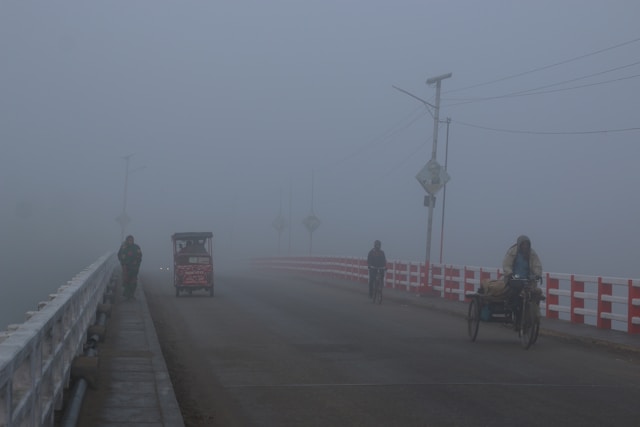
She explained that while pollution readings have shown a slight increase in recent days, such variations are neither unusual nor significantly different from typical long-term air quality fluctuations observed across Sri Lanka. The marginal rise, she noted, is partly attributable to transboundary air pollution — specifically dust particles transported by atmospheric circulation from India and Bangladesh in this season January to March. However, even with this influence, Jaffna’s overall air quality does not stand out as exceptionally poor when evaluated against national trends and historical AQ data.
Also Read: Air Quality Levels Decline Across Sri Lanka Due to Transboundary Pollution, Authorities Confirm
Ranawaka Arachchi also confirmed that the CEA has already submitted a report on Jaffna’s air quality to the Court of Appeal of Sri Lanka, indicating that the matter is under formal review through established institutional channels.
While speaking about the issue of the open burnings, etc., in Jaffna, she stated that no matter whether Jaffna or any other area, the open burnings are legally prohibited, but however, air quality of Jaffna has been largely in the same pattern without having big unusual ups and downs.
To independently verify the situation, Climate Fact Checks reviewed the latest real-time Air Quality Index (AQI) readings published by the National Building Research Organization (NBRO). Those measurements similarly show that although Jaffna’s AQI values are somewhat elevated, several other Sri Lankan cities — including Puttalam, Polonnaruwa, Dambulla, and Badulla — currently record higher pollution levels. This comparison further challenges narratives suggesting that Jaffna is experiencing an unprecedented or isolated air quality crisis.
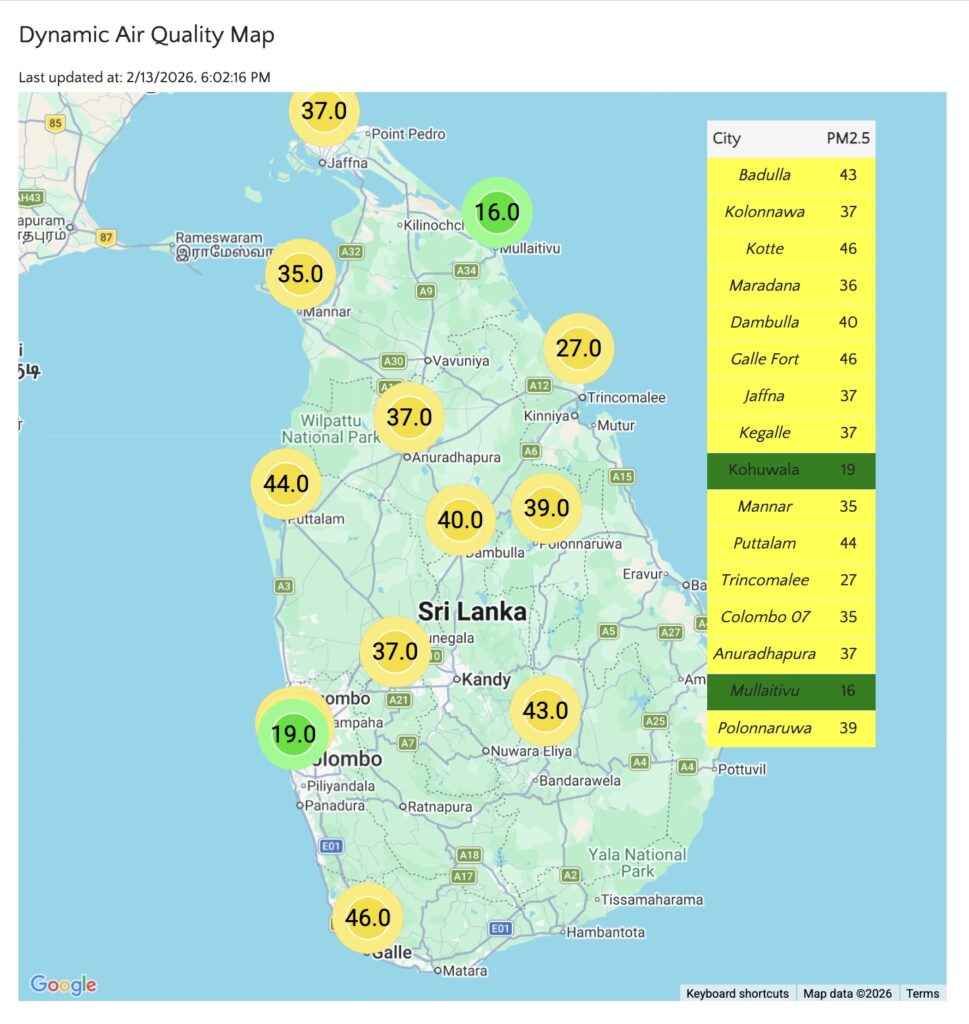
The public discussion around Jaffna’s air pollution follows recent legal proceedings. Approximately two weeks ago, the Court of Appeal directed the Jaffna Municipal Council to submit a report detailing actions taken to mitigate air pollution in the area. The order arose during hearings of a writ petition filed by Dr. Uma Sugi Nadarajah, a Jaffna resident, who sought judicial intervention to address local environmental concerns.
According to media coverage by Ada Derana, the petitioner’s legal counsel argued that open burning of waste, particularly garbage disposal practices, has been a major contributor to air pollution in Jaffna. The attorney further highlighted that wind patterns may carry additional pollutants from South India, potentially aggravating local air quality conditions. Supporting reports were presented to court, asserting that deteriorating air quality could be linked to adverse health effects among residents.
After reviewing the submissions, the Court of Appeal instructed both the Jaffna Municipal Council and the Central Environmental Authority to provide detailed accounts of measures implemented to control pollution. During proceedings, the President of the Court of Appeal questioned why closer cooperation had not occurred between municipal authorities and the CEA, emphasizing that environmental challenges of this nature are often better resolved through inter-agency coordination rather than litigation.
The court stressed the importance of dialogue and institutional collaboration, noting that preventive and corrective strategies can typically be developed through discussions among responsible state bodies without resorting to legal disputes.
Overall, available monitoring data and official statements indicate that while Jaffna, like many regions, experiences periodic air quality variations, there is no evidence of an extraordinary or unprecedented pollution event. Authorities continue to monitor conditions, and the issue remains subject to regulatory and judicial oversight.
References
https://www.adaderana.lk/news.php?nid=117725
Banner Image: Photo by Eshan Malaviarachchi on Unsplash
Sections of this article may have been developed with the assistance of artificial intelligence tools to support research, drafting and language refinement. All information has been reviewed, edited and verified by the author/editor to ensure accuracy, context and editorial integrity. The responsibility for the final content, interpretations and conclusions rests solely with the publisher.