Physical Address
23,24,25 & 26, 2nd Floor, Software Technology Park India, Opp: Garware Stadium,MIDC, Chikalthana, Aurangabad, Maharashtra – 431001 India
Physical Address
23,24,25 & 26, 2nd Floor, Software Technology Park India, Opp: Garware Stadium,MIDC, Chikalthana, Aurangabad, Maharashtra – 431001 India

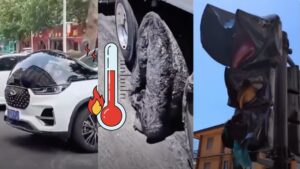
A helmet-shaped blob dripping on a car’s windshield. A shopping trolley twisted out of shape. A bridge railing with something white pooling beneath it. A boot melting into a puddle of black rubber. These clips have been circulating in a Facebook reel this week, stitched together under red-and-yellow text warning “Europe right now… and it’s scary,” and captioned to suggest the region’s heatwave is liquefying everyday objects in real time. It builds on an earlier viral claim that the same heatwave melted traffic lights in Italy and Germany. Similar reels are going viral on X and other platforms as well. Together, the claims paint a picture of a continent where plastic and metal are giving way under the sun.
None of these claims hold up the way they are being presented.
The Claim
Social media posts, including the reel in question, say the visuals of melting objects, cars, trolleys, bridge railings and more, are happening in Europe right now because of the ongoing heatwave. A similar claim went viral days earlier about traffic lights supposedly melting in Verona, Italy, and Berlin, Germany, for the same reason.
What We Found
The traffic light claim has already been checked against local records, and it does not hold up. An investigation by the Dubai and Lahore based outlet Nukta traced the two clips in that video to separate fire incidents, not heat. The first clip, from Verona, matches local Italian reporting on a car that caught fire while stopped at a red light, which is what warped the plastic housing of the signal, as confirmed by the local outlet Il Baco da Seta. The second clip, from Berlin, was traced to a nightclub fire at the Wilde Renate venue on the banks of the Spree in June 2025, a full year before this heatwave, with German broadcaster RBB24 and press agency DPA both having documented the blaze when it happened. Matching signage and buildings visible in the background confirm the location. In both cases, it was direct flame, not ambient summer heat, that deformed the plastic.
The newer reel showing a car, a trolley, a railing, and other objects follows the same pattern but is harder to pin down. It carries no location tag, date, or original source, just a recycled watermark from a page that mixes horror, shock, and clickbait content rather than news reporting. We could not independently verify where or when any of these individual clips were filmed, which is itself a warning sign. Genuine documentation of a weather event usually comes with a place, a date, and a named source. This video has none of the three. Reused, decontextualised footage that gets recaptioned with a new disaster label is one of the most common tactics in viral weather misinformation, and this compilation shows several of the classic markers of it: rapid, ambiguous close-ups, no wide shots that would reveal a location, and on-screen text designed to provoke an emotional reaction rather than inform.
What Is Actually Happening
None of this means Europe’s heatwave is mild. It is real, and it is severe. According to weather agency data reported by AFP via Khaleej Times, Poland recorded an all-time national heat record of 40.5 degrees Celsius, the Czech Republic hit 41.9 degrees Celsius at Doksany, and Germany’s weather service recorded a preliminary national record of 41.7 degrees Celsius near the Polish border. The World Health Organization has said the heatwave is linked to more than 1,300 excess deaths across the continent since 21 June, with tens of millions of people living under extreme heat warnings.
The heat has genuinely damaged some infrastructure, just not in the cartoonish way the viral clips suggest. In Leipzig, Germany, the sealant used to fill gaps around tram rails softened and seeped out under the heat before hardening into clumps, which forced a temporary suspension of tram services, a real and verifiable case of heat affecting infrastructure, as reported by Athens Times. Sections of asphalt on the A2 motorway near Berlin have reportedly cracked and buckled under thermal stress, and rail networks in the region have imposed speed restrictions because tracks expand and can warp slightly in extreme heat. Berlin police have also deployed water cannon, not for crowd control but as makeshift cooling mist for residents.
So the real story is less cinematic than “cars and trolleys are melting,” but it is still serious: record temperatures, real strain on transport infrastructure, and a rising death toll. That is arguably more worth people’s attention than a shopping trolley video with an unclear origin.
How To Spot These Clips Yourself
A few quick checks work for almost any viral disaster clip. First, look for a location and date in the caption or the video itself, not just a country name. Genuine local reporting almost always includes both. Second, check who posted it. Pages built around shock content, horror branding, or recycled meme material are not journalism, even when their captions borrow a news tone. Third, run a reverse image search on a clear frame using a tool like Google Lens, since most viral “disaster” clips have circulated before under a different, often unrelated, headline. Finally, be wary of compilations that jump between several unrelated objects in quick succession. A single, sourced clip with visible context is far more trustworthy than a rapid montage designed to overwhelm rather than inform.
The Bottom Line
The traffic light videos are confirmed to be from unrelated fires, one in 2026 and one from a full year earlier. The newer reel of melting cars, trolleys, and other objects cannot be verified against any credible source or location and shows several hallmarks of recycled shock content rather than real reporting, a dynamic that Euronews reports is a recurring feature of this heatwave season. What is verifiably true is that Europe is in the grip of a severe, record-breaking heatwave that has already caused real infrastructure strain and a significant, tragic rise in heat-related deaths. Readers do not need an exaggerated video to understand the scale of what is happening. The verified numbers are alarming enough on their own.
References
https://www.khaleejtimes.com/world/europe/traffic-lights-melt-latest-heatwave-facts
https://athens-times.com/heatwave-melts-tram-tracks-in-berlin-as-europe-swelters
Banner Image: Screengrabs from various claims
Sections of this article may have been developed with the assistance of artificial intelligence tools to support research, drafting and language refinement. All information has been reviewed, edited and verified by the author/editor to ensure accuracy, context and editorial integrity. The responsibility for the final content, interpretations and conclusions rests solely with the publisher.

Comments are closed.







[…] Climate Fact Checks, Fact Crescendo’s partner organisation covering climate misinformation, has investigated this specific set of viral videos in detail. Their full analysis is available here. […]